
Chapter 1: Why You Hate Selling (And Why That's Actually Good News)
You hate selling.
The thought of cold calling makes your stomach turn. Writing outreach emails feels like begging. Following up with a prospect who went quiet feels desperate. The moment a conversation shifts from "let me show you what I built" to "would you like to buy it?" is the moment you'd rather go add a feature.
That discomfort is a good sign: it means you're not the kind of person who manipulates others. You've been on the receiving end of pushy pitches and conversations that felt more like extractions than exchanges. Not wanting to become that person is a reasonable response to what you've seen.
Research shows that 84% of entrepreneurs experience imposter syndrome [1]. Technical founders often feel it most: they can architect complex systems under pressure, yet they avoid customer acquisition for reasons unrelated to skill. To see why, start with the research on identity and rejection.
The Identity War Inside Your Head
Capable builders hit a wall at customer acquisition: the prospecting, outreach, and closing that turn a product into a business. On a small team, the same wall shows up in the first GTM hire who'd rather build the playbook than work it.
Note: The psychology in this chapter applies whether you're solo or running a small team. Where tactics differ by business model (B2B SaaS vs. creator/coach), you'll see callouts throughout and detailed playbooks in Chapter 10.
The usual assumption is that they need "sales training," but the resistance is an identity threat more than a skills problem.
Research on cognitive dissonance, beginning with Leon Festinger's work in the 1950s and later refined by Elliot Aronson around the self-concept, shows that people feel real discomfort when they act in ways that contradict how they see themselves [2]. For builders and creators, "salesperson" often represents everything they're not: pushy, superficial, focused on manipulation rather than value. So when you sit down to write a sales email, you feel a threat to your self-concept as a craftsman and an honest person.
This explains the "just one more feature" delay: "I'll start selling once the product is ready." The product never quite gets there, because there's always one more feature.
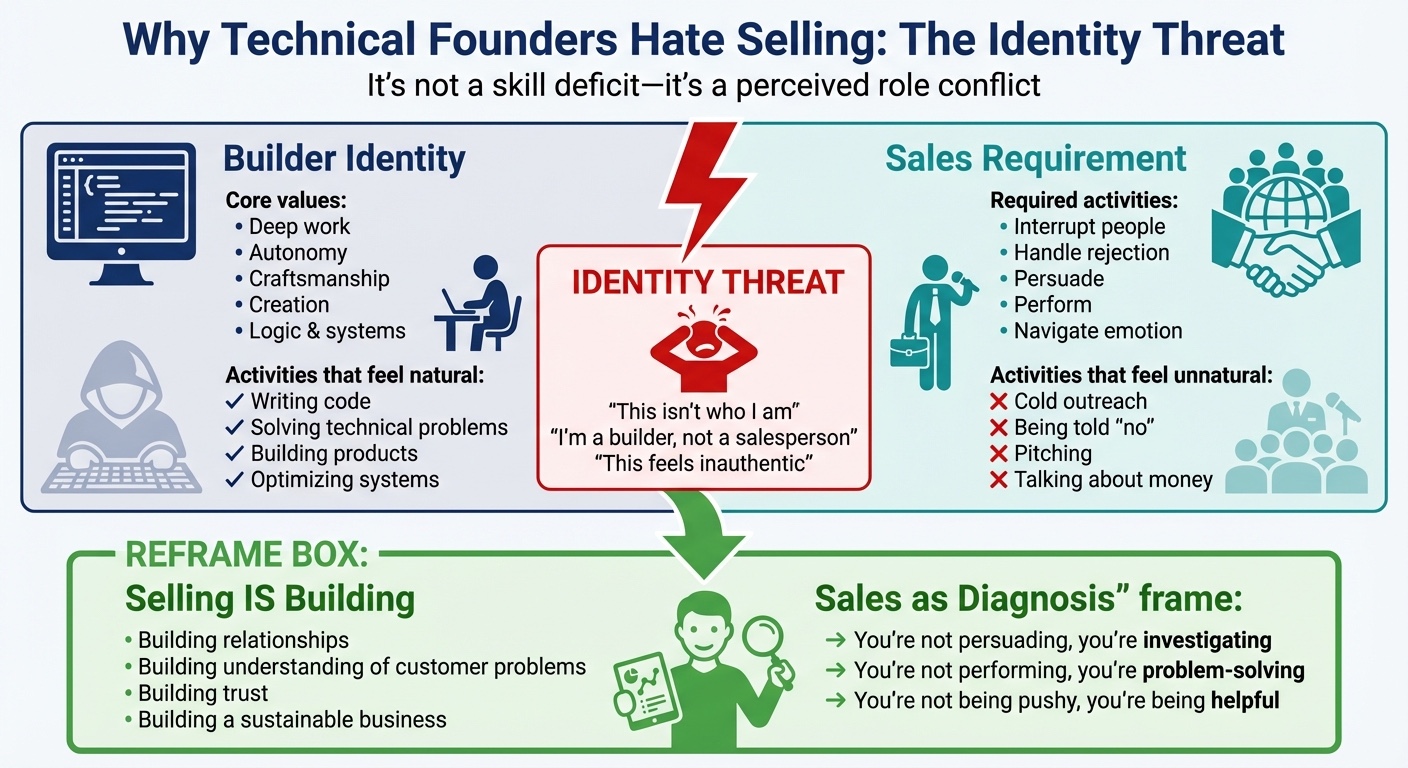
Figure 1.1: The Identity Threat Framework. The conflict is a perceived clash between your builder identity (deep work, autonomy, craftsmanship) and what you think sales requires (interruption, performance, persuasion). The chapter's answer is to treat selling as another kind of building, of relationships, understanding, and trust.
Creator founders have their own version, the content treadmill: posting endlessly, building an audience, but never making a direct offer. The implicit logic, "If I give enough, they'll buy without me having to ask," rarely pays out. Both patterns let you avoid the moment where rejection becomes possible.
Common Mistake: Waiting Until You "Feel Ready" to Start Selling
Founders delay outreach until the product is "ready," the pitch is "polished," or they "feel confident." That moment never arrives. The discomfort feels like a sign you need more preparation, but it stays until you've had the conversations.
What to do instead: Start before you're ready. Your first 10 conversations will be awkward, and that's how you learn what works. Confidence comes from doing them. Set a date and start.
The Math Your Brain Gets Wrong
Research on negativity bias shows that bad experiences carry more psychological weight than good ones of the same size [3]. The bias is an evolutionary inheritance. Brain imaging studies have found that social rejection activates some of the same regions involved in physical pain [4]. For early humans, being cast out of the group could be fatal, and your nervous system still reacts to a prospect's "no thanks" as if it carried that kind of risk. You can't eliminate the discomfort, but you can recognize it for what it is; founders who don't end up taking every rejection personally.
The feedback is lopsided. In coding the signal is mostly positive: problem solved, test passed, feature shipped. In sales it's mostly negative: no response, no interest, no deal. Founders who stay energized through all-night coding sessions burn out after a week of cold outreach. The cause is working where "no" is the default response.
Case Study (B2B): A founder spent weeks researching a prospect, a VP at a mid-sized company, tailoring a proposal, and rehearsing his pitch. The VP asked good questions, requested a follow-up, and then went silent. The founder assumed he'd blown it. Three months later he learned that the parent company had frozen all capital expenditures during a merger. The VP couldn't have bought from anyone. That rejection had nothing to do with the founder. (A creator/coach version plays out the same way: an enthusiastic client goes silent, the founder blames their pricing, and weeks later learns a family medical crisis froze all non-essential spending.)
Most rejections fall into three buckets:
- Wrong timing. Budget cycles, internal politics, competing priorities the founder knew nothing about.
- Wrong fit. The prospect needed something the founder couldn't provide. Finding that out quickly saves you both time.
- Wrong person. The founder was talking to someone without decision authority who was too polite to say so.
None of these reflect the founder's worth or the value of what they're selling. But these distinctions are hard to make in the moment. When you've built the thing yourself and someone rejects your offer, the math gets distorted: They rejected my product → I built my product → They rejected me. A solo founder has no team to absorb the rejection; every "no" lands on one person. Even CEOs with entire organizations around them feel this: 71% of US CEOs report imposter syndrome [5]. A solo founder carries the same feeling with no one to share the load.
Insight: The Solo Disadvantage
A co-founder or early hire who's naturally better at sales conversations is a real advantage that a solo founder lacks. You can close much of that gap: learning to adapt your communication style to different buyer types (Chapter 4's DISC framework) builds the conversational skill that teammate would have brought.
The Two Flavors of Avoidance
Whether they build B2B software or sell courses, founders share the same underlying fears, but their avoidance patterns differ by type.
Technical founders fear incompetence and inefficiency. The narrative: "I'm an engineer, not a salesperson. The product should sell itself if it's good enough." This leads to procrastibuilding: adding features nobody asked for instead of talking to customers who might say no. Personality research on software engineers finds they skew heavily toward analytical, thinking-oriented types [6]. If you've taken a DISC assessment, that often shows up as high Conscientiousness (C), and sometimes Steadiness (S): high-C founders tend toward analysis paralysis, refusing to sell until the product is "perfect"; high-S founders tend to avoid the interpersonal tension of sales, prioritizing harmony over closing.
One technical founder spent eight months perfecting his analytics dashboard before showing it to a single potential customer, and the first ones he showed it to wanted something completely different. He'd built the wrong thing because he was too afraid to ask what they needed.
Creator founders fear inauthenticity and betrayal. The narrative: "If I sell too hard, I'll become one of those sleazy gurus and my audience will stop trusting me." This leads to endless free content and zero revenue. Jay Clouse, founder of Creator Science, has written that as a Midwesterner he grew up feeling "a certain amount of guilt around selling" [7]. His way through it was to remember how buying works: when you pay someone, it's because they solved a problem you'd rather have solved than keep the cash.
Both patterns end the same way: plenty of activity and little revenue.
The Behavioral Economics of the Builder's Trap
Coding gives a tight feedback loop: write a function, run the test, see green lights, and get an immediate hit of dopamine. Sales gives the opposite: 50 calls, 48 rejections, 2 conversations, maybe a check in 90 days. You gravitate toward the certain reward, then rationalize it: "better code" supposedly increases future sales. In reality you're choosing the activity that feels productive over the one that generates revenue, and each new feature becomes a justification to delay the launch (and the rejection) by another two weeks.
The cost is measurable. George Dudley and Shannon Goodson, whose research on sales call reluctance spans decades of testing with working salespeople, attach a price to each form of it: fear of group presentations alone was tied to roughly $10,800 in lost annual gross sales per rep [8]. For a startup, the cost can be the company itself. Running out of cash, one of the most commonly cited reasons startups fail, can be a lagging indicator of call reluctance: the founder burns through runway and starts selling only when cash is critical, by which point desperation makes them less effective.
For service-based founders, the same avoidance creates a "feast and famine" cycle: land a client, stop prospecting to focus on delivery, then panic when the project ends and the pipeline is empty. They hustle, land a client, and repeat, without ever building predictable revenue.
The Price of Underpricing
Founders terrified of charging "too much" price at the bottom of the market, then wonder why customers don't take them seriously. Usually this is imposter syndrome presented as strategy.
When founders don't believe they're worth $3,000, they charge $300. The low price creates its own problems: you attract price-sensitive customers who demand more and appreciate less, you burn out delivering unrealistic value, and you signal to serious buyers that you're not serious yourself. The hidden logic: If they say no to $300, it's the wrong fit. If they say no to $3,000, it means I'm not worth $3,000. So you avoid testing the second one.
The Reframe That Works
Most sales psychology advice prescribes "confidence" as the cure: believe in yourself, visualize success, fake it till you make it. That advice doesn't help much, because you can't will yourself into a different identity. You can change how you think about what selling is.
The most effective intervention is reframing selling from "extraction" to "diagnosis" [9]. When a doctor asks about your symptoms, you don't feel manipulated; the questions serve a purpose: understanding your problem so they can offer an appropriate solution. Founder-led sales can work the same way. Instead of "I'm trying to get money from this person," try: "I'm trying to find out if I can solve their problem."
The reframe changes the questions you ask, the tone of your conversations, and your response to "no." When the goal is diagnosis, rejection becomes information: this solution doesn't fit this problem for this person right now.
Case Study: A founder selling B2B automation software competed against established players for a manufacturing client. While competitors prepared slide decks, he asked for a meeting just to understand their situation: no slides, just questions. The operations director talked for forty-five minutes about supply chain deadlines, budget constraints, skeptical floor supervisors, and his personal fear that this project would define his credibility. The founder took notes and didn't mention his product once. "You're the first vendor who actually listened," the director said. By the third meeting, when the founder finally presented, he knew exactly what mattered. He won the deal.
The Scientist Reframe (For Technical Founders)
If you're a technical founder, this reframe fits how you already think. Stop thinking of customer calls as "sales conversations" and start thinking of them as "data collection." Customer conversations are a source of qualitative data. Every call teaches you the language prospects use for their problems, which features they care about (vs. what you assumed), which objections recur, and what their buying timeline is. This makes your product better and your marketing more relevant, but you only get it by having the conversations you've been avoiding.
Founders who make this shift tend to describe it the same way: they stopped thinking of it as sales and started thinking of it as research, meeting customers to hear about their pain, and found that people like talking about their pain. You are collecting data, and the fact that some of it results in revenue doesn't make it manipulation.
The Invitation Reframe (For Creator Founders)
If you're a creator selling courses, coaching, or services, your fear is different: corrupting the authentic relationship you have with your audience.
The reframe: treat an offer as an invitation. "I've created this solution. You're invited to join if it fits your needs." This removes the pressure to "convince" anyone. You're describing an option and letting people self-select. Your audience already trusts your perspective; they want a way to go deeper. Never making an offer leaves your audience without a way to take the next step.
Justin Welsh built a seven-figure one-person business selling digital products to his LinkedIn audience this way [10]. Instead of pitching in his posts, he sends readers to his website to learn more about the problem they're trying to solve, and lets them decide from there. Creators who avoid selling often leave their audience to buy from weaker competitors who are willing to make an offer.
Separating Self-Worth from Market Feedback
The hardest shift is separating what you offer from who you are.
When someone declines your offer, they're not rejecting your value as a human being. They're saying this particular offer doesn't fit their particular situation right now. These are different things, even though they feel identical.
Bad mental model: "They said no, so I am a failure." Better: "They said no, so the offer needs iteration." The first treats rejection as a judgment of your worth; the second treats it as feedback on a variable you can adjust. Price, positioning, timing, packaging, audience: all affect whether someone buys, and all can be changed. Your value as a person isn't on the table.
This shift takes time; reading it in a book won't make you believe it. Each conversation where you practice seeing "no" as information rather than verdict builds the new pattern.
What Happens When You Start
Most of the fear comes from imagining the worst case: being pushy, making people uncomfortable, and still not selling. When you treat customer acquisition as diagnosis, a few things tend to happen. People appreciate the conversation: curiosity about their problems makes prospects feel heard, and they'll often thank you even if they don't buy. You learn faster, and rejection stops hurting: the first few "no" responses sting; by the twentieth you've recalibrated. Your product improves and revenue follows: feedback only comes from conversations you're willing to have, and you cannot make money from customers you never talk to.
The Cost of Avoidance
Avoiding these fears feels safe, but the costs build up slowly. You keep building features nobody asked for, posting content without making offers, keeping prices low to avoid real rejection. You stay busy but broke.
One developer spent two years perfecting a project management tool, convinced perfection would attract customers; competitors with inferior products but better sales skills captured the market before he ever reached out. A business coach made the mirror-image mistake: 15,000 loyal subscribers, three years of content, zero products. Her eventual course flopped because she'd trained her audience to expect only free value.
The same avoidance shows up inside conversations. Sales coaches call it "happy ears": hearing interest as intent without ever asking directly. Paul Gassée, who coaches startup founders on sales, puts weak qualification on his list of the most common founder sales mistakes [11]. The result is a pipeline full of "maybes" who were never going to buy; you just didn't ask the questions that would have revealed it earlier.
The fix is simple but uncomfortable: ask direct questions early. "Is solving this a priority right now, or more of a someday thing?" "Have you set aside resources, or would this require new budget?" These feel risky because they invite "no." But hearing "no" now beats hearing it after six months of false hope, and early disqualification frees you for prospects who can become customers.
Permission to Be Bad at It
You have permission to be bad at sales at first. You'll get better with practice, but in your first conversations you're going to stumble, ask awkward questions, and feel uncomfortable. The only way past that is to keep having them.
Your prospects don't expect a polished sales machine. Many talk to founders because they're tired of polished sales reps. They want directness and someone who understands their problem, and you can offer both once fear stops getting in the way.
Chapter Summary: TL;DR
The core insight: Your resistance to selling comes from an identity threat. Sales feels like a conflict with your builder identity, and the rejection selling risks registers in some of the same brain regions as physical pain. The fix is reframing selling as diagnosis (helping) rather than extraction (manipulation).
Key takeaways:
- 84% of entrepreneurs experience imposter syndrome; you're not alone
- Identity threat (not lack of skills) drives sales avoidance
- Negativity bias makes rejection feel more intense than it is
- Reframing selling as "helping" reduces the psychological conflict
- Technical founders (often high-C, sometimes high-S) face specific challenges with sales activities; Chapter 4's DISC framework helps you adapt
The Exercise: Name What You're Avoiding
Write down the last three times you avoided a sales activity: a delayed follow-up, "polishing" the product instead of showing it, posting content instead of making an offer. For each, ask: what was I afraid of? Usually it's one of three things:
- Fear of rejection. "They might say no, and I'll have to sit with that sting."
- Fear of judgment. "They might think I'm pushy or sleazy."
- Fear of confirmation. "If they say no, it proves what I already suspected: that I can't do this."
These are predictions filtered through negativity bias, and experience updates them. One conversation at a time, you'll collect evidence that selling doesn't have to feel manipulative, that rejection isn't personal, and that the judgment you fear is bigger than the judgment you get.
Start with one conversation and see what happens.
Chapter Checklist
Before moving to Chapter 2, complete:
- Identified your specific avoidance pattern (procrastibuilding, content treadmill, or other)
- Written down the last 3 times you avoided sales activities and what you were afraid of
- Recognized rejection sensitivity as a biological response
- Reframed selling as "helping" rather than "extraction"
- Committed to starting with one conversation to test the reframe
Self-assessment questions:
- What's my primary fear around selling? (rejection, judgment, or confirmation)
- When I think about "selling," what image comes to mind? (This reveals your mental model)
- What would "helping" look like instead of "selling" in my specific context?
The later ICP, outreach, and pricing tactics depend on treating sales as diagnosis; without that, you'll keep defaulting to building over selling. Even with the right frame, you can waste a lot of energy talking to the wrong people. In Chapter 2, you'll define exactly who to talk to: your Ideal Customer Profile, the people you can help most, who can pay you fairly, and who you'll enjoy serving.
[1] Kajabi, "Impostor Phenomenon Study: Most Entrepreneurs Affected," November 2020. https://kajabi.com/blog/impostor-phenomenon-study. Survey of 600+ entrepreneurs found 84% experience imposter syndrome.
[2] Festinger, L., A Theory of Cognitive Dissonance, Stanford University Press, 1957; Aronson, E., "Dissonance theory: Progress and problems," in Abelson, R. P., et al. (eds.), Theories of Cognitive Consistency: A Sourcebook, Rand McNally, 1968.
[3] Baumeister, R. F., Bratslavsky, E., Finkenauer, C., and Vohs, K. D., "Bad is stronger than good," Review of General Psychology, 5(4):323-370, 2001. https://doi.org/10.1037/1089-2680.5.4.323
[4] Eisenberger, N. I., and Lieberman, M. D., "Why rejection hurts: a common neural alarm system for physical and social pain," Trends in Cognitive Sciences, 8(7):294-300, July 2004. https://pubmed.ncbi.nlm.nih.gov/15242688/.
[5] Korn Ferry, "71% of U.S. CEOs Experience Imposter Syndrome," Workforce 2024 Global Insights Report, June 2024. https://www.kornferry.com/about-us/press/71percent-of-us-ceos-experience-imposter-syndrome-new-korn-ferry-research-finds.
[6] Capretz, L. F., "Personality types in software engineering," International Journal of Human-Computer Studies, 58(2):207-214, 2003. https://doi.org/10.1016/S1071-5819(02)00137-4
[7] Clouse, J., "Don't be afraid to sell yourself," LinkedIn, February 9, 2021. https://www.linkedin.com/pulse/dont-afraid-sell-yourself-jay-clouse
[8] Dudley, G. W., and Goodson, S. L., The Psychology of Sales Call Reluctance: Earning What You're Worth in Sales, Behavioral Sciences Research Press. The per-type cost figures come from the book's twelve-type classification.
[9] Rackham, N., SPIN Selling, McGraw-Hill, 1988. Rackham's study of more than 35,000 sales calls found that in larger sales, question-led diagnosis of the buyer's problems outperformed pitching.
[10] Welsh, J., "A Complete Guide to Passive Selling," justinwelsh.me, 2024. https://justinwelsh.me/essays/a-complete-guide-to-passive-selling
[11] Gassée, P., "The Greatest Sales Mistakes Founders Make," Gassée Consulting, July 2023. https://paulgassee.com/the-greatest-sales-mistakes-founders-make/