
Introduction: The Solo Founder's Dilemma
In early 2026, as I was finishing the manuscript of my first book, AI-Powered Customer Acquisition Playbook, I had just built its companion GTM platform on a major cloud provider. Then the provider's sales team called, and over two conversations showed me exactly what this book teaches you not to do.
The first rep asked how his company could support my project. I spent hours on a document covering my architecture, the services I used, and how we might partner. We met, and he called it fantastic and promised to follow up. His next email was a generic cold-outreach template, as if the meeting had never happened.
Weeks later, a second rep from the same company emailed. After the first experience, I ignored him. He kept at it and finally called. I agreed to one meeting and wrote on the booking form exactly what I needed: a clear explanation of my bill, a way to avoid surprise charges before I had revenue, and how my developer credits worked. I did not need technical help. The platform was already built and running on their cloud.
He never asked about any of it. He wanted a spending forecast: at $12,000 a year, I would qualify for a "comprehensive demo." I said I didn't need a demo. He kept pushing the forecast.
The week of that second call, I closed my accounts with them and refactored the entire platform to run on my own VPS. That platform became GTM OS, and this book grew out of it, with the Playbook as its foundation.
You've probably met a salesperson like this: a SaaS vendor pushing enterprise tiers you didn't need, a platform rep upselling when you only wanted help with a confusing bill. Experiences like these leave many founders afraid of becoming that person. You don't have to. This book teaches a diagnostic approach: listen first, solve real problems, and let the customer decide.
There's also a structural lesson: large vendors don't optimize for small customers. If you're bootstrapping and aiming for profitability before raising, their support model isn't built for you. Sometimes control and predictability matter more than features. (Chapter 7 shows the self-hosted stack I moved to.)
In MicroConf's 2022 survey of independent SaaS founders, 55% of respondents were solo founders [1], and even teams that grow stay small for a long time. Solo founders are the norm, yet almost everything written about customer acquisition assumes you have a sales team.
A note on scope: This book uses US data and examples, but the principles apply internationally. Adjust pricing, channels, and regulations to your market.
You Built Something. Now You Need to Sell It.
You built something valuable: software that solves a problem you struggled with for years, a course that packages hard-won expertise, a service for challenges you've already conquered. You figured out the building part. The acquiring-customers part is killing you.
Almost every founder hits this, and the cause is structural. Whether you're solo or a team of three, the same few people do the work of an entire company: product, support, marketing, sales, operations, accounting. Customer acquisition is one more job on that list, and it decides whether the others matter.
The Structural Reality of Building Lean
Founders and small teams operate under constraints that generic playbooks ignore:
Time. Most have only a few hours per week for customer acquisition; the rest goes to building and running the business.
Revenue pressure. A large share of indie SaaS businesses earn under $1K in monthly revenue, and many founders spend 6-12 months or more reaching their first $1K MRR, often because distribution never caught up to development.
Sales experience. Many founders come from engineering, product, or specialist roles where "sales" was something other people did.
Psychology. Sales carries negative stereotypes for many people, and those associations don't disappear just because you founded a company.
Most founders have little time, little sales experience, and mixed feelings about selling, in a business whose survival depends on acquiring customers reliably.
Why Generic Advice Doesn't Work for You
In CB Insights' 2026 analysis of 431 venture-backed shutdowns, most companies ended by running out of money, and the most common underlying cause was poor product-market fit, cited in 43% of cases [2]. Some of those products solved nothing anyone needed. Others solved a real problem but never reached the people who had it. This book is about the second failure, distribution. Plenty of advice exists on fixing it, but most of it is written for someone else:
| The Playbook | What It Assumes |
|---|---|
| Enterprise Sales | SDRs filling calendars, AEs running demos, sales engineers handling technical depth |
| VC Growth | Five-figure ad budgets, dozens of experiments, "profitability later" mindset |
| Creator Marketing | An existing audience of 50,000+ followers and hours to post daily |
If you're selling $49-$5,000 offers with a limited budget and fewer than 7 hours per week for customer acquisition, much of that advice doesn't work. You cannot hire an SDR while you "focus on product," run 10,000-impression ad tests weekly, or redesign your funnel three times a quarter.
Your constraints are different, so your acquisition system has to be different. This book treats those constraints as design parameters to plan around.
The Lean Founder Constraint Triangle
For bootstrapped founders and small teams, three constraints are non-negotiable. Every tactic in this book is designed to work within them.
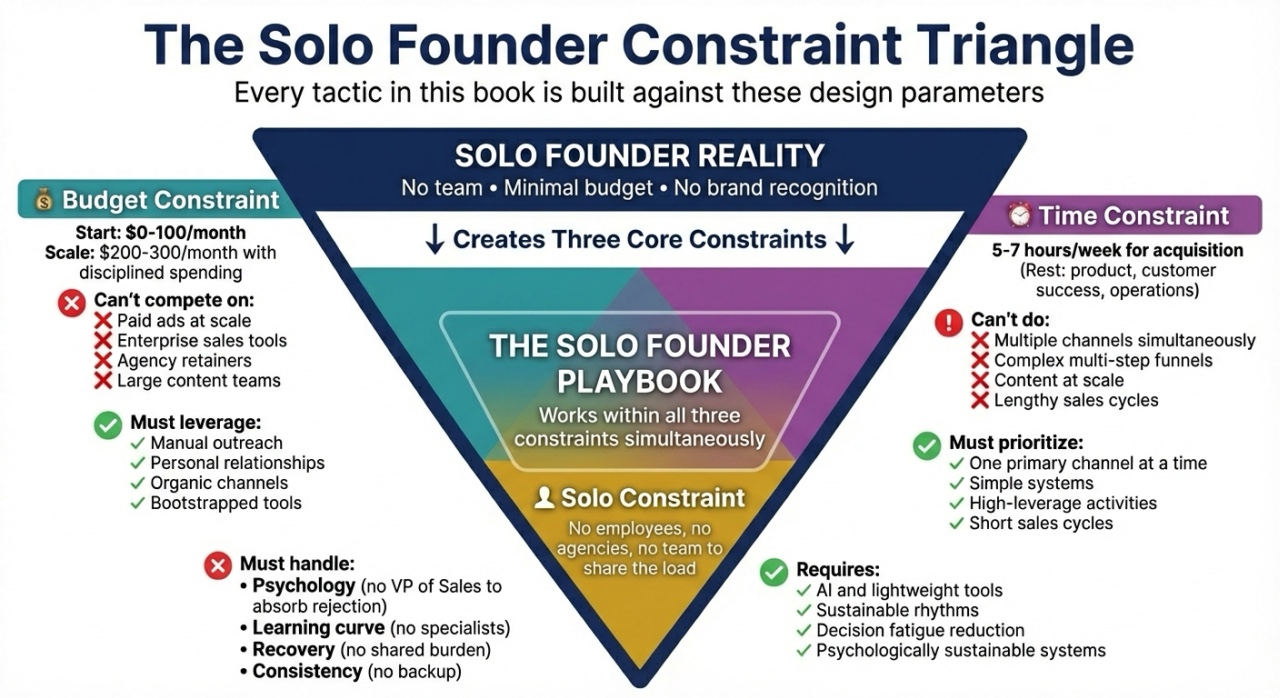
Figure I.1: Lean Founder Constraint Triangle. The three non-negotiable constraints for bootstrapped founders and small teams: budget, time, and headcount. Every tactic in this book is designed against these parameters.
-
Budget. Most founders start at $0-$150 per month on tools and win their first customers through manual outreach, communities, and content. As you scale, $200-$400 per month is a sensible, disciplined investment. No five-figure campaigns or agency retainers.
-
Time. You have 5-7 hours per week; the rest goes to product, customer success, and operations. That rules out winning on volume. Pick one primary channel at a time and build simple systems around it.
-
Lean headcount. No agencies, at most a couple of people to share the load. Everything must be executable by one or two people with AI and lightweight tools: systems that reduce decision fatigue and make selling psychologically sustainable.
These constraints rule out paid ads at scale, enterprise sales tools, agency retainers, juggling five channels, and anything that depends on a large team. They push you toward manual outreach, relationships, organic channels, and one acquisition path at a time. Many founders reach $3,000-$5,000 MRR with zero ad spend and minimal tooling. In Parts I through IV, if a tactic requires more than a few hundred dollars a month, a dedicated team, or six-month sales cycles, it isn't here; Parts V and VI cover the strategy and hiring decisions you face once a motion works and you choose to scale it. The goal is a complete customer acquisition system that works within these constraints.
What You'll Walk Away With
After reading this book and completing the exercises, you'll have:
- A diagnostic sales mindset that makes customer conversations feel like problem-solving (Chapter 1)
- A one-paragraph Ideal Customer Profile tight enough to stop wasting time on wrong-fit prospects (Chapter 2)
- A repeatable outreach and discovery system you can execute in 5-7 hours per week (Chapters 3-4)
- Pricing confidence backed by frameworks (Chapter 5)
- AI-assisted workflows that multiply your output without replacing your judgment (Chapter 7)
- A 90-day execution plan with weekly rhythms, metrics, and milestones (Chapter 10)
- Sustainability habits that prevent burnout and keep acquisition consistent (Chapter 12)
Every framework comes with an application, and none requires a team. These are the systems that take founders to $3K-$10K MRR and beyond.
Why Listen to Me?
I'm a practitioner. I've spent decades in enterprise tech and startups and built these systems under real constraints.
- 30+ years in enterprise tech and startups: GE Technical Marketing Program, AirDefense, AeroScout, CIC. My job was turning technology into revenue: market research, IP strategy, pitch decks, negotiation, delivery.
- Two wireless security patents: I've done the kind of technical work that technical founders respect, and I know how to translate it into revenue.
- 14 years on Upwork, 100% client satisfaction: I've acquired clients one conversation at a time, with no brand and no team.
- Building GTM OS while teaching it: I coded and deployed GTM OS, the AI-first companion platform for this book, and I'm running the acquisition playbook in public as I grow it.
This book focuses on the strategic frameworks for founder-led customer acquisition. For deeper, AI-supported implementation (training, practice, and support), see GTM OS, the platform this book grew out of. The book stands alone; GTM OS helps you execute it. The frameworks (the Prescription Frame, MVQ, diagnostic discovery) are distilled from what worked across consulting, services, and product for lean operators with limited time and budget.
AI as Your Force Multiplier
AI tools now give small operators capabilities that once required entire teams, which is why the playbook applies whether you're alone or a few people. You can now:
- Research and personalize outreach at scale (once a full-time SDR)
- Analyze discovery calls for patterns (once a sales-enablement role)
- Generate and test content without a marketing agency
- Build automation workflows without a developer
The tools are only as good as the strategy behind them: AI-personalized cold emails to the wrong people are still spam, sent faster. This book teaches the strategy first, then shows where AI helps. The chapters are built around the specific problems founders and small teams face, because a small company is not a failed big company and needs a playbook written for how it works.
Who This Book Is For
This book is for founders building real businesses who are the sales team: no hires or one early teammate, no agency, 5-7 hours a week for acquisition. Your offer is in the $49-$5,000 range (subscriptions, courses, consulting, implementation), you're bootstrapped or running lean, and you'd rather diagnose a customer's problem than pitch a generic solution.
The primary audiences: technical founders who dread sales conversations; creator founders who can't monetize their audience without feeling sleazy; consultants and freelancers stuck in a feast-or-famine cycle. The frameworks (ICP, MVQ, Prescription Frame, diagnostic discovery) apply to all three and survive your first hire, since a rep can co-own the same playbook.
Who This Book Is Not For
If you need a manual for building a sales organization, with SDR teams, quotas, and sales managers, this is the wrong book. The table below shows where others fit better. This is for founders selling $49-$5,000 offers where each customer relationship matters. When the motion works and you are ready for help, Chapter 21 covers your first one or two GTM hires, not a sales org.
It's not about manipulating people into buying things they don't need (no acquisition strategy saves a product that doesn't solve a real problem), not about growth at all costs (every tactic targets profitability), and not about becoming someone you're not (the approach is diagnostic).
| If you're considering… | That book assumes… | This book assumes… |
|---|---|---|
| Founding Sales | You'll hire your first rep within 12 months | You are the sales team until the motion is proven (Chapter 21) |
| $100M Leads | Paid ads and high-volume funnels | Organic channels, manual outreach, $0-$400/month |
| The Mom Test | You need to validate demand and talk to customers | You've built something; you'll test your targeting as you go, but the focus is closing and systematizing |
| Generic enterprise playbooks | SDRs, AEs, budget, long cycles | Founder or small team, 5-7 hrs/week, $49-$5,000 offers |
How This Book Is Organized
- Part I: Psychology & Positioning (Ch. 1-3): reframing sales, finding your ideal customer, getting noticed.
- Part II: Conversations & Conversion (Ch. 4-7): discovery calls, pricing, retention, AI.
- Part III: Systems, Metrics & Playbooks (Ch. 8-12): metrics, objections, your 90-day plan, diagnosis, sustainable habits.
- Part IV: Your Playbook & the Future (Ch. 13-15): your one-page playbook, Answer Engine Optimization, community and social proof.
- Part V: GTM Strategy (Ch. 16-18): choosing your motion, pricing and packaging, channel strategy.
- Part VI: Scaling the Machine (Ch. 19-21): onboarding and activation, GTM operations, your first GTM hires.
The book closes with Your Next 30 Days, a plan for turning what you've read into action.
You can read straight through or jump ahead: if you're stuck on pricing, go to Chapter 5; if cold emails aren't working, Chapter 3; if you're burning out, Chapter 12.
Appendices: a Glossary (40 key terms), a Framework Index of all methodologies with chapter references, a unified Sources & Citations bibliography, and Complete Playbook Examples with copy-paste templates. Numbered references [1], [2], etc. point to full citations at the end of each chapter and in Sources & Citations.
Each chapter ends with an exercise or a concrete action step. Do them; reading about customer acquisition won't improve yours on its own.
One Thing Before We Start
I've written this book the way I wish someone had written one for me years ago, as a practitioner who's made the mistakes and is still learning, with no promises about passive income or four-hour workweeks. Some of what I share will work for you and some won't fit your market or style, so adapt the principles to your situation.
The core tactics come from my own selling, and I paid for those mistakes myself. Where a chapter goes beyond what one founder can test alone, such as hiring or larger motions, it leans on cited research and says so. Use that to shorten your own learning curve. Part I starts with the psychology of selling.
[1] MicroConf, The 2022 State of Independent SaaS report. https://issuu.com/microconf/docs/the_2022_state_of_independent_saas_7_. Survey shows 55% of respondents were solo founders (55% solo founder, 35% two co-founders, 8% three co-founders, 2% four or more).
[2] CB Insights, "The top reasons startups fail," March 5, 2026. https://www.cbinsights.com/research/report/startup-failure-reasons-top/. 431 VC-backed companies that shut down since 2023: ran out of capital 70% (the final cause, not the root problem), poor product-market fit 43%, bad timing or macro conditions 29%, unsustainable unit economics 19%.