
Chapter 10: Playbooks for Different Starting Points
When you sit down to apply the frameworks, the first question is usually whether they apply to you. A founder with zero customers faces different constraints than one with 50; a B2B SaaS product needs different tactics than a coaching business; and bootstrapped founders can't follow VC playbooks that assume burning cash for market capture.
Take CAC payback: as a rule of thumb, a bootstrapped founder should aim to earn back what it cost to win a small-business customer within about 4-6 months, while a venture-backed company can accept 6-12 months because investors fund the gap. Neither standard is better; they fit different situations. This chapter gives five playbooks for different founder situations (solo or small-team); find the one that matches your situation and follow it.
Founder-Type Note: The five playbooks address distinct situations, not distinct people. Many founders span categories, like a coach who also sells courses (Playbook 3 + 4), or a SaaS founder just starting out (Playbook 1 + 2). If you're in between, read both sections and blend.
Common Mistake: Switching Playbooks Too Frequently
Founders abandon an approach after 2-3 weeks because "it's not working," but early results are usually underwhelming, and most playbooks need 60-90 days of consistent execution before you can evaluate them. Commit to 90 days before major pivots. Track weekly inputs (outreach sent, content published, calls completed), not just revenue. Adjust tactics within your playbook, but don't abandon the strategy before a fair test.
Decision Map: Which Playbook Is Right for You?
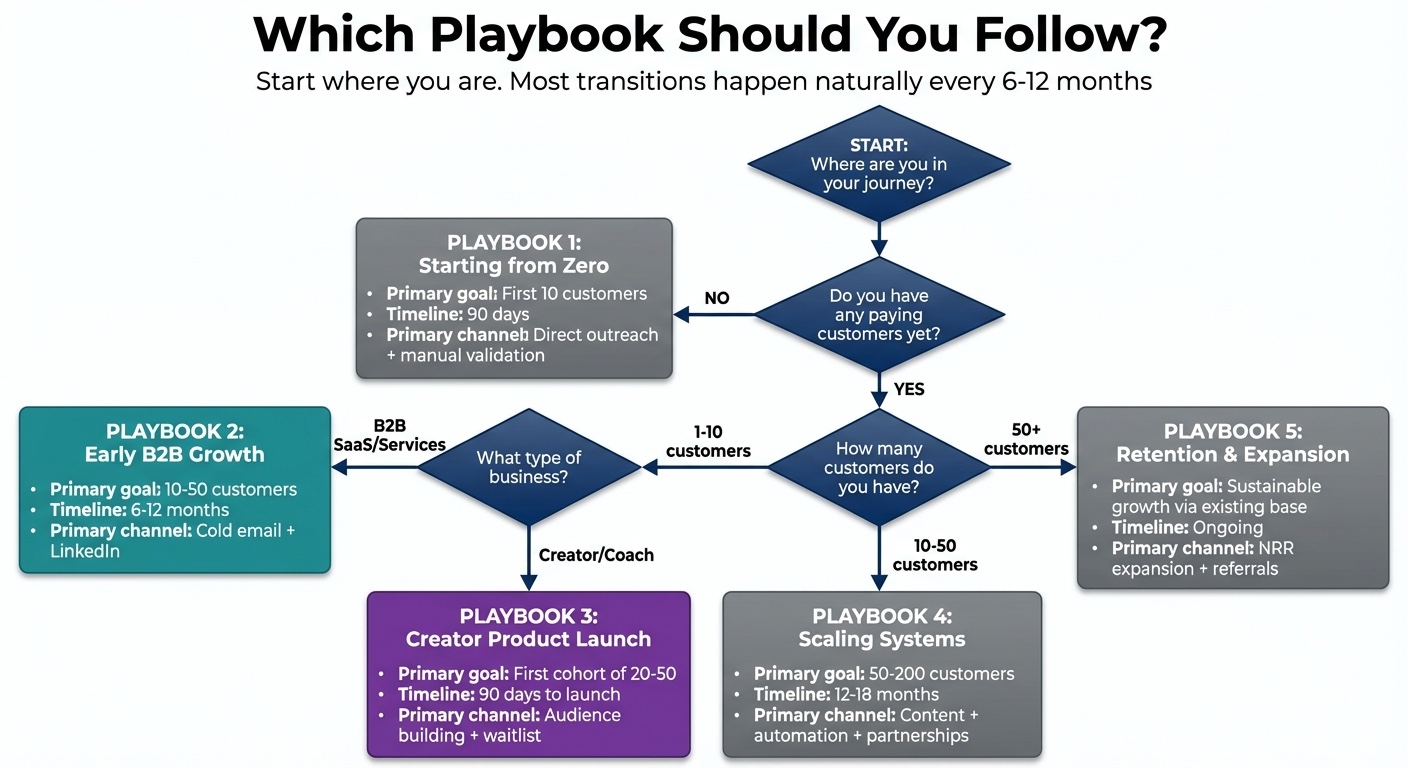
Figure 10.1: The Playbook Selection Framework. Use this decision map to identify which playbook matches your situation: Starting from Zero, B2B SaaS Founder, Coach/Consultant, Creator, or Scaling from 50 to 500.
No paying customers yet? Start with Playbook 1. Otherwise, pick by what you primarily sell:
- Playbook 1: Zero Customers. Manual, intensive, learning-focused. Get to 10 customers to validate.
- Playbook 2: B2B SaaS. LinkedIn + cold email + content; multi-stakeholder sales, longer cycles.
- Playbook 3: Coach/Consultant. Content-first trust building; product ladder from free to high-ticket.
- Playbook 4: Creator. Audience + email list + launches; platform-specific content.
- Playbook 5: Scaling (50→500). Systematize what works; automation and delegation without losing quality.
Playbook 1: Starting from Zero (No Customers, No Audience)
This is the hardest starting point. You have a product or service, but no one knows about it or is buying it yet. You have no testimonials, referral network, or audience, and you don't know whether you have product-market fit.
Your one job: Get to 10 paying customers as fast as possible, and treat everything else as secondary.
The Zero-to-Ten Sprint: a 12-week cadence
Weeks 1-4: Foundation and first outreach. Write a specific ICP hypothesis ("marketing agencies with 5-15 employees in the U.S. who struggle with client reporting," not "small businesses"), then build a list of 100-200 verified prospects with contact info. Send 25-50 personalized messages a week (warming up on LinkedIn first where you can) and book discovery calls with early responders. Track: messages sent, response rate (target 10-15% on warmed, personalized outreach; cold email runs far lower, see Chapter 8), calls scheduled.
Weeks 5-8: Discovery and learning. Run 8-12 discovery calls (roughly half of the 10-30 responses your first month should produce) with the MVQ framework: understand problems, don't pitch. Review notes for patterns (what problems repeat, what language they use) and refine your ICP. Then present offers to qualified opportunities using the Prescription Frame; be honest about being early-stage and trade a discount for feedback. Close your first 2-4 customers and onboard immediately. Track: offers presented, close rate (target 30-40%), pricing feedback.
Weeks 9-12: Scale and systematize. Document what worked, turn it into messaging templates, identify 50-100 more prospects on your refined ICP, and stand up basic automation (email sequences, CRM workflows) to amplify proven messaging for the final push to 10 customers. End with a written review.
The principle underneath the calendar: weeks 1-8 are manual and intensive because you're learning what works; weeks 9-12 systematize only what's proven.
Ten customers is not a business, but it proves someone will pay. At this stage, customer acquisition is mostly about learning. Those ten give you real feedback, stories for marketing, confidence the idea is viable, data to refine your ICP, and the exact language customers use for their pain. Once you have satisfied customers, referrals tend to convert far better than cold leads because they come with social proof built in. That is the hardest phase; what comes after is easier, though still hard work.
Playbook 2: The B2B SaaS Founder (Selling Software to Businesses)
For bootstrapped B2B SaaS founders, content and SEO often deliver lower CAC than paid ads (though benchmarks vary). Combine direct outreach (short-term pipeline) with content (long-term compounding). Your primary channels: LinkedIn (prospecting and content), cold email, content marketing for inbound, and partnerships/integrations.
The Unique B2B Challenge
B2B sales involve multiple stakeholders, longer cycles, and more risk aversion than selling to individuals. The user often isn't the payer, and the payer often needs approval, so your discovery must account for the buying committee even when you're talking to one person: "Who else needs to weigh in?" and "What's the approval process here?"
For your first few deals: selling to a buying committee is harder. While closing your first 5-10 customers, focus on single-decision-maker opportunities (smaller companies, founder-led businesses, or champions with budget authority) and develop committee skills as deal sizes grow. Note too: a lukewarm champion who can shepherd a deal through procurement beats an excited one who has no idea how to get budget approved.
Case Study (composite): A developer-tools founder ran a compressed version of the Zero-to-Ten Sprint for 90 days, pitching from the first calls instead of waiting for week 5. Month 1: 50 personal emails, 8 responses (16%), 3 customers ($891 MRR). Month 2: 100 refined emails, 21 responses (21%), 4 more ($2,079 MRR). Month 3: automated with Instantly using the proven messaging, 20 calls booked, 3 more. Total: 10 customers, $2,970 MRR. Because the founder validated manually first, month-3 automation scaled messaging that already worked.
The Weekly Rhythm
Monday: prospecting. Find 20-30 new ICP-matched prospects in LinkedIn Sales Navigator and add them to your CRM with a fit note. Tuesday-Thursday: engagement and outreach. Engage with prospects' content, send connection requests to those you've warmed up, follow up conversations, send cold emails. Friday: content and admin. Publish one piece, clean up your CRM, review the week's metrics.
The B2B Content Strategy
Your content should demonstrate expertise in your customers' problems, not your product's features. If you sell HR software, write about hiring, onboarding, and retention; if you sell marketing automation, write about campaign strategy and conversion. That shows you understand their work, so when they're ready to buy they already trust you. Format matters: in Socialinsider's 2025 data for LinkedIn company pages, document posts (carousels) averaged 7.00% engagement, video 6.00%, and text posts 4.50% [1]. But the payoff takes time. Plan for 6-12 months before organic traffic gains momentum, which is why you need direct outreach while content compounds in the background.
The Cold Email Infrastructure
Key principles for B2B SaaS cold email:
- Never send from your primary domain. Use dedicated outbound domains.
- Warmup is critical: new domains start at 5-10 emails/day and ramp over three to four weeks (some senders take six). Jumping straight to high volume triggers spam filters.
- Volume: 30-50 emails/day per domain is sustainable for B2B, but only after warmup.
- Structure: personalized first line + one-sentence value prop + low-friction ask ("Worth a 15-minute conversation?").
- Compliance: always include one-click unsubscribe (List-Unsubscribe header) and a visible opt-out link. Deliverability depends on them.
- Benchmarks: keep bounces under 2% and spam complaints under 0.1%, as Google asks of every sender [2]; judge reply rate against your own baseline (Chapter 8 explains why published reply rates differ so much).
Pricing and Packaging
B2B buyers expect to talk to someone for deals over $2,000-$3,000/year; below that, self-serve makes sense. Put clear pricing on your website, even for enterprise deals; hiding it frustrates buyers and wastes time on unqualified conversations. Offer a 10-20% discount for annual payment, which reduces churn.
The Partnership Accelerator
B2B growth often comes through partnerships with complementary, non-competing products that share your customer: integrations, referrals, and co-marketing all work. Identify 10-15 products your ideal customers also use and reach out with a specific proposal: "I think our customers overlap. Want to do a joint webinar on [topic]?" One good partnership can produce more leads than months of cold outreach.
AI Leverage Points for B2B SaaS
AI speeds up execution, but the judgment that closes deals stays with you: AI-powered CRMs (like Attio) enrich prospect data; tools like Instantly's AI Reply Agent craft personalized follow-ups at scale; AI drafts carousel slides, blog outlines, or email sequences for you to edit for voice; and it can find patterns in call transcripts. As in the other playbooks, validate manually first, then use AI to scale what works.
B2B SaaS Reality Check
This playbook requires patience: content compounds over 6-12 months and a referral network takes years. Enterprise cycles (3-6 months or more) sit outside this book's constraints, so start with smaller, shorter-cycle deals while building toward larger ones. Founders who make this work commit to the long cycle and keep cash coming in from smaller deals.
Playbook 3: The Coach or Consultant (Selling Services to Individuals or Businesses)
You're selling your expertise (coaching, consulting, training, or done-for-you services) with offers from $50 low-ticket products to high-ticket programs. Your primary channels: content and audience building (LinkedIn, YouTube, newsletters), referrals from satisfied clients, speaking and guesting (podcasts, webinars, events), and communities where your ideal clients gather.
The Content-First Approach
For service businesses, content does most of the selling. People buy coaching and consulting from people they trust, and trust builds through consistent demonstration of expertise. So teach everything you know: give away the "what" and the "how"; people pay for implementation, accountability, and personalized guidance. Share your best frameworks publicly and you attract clients who want help applying them; hold everything back and people have little reason to find you.
The Product Ladder
Most successful coaching and consulting businesses offer multiple price points:
- Free content: blog posts, social, YouTube, podcasts. Attracts attention, builds trust.
- Low-ticket ($50-$500): e-book, course, workshop, templates. Identifies serious prospects.
- Mid-ticket ($500-$3,000): group program, cohort course, one-day intensive.
- High-ticket ($3,000-$10,000): 1:1 coaching, done-for-you, VIP days. Employer-paid executive programs can run $10,000 or more.
Each tier feeds the next, but you don't need all four at once. Start with one (usually mid or high-ticket for coaches, where the revenue is) and prove you can sell it consistently before adding others. Many coaches run on two tiers for years: free content and one paid offering.
The Enrollment Conversation
High-ticket services require conversations. The discovery-call framework applies directly, with a diagnostic frame: "I want to understand your situation and see if I can help. If I can, I'll explain how. If I can't, I'll tell you that too." Qualification matters more than closing: wrong-fit clients don't get results, complain, and don't refer, so turn away people who aren't right.
Case Study (composite): A marketing consultant accepted 8 clients in 6 months with weak qualification: anyone who could pay. Five of eight (63%) churned within 3 months, each needing 2-3x the estimated support hours, none referring. After adding three non-negotiable criteria (pain clarity, implementation capacity, realistic timeline), they accepted only 5 over the next 6 months: 80% completed successfully, each referred 2-3 others, and revenue per client rose 80%, so total revenue grew about 12% on five clients instead of eight, before counting the referrals.
Playbook 4: The Creator (Selling Digital Products to an Audience)
You're building an audience and monetizing through digital products (courses, templates, communities, newsletters), and your buyers discovered you through your content. Your primary channels: platform-specific content (YouTube, X, LinkedIn, TikTok, newsletters), email list building, product launches to your audience, and collaborations with other creators.
Building the Audience
The creator model needs an audience paying attention before you can sell anything. Build where your ideal customers already spend time, and early on let consistency beat quality: posting three times a week for a year builds more audience than once a month of "perfect" content. Platform algorithms favor accounts that post regularly, and audiences build habits around a regular schedule.
Common Mistake: Spreading Across Too Many Channels
Creators try to master YouTube, X, LinkedIn, and TikTok at once, usually out of FOMO. Instead, pick one primary channel and commit for 90 days; master it before adding a second.
The Email List and Newsletter Nurture
Social platforms can change algorithms or ban your account; your email list is the asset you own. So every piece of content should have a path to it: offer something valuable for the email (a checklist, template, or short guide); the best lead magnets are repurposed versions of your best-performing content, not new content. Your newsletter is then a multi-touch nurture system, since most buyers need several touches before they decide. Keep 80%+ of emails pure value with no pitch: deliver the lead magnet, share frameworks and case studies for a few weeks, then introduce your paid offering with a soft ask.
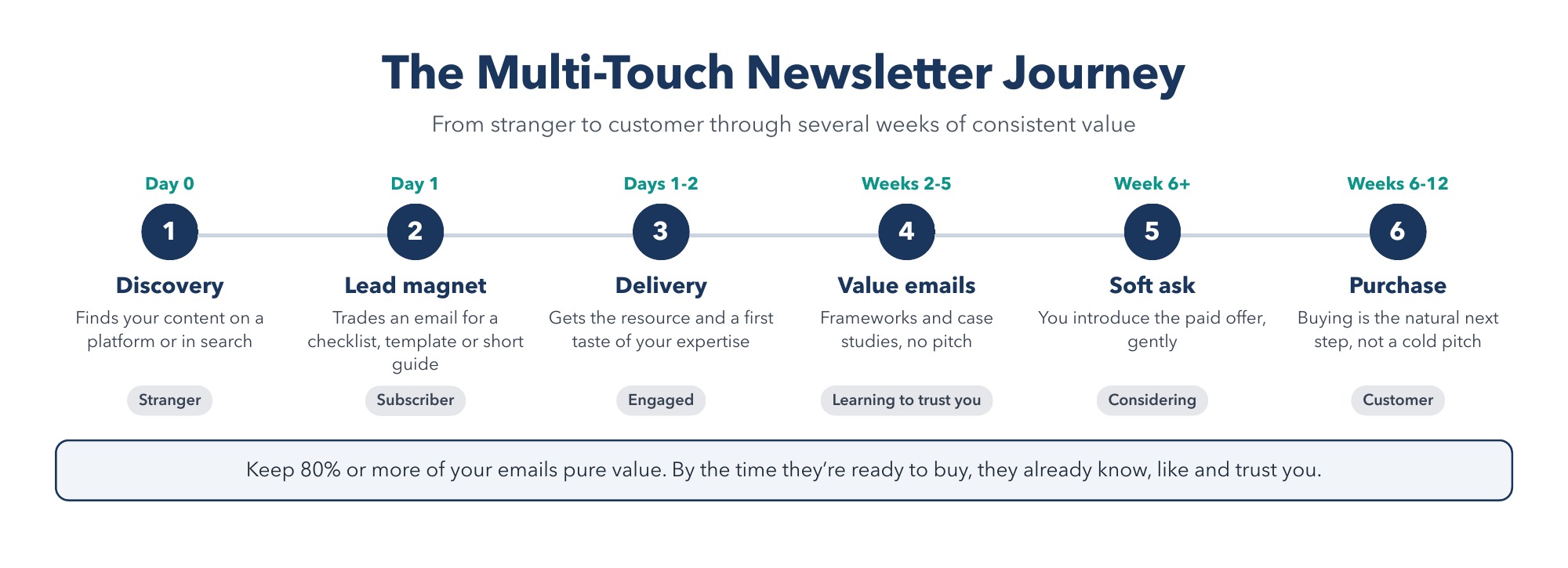
Figure 10.2: The Multi-Touch Newsletter Journey. Buyers usually need several touches before they buy. Your newsletter creates these touchpoints systematically.
This might take 6-12 weeks of consistent value delivery, but by the time they're ready to buy they already know and trust you, so your offer doesn't land as a cold pitch.
Launch Strategy
Digital products sell best in concentrated launch windows; the "evergreen" approach is steadier but lower-revenue. A simple structure: pre-launch (2 weeks): seed the problem, build anticipation; launch window (5-7 days): open for purchase, send daily emails, create urgency with a real deadline; post-launch: close the doors or remove bonuses, deliver, gather feedback for next time.
The Creator's Pricing Psychology
Creators underprice because they compare themselves to free content: "Why pay $500 for my course when YouTube is free?" Buyers pay for curation, structure, accountability, and access to you; the information alone is the cheap part. Price on the outcome rather than the hours of video: if your course helps someone land a job paying $20,000 more a year, it's worth thousands, not $49.
Community as Moat
Community is both a product and a retention mechanism: ongoing value, switching costs, recurring revenue. It works when you facilitate connections beyond your own content: a place where you answer questions is support, but a place where members help each other has standalone value. Communities take time to build, and an active one is hard for a competitor to copy.
Creator Reality Check
The creator path looks glamorous (passive income, lifestyle freedom), but building an audience takes years of consistent content, and many creators quit within the first year when results don't come quickly. Creators who last treat content as a long-term investment. If you need revenue now, offer services first while building your audience in the background. Many creators started as consultants and only moved to products once their audience could support it.
Playbook 5: Scaling from 50 to 500 Customers
You have traction and a validated market. Now you need to grow without breaking what works. Your time becomes the bottleneck, manual processes stop scaling, and keeping quality consistent gets harder.
What to Systematize First
Not everything should be automated. Start with the highest-volume, lowest-judgment activities: lead capture and routing, follow-up sequences (post-call nurture, post-purchase onboarding), scheduling, and auto-updating dashboards. Keep the high-judgment activities manual: discovery calls, proposal customization, key-account check-ins.
Hiring or Outsourcing
At some point you'll hit capacity. Limit growth to what you can handle, or bring in help. If you can't afford contractors yet, this is aspirational; many founders run solo well past 50 customers before revenue justifies help (the tactics below assume $5K+ MRR first). To stay lean, use contractors for specific functions: a VA for scheduling, CRM, and research; specialist freelancers for content, email setup, or technical work; fractional sales support for overflow. Keep the core that differentiates you (strategy, high-touch sales, key relationships) and delegate execution anyone competent can do.
The first GTM hire (small-team transition). If you're building toward a team, sequence it deliberately. By 50 customers you should already sell repeatably (the same ICP, stages, objections, and pricing across at least 10-20 deals); if you don't, fix that before hiring. SaaStr's Jason Lemkin observes that founder-led sales generally stops scaling somewhere around $1M-$2M ARR, sometimes later for freemium products or very small customers [3]; at this book's price points that can mean hundreds of customers, so your hours, not your ARR, usually trigger the first hire. Your first hire is an AE or "founding seller," not a VP of Sales; a player-coach sales leader comes later. Hand off gradually rather than in a hard cutover: the rep shadows you, then reverse-shadows while you watch. You stay in deal reviews and forecasts even after a leader joins. And don't hire a "killer to figure it out" with no playbook: write down how you already close (from call recordings, emails, proposals) and have your first reps co-author and stress-test it. AI prospecting can delay the hire longer than was possible a decade ago, but the same rule applies: don't scale, with humans or AI, before a working motion exists.
Maintaining Quality at Scale
The danger of growth is that quality slips: response times rise, personalization drops, the experience that won your early customers degrades. Founders who rush (automating unproven processes, hiring before they can afford to, chasing growth over quality) scale their problems with their revenue. Build quality indicators into your metrics (response times, satisfaction scores, referral rates), and if they decline you're scaling too fast or automating the wrong things. Each new system should make the next customer easier to serve.
Choosing Your Playbook
The playbooks overlap: a B2B SaaS founder might also build content; a coach might need the zero-to-ten sprint first; a creator might move to B2B. Start with the one that matches your primary motion now, and borrow tactics from the others. The fundamentals (ICP, discovery, follow-up, retention) run through all of them, even where the tactics differ.
The Hybrid Path
Many founders don't fit one category. They sell B2B software and offer consulting, or coach and sell courses. The hybrid approach works when the pieces reinforce each other (consulting informs your software, course content feeds your coaching pipeline) and fails when they compete for attention. Find what connects them; if you can't say clearly what it is, you're probably doing too many things.
The 90-Day Focus
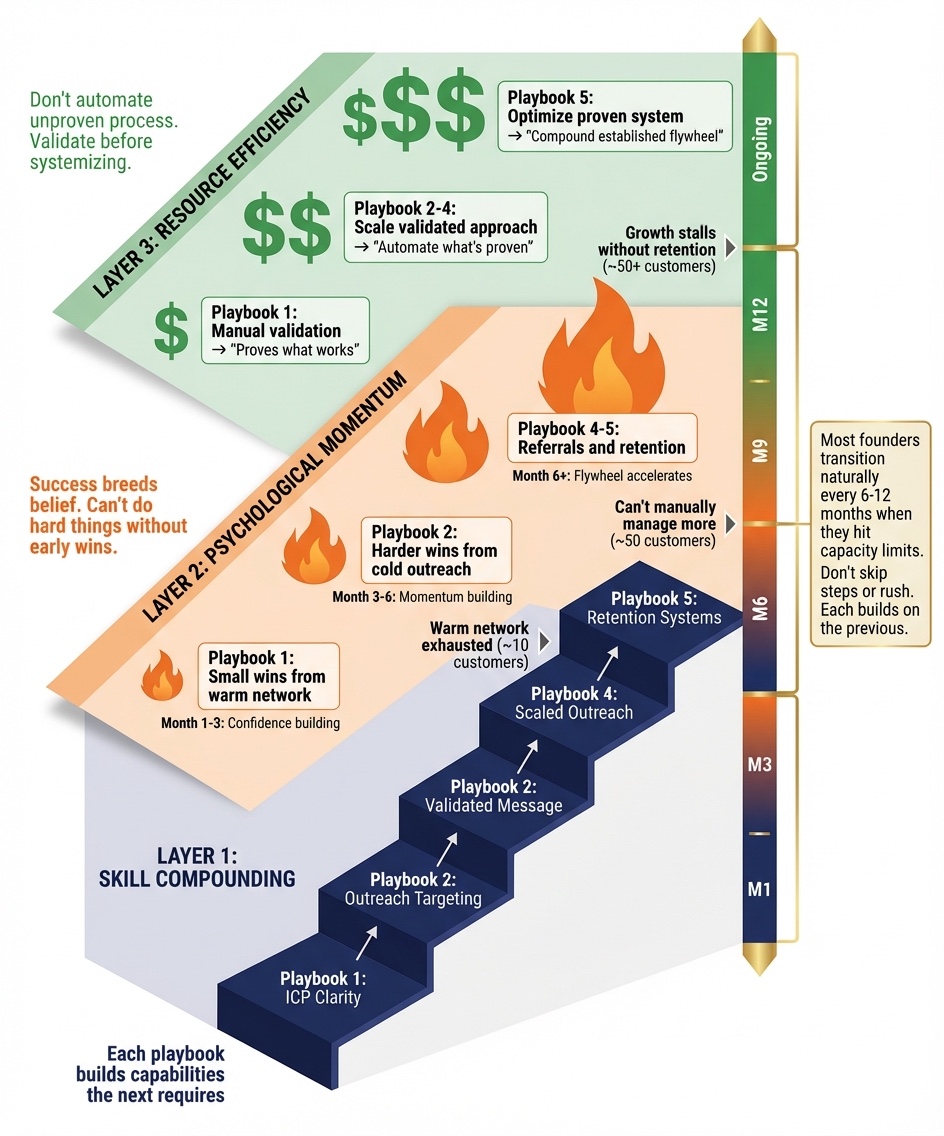
Figure 10.3: The Playbook Progression. Each playbook builds toward a sustainable acquisition engine. The 90-day commitment is the minimum time needed to generate meaningful data about what's working.
Whichever playbook you're following, commit to it for 90 days before evaluating, with checkpoints along the way. Day 30: have you established your weekly rhythm and are you hitting activity targets? If not, fix execution before you question the strategy. This checkpoint matters most, since most playbook failures are consistency failures. Day 60: are you seeing leading indicators (responses, engagement, conversations)? Day 90: what are the actual results versus your goals?
When to Pivot
After 90 days you have real data. Keep going when leading indicators are positive, revenue or strong signals appear, and metrics improve week over week. Adjust when you see no leading indicators despite consistent activity, a negative feedback pattern (same objection, consistent ghosting at the same stage), an offer/market misalignment, or you can't sustain the activity level. Adjusting means changing one variable while keeping the playbook: shift your ICP, change messaging, try a different channel, or refine your offer. Iterate from the data; don't restart from scratch every time something doesn't work immediately.
When to Graduate to Paid Acquisition
Parts I through IV intentionally focus on manual, organic methods (cold email, LinkedIn, content, community); Chapter 18 weighs paid channels alongside them. Paid needs different skills, budgets, and risk tolerance, so master the manual methods first. Paid makes sense once (1) you've proven manual methods work: messaging converts and leads flow; (2) you have predictable unit economics: you know your CAC, LTV, and stage conversion rates; (3) you're limited by capacity: turning away opportunities for lack of time while leads keep coming; and (4) you have 3-6 months of runway, since paid has a learning curve.
The bootstrap approach: treat paid ads as an optional later test that sits outside the few-hundred-dollar budget in the introduction. A test that tells you anything usually needs about $600-$1,500 a month on Google Search or Meta for at least four weeks (LinkedIn typically needs $1,500-$3,000 or more), so pick one channel and track everything so you know whether paid is cheaper than your time. Some founders reach $50K-$100K MRR on organic alone, but a small paid budget for retargeting or content amplification can accelerate growth once messaging and unit economics are validated, especially when you're ready to hire and need leads faster than one person can create.
Chapter Summary: TL;DR
The core insight: Your constraints determine your playbook. Bootstrapped founders can't follow VC playbooks, but manual methods can scale a long way with consistent execution, and a small paid budget can accelerate once you've validated. Pick the playbook that matches your situation and commit to 90 days.
Key takeaways:
- Zero to 10 customers is a validation phase: manual, intensive, learning-focused.
- B2B SaaS usually means selling to several stakeholders; fastest-closing deals often have champions who understand the internal buying process.
- Coaches/consultants: qualification matters more than closing; wrong-fit clients cost more than they're worth.
- Creators: consistency builds the audience, launches convert it, and your email list is the asset you own.
- Scaling (50→500): systems become critical; founder-led sales usually stops scaling around $1M-$2M ARR, and the first GTM hire is an AE, not a VP. Write down how you close before handing it off.
Next chapter: Chapter 11 builds a diagnostic framework for when your acquisition system breaks, so you can find what's wrong and fix it faster.
The Exercise: Create Your 90-Day Plan
Based on the playbook that matches your situation, create a specific 90-day plan.
- Identify your playbook. Which of the five scenarios best describes you right now? Be honest about where you are.
- Define your weekly rhythm. What specific activities each week? Block calendar time for outreach, content, calls, and admin.
- Set your 90-day goals. Be specific: conversations, pipeline value, revenue.
- Identify your constraints. What's most likely to derail you? Time, consistency, fear of outreach? Plan for it.
- Create accountability. Peer accountability, public commitment, or a weekly review with someone who'll hold you to the plan.
- Schedule your 90-day review. Put a date on the calendar to evaluate results and adjust for the next 90 days.
Want Copy-Paste Examples? See Appendix: Complete Playbook Examples: filled-out ICP definitions, messaging templates, weekly rhythms, and 90-day projections for five profiles.
Chapter Checklist
Before moving to Chapter 11, complete:
- Identified which playbook(s) match your current situation
- Defined your specific weekly rhythm (what activities, when)
- Set measurable 90-day goals
- Identified your primary constraints and obstacles
- Created an accountability mechanism (peer, public commitment, weekly review)
- Scheduled your 90-day review date
Self-assessment questions:
- Am I honest about where I am, or following a playbook for where I want to be?
- Have I committed to 90 days, or am I likely to quit at week 3?
- Do I have accountability, and have I blocked calendar time for my playbook's activities?
[1] Socialinsider, "LinkedIn Organic Benchmarks 2026." https://www.socialinsider.io/social-media-benchmarks/linkedin
[2] Google, "Email sender guidelines FAQ," Google Workspace Admin Help. https://support.google.com/a/answer/14229414
[3] Lemkin, J., "Founder-Led Sales Breaks Earlier Than You Think," SaaStr. https://www.saastr.com/why-founder-led-sales-breaks-earlier-than-you-think