
Chapter 16: What Go-to-Market Really Is: Choosing Your Motion
You shipped v1. It took six months of building in the dark: weeknights, weekends, maybe a first hire or a contractor. Now you need customers, the real kind who pay. So you open LinkedIn for guidance, and the advice contradicts itself as you scroll. "Go product-led." "Outbound is dead." "Build a community." "Nobody buys without a demo." Every post sounds certain, and they all point in different directions.
Start by separating two things that usually get lumped together: tactics and the motion. Go-to-market is the main way you turn strangers into paying customers and keep them expanding. Ads, webinars, cold emails, LinkedIn posts, and conference booths are tactics. The motion is how a buyer first meets you, how they reach value, and how the deal closes. Many early teams lose months running tactics for three motions at once and never get any of them working.
This chapter is about a single decision: pick one primary motion, the one that should produce most of your customers, and match it to your price, your product's complexity, how your buyers buy, and your own strengths. Everything else becomes a supporting motion you add later, on purpose rather than by accident. With the right motion, a team of one to ten people can build something repeatable. With the wrong one, the same team usually works harder and gets less pipeline.
The Six Motions in Plain Language
Choosing is easier once you can picture what each motion looks like day to day.
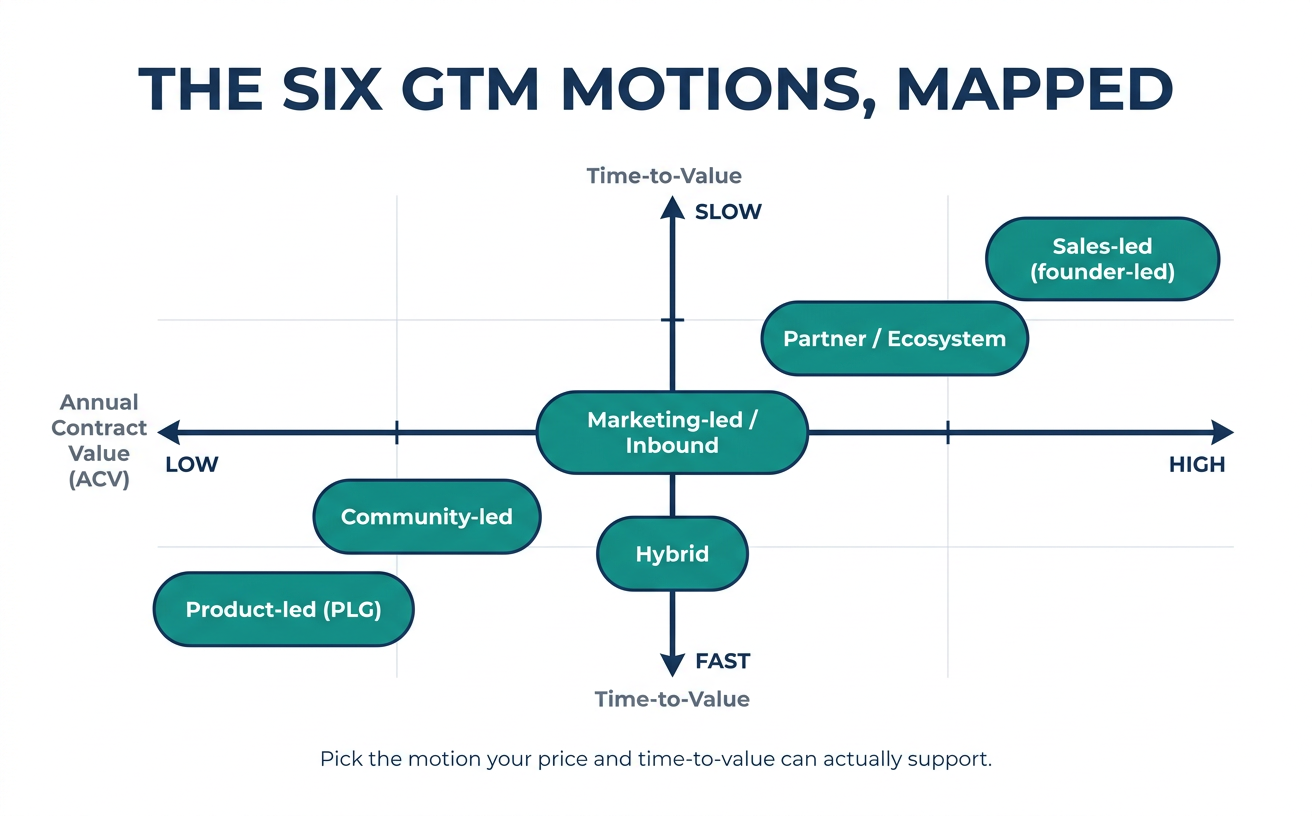
Figure 16.1: The six motions placed by ACV and time-to-value. Pick the motion your price and time-to-value can support.
Product-led (PLG)
The product does most of the selling. Someone finds your site, signs up on their own (a free trial, freemium, or a sandbox), and reaches a useful result without ever talking to you. They hit a limit, or invite a teammate, and upgrade from inside the app. Acquisition, onboarding, and the upgrade prompt are all wired into the product itself, and pricing is usually tied to usage or seats [2][9].
You'll know it's this if: most users can set up and see real value without talking to a human.
PLG depends on time-to-value. If a new user can reach a first real win in minutes, PLG can carry you with little sales cost. If they can't, free users sign up, get stuck, and churn, and your dashboard fills with numbers that don't mean much.
Sales-led (founder-led / outbound)
You sell directly. You find prospects, run discovery, give a demo, send a proposal, and walk the deal through whatever approvals the buyer needs. Early on this is founder-led sales: you are the SDR, the account exec, and the sales engineer in one person [2][3]. When you add your first GTM hire, the motion doesn't change (a human still moves each deal forward); the work starts to split between the two of you.
You'll know it's this if: buyers need a conversation, a demo, and an internal champion before money moves.
Sales-led runs on pipeline. Your week is organized around opportunities, stages, and win rates rather than signups. It's the right choice when deals are big and complex enough to pay for the human time they take. When they aren't, it gets expensive.
Marketing-led / inbound
Buyers come to you. They find a blog post, a video, a podcast, or a search result, arrive already half-convinced, and then request a demo or start a trial [1][2][8]. A piece you published months ago can keep bringing in buyers.
You'll know it's this if: a meaningful share of your pipeline traces back to content you published weeks or months earlier.
Inbound compounds: it's slow to start and cheap to keep going. It only works if you publish consistently, so a founder who publishes for three weeks and then stops won't get much from it.
Community-led
A community of users and advocates does much of the work: answering each other's questions, sharing templates and playbooks, and bringing new people in through Slack groups, Discord servers, forums, or meetups [1][5]. The influence is peer-to-peer, which usually makes it more trusted than anything you could say about yourself.
You'll know it's this if: your users are teaching each other how to get value from your product without you in the room.
For a team of one to ten, community rarely stands on its own. More often it amplifies another motion, usually PLG or sales-led, and it asks for real founder time before it pays anything back.
Partner / ecosystem-led
Other companies resell or recommend you: agencies, resellers, and especially the platforms your customers already live in [1][6][8]. You become "the best X for HubSpot users," or the obvious add-on inside an app store. You're borrowing their distribution and their trust.
You'll know it's this if: your best deals close because a partner or an integration pointed the customer at you.
Ecosystem motions usually take 12-24 months to produce real pipeline, and you pay for the reach through revenue share (commonly 20-30%) or discounts rather than cash up front [6][8]. A small team usually does better going deep in one anchor ecosystem than chasing a dozen logos.
Hybrid
Almost every company ends up combining motions over time. A working hybrid has a dominant motion: one motion drives roughly 60-70% of pipeline, with one or two others in a defined supporting role [3][8]. A common pattern is PLG with sales-assist: self-serve for small accounts, with a human stepping in only when a free team hits a collaboration limit or asks about a rollout.
Founder-Type Note: Hybrid is usually a destination. Before product-market fit, run one motion until it's repeatable. Calling yourself hybrid on day one usually means you haven't picked a motion yet.
The Decision: Four Filters and a Gut Check
Choose a motion by reading four things about your business, not by taste: ACV, deal complexity, time-to-value, and how your buyers buy. Then you sanity-check the answer against where you can personally create pipeline in the next 60 days.
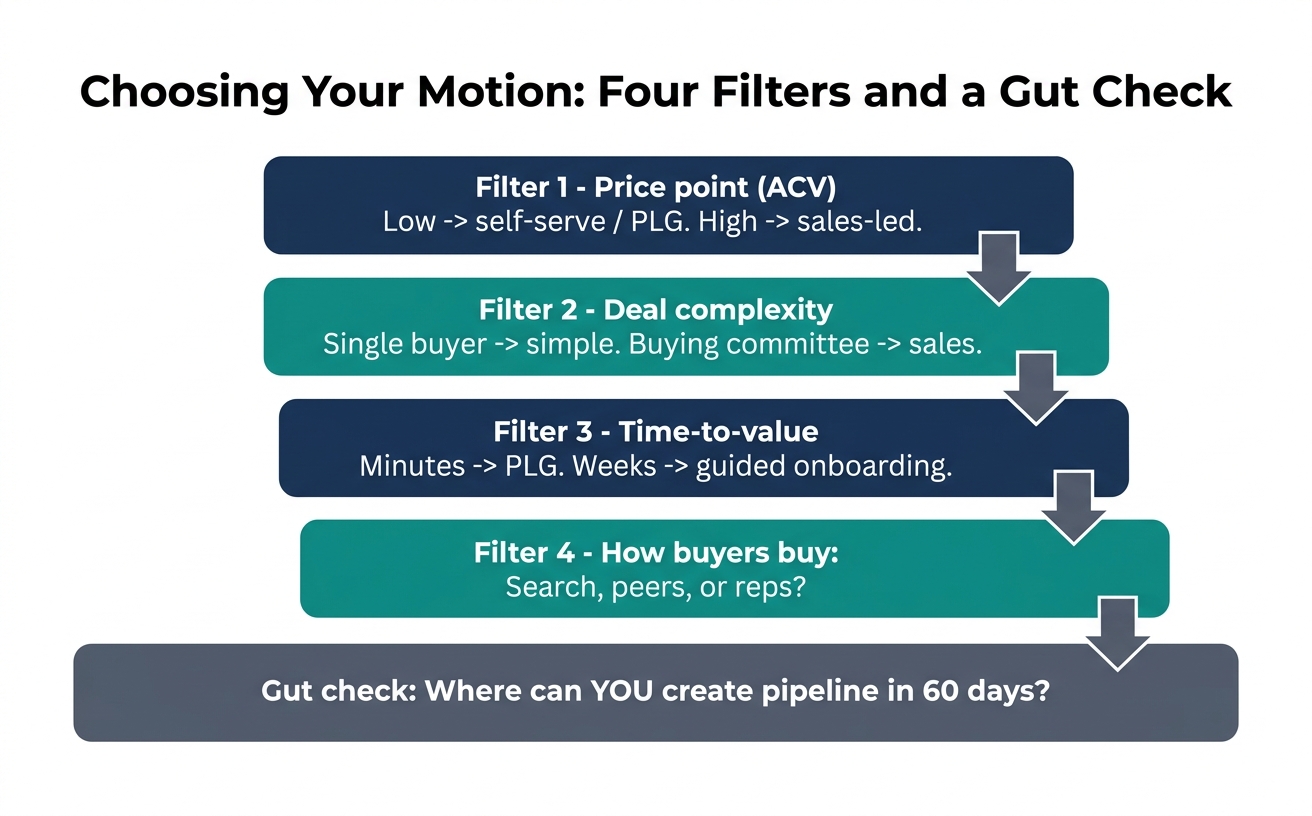
Figure 16.2: Read four things about your business, then apply the gut check. Each filter narrows the field; the gut check breaks ties.
Filter 1: Price point (ACV)
Your average annual contract value sets a ceiling on how much human selling you can afford. The rough bands below are operator rules of thumb, not survey data.
| New-logo ACV | Best-fit primary motion | Why it tends to win |
|---|---|---|
| Under $1K | Pure PLG (or PLG + inbound) | No margin for a paid sales team; needs ultra-low-cost self-serve |
| $1K-$5K | PLG + light sales-assist, or inbound | Hard to justify a full sales process; assist the high-potential accounts |
| $5K-$25K | Hybrid: PLG + sales-assist, or inbound + founder-led | Enough margin for human time if win rates hold; mid-market buyers expect a conversation |
| $25K-$100K | Sales-led (founder-led, then a first AE) + inbound | Deal size and stakeholders justify the cost of selling |
| Over $100K | Enterprise sales-led + partners; PLG only for land-and-expand | Multi-stakeholder, long, bespoke procurement |
A rule of thumb many operators use: PLG tends to work below roughly $10K-$15K ACV, and sales-led usually starts to make sense above about $15K-$20K [2][6][9]. Below that range, a human on every deal eats your margin. Above it, a buyer spending real money usually expects a person to talk to.
Filter 2: Deal complexity
Count the stakeholders and the gates. Low complexity (one or two users, a credit card, no security review) points to PLG or inbound self-serve. Moderate complexity (a team rolling it out, basic legal, two to four stakeholders) fits a hybrid, or inbound plus founder-led selling. High complexity (a cross-functional rollout, a security audit, an integration project) usually calls for sales-led selling, with partners in the mix if your buyers prefer to buy through vendors they already use [2][3][6][8].
Filter 3: Time-to-value (TTV)
This filter is the hardest to fudge, because it measures your product. Measure the time from signup to a meaningful result:
- A day or less, ideally minutes: a strong PLG candidate.
- More than a day and up to four weeks with some guidance: PLG plus sales-assist, or inbound plus sales.
- More than four to six weeks, or a real implementation project: sales-led or partner-led, even if you offer a sandbox [2][3][6].
The short version: if a buyer can't get to value on their own, PLG probably can't be your primary motion. Plenty of teams copy a well-known PLG company, ship a free trial, and then watch users churn because the product needs a week of setup.
Filter 4: How buyers buy
Ask plainly whether most of your buyers can confidently purchase without talking to a person. If they can, and a card can close it, PLG or marketing-led fits. If they need social proof, procurement, and internal alignment first, you're closer to sales-led. If the honest answer is "some can, some can't," that points to an explicit hybrid: self-serve for the small accounts, sales for the org-wide deals.
The gut check: where can you create pipeline in 60 days?
For a team of one to ten, founder strengths can override the textbook for the first year or two. A founder who can sell can often run a sales-led motion at a lower ACV than the bands suggest. A product-minded founder with a short time-to-value should usually start with PLG. A founder with an existing audience can sometimes make inbound carry deals up to around $25K ACV, because that audience lowers their cost of acquisition.
Once the four filters point somewhere, apply one tiebreaker: lean toward the motion where you can personally generate pipeline in the next 60 days with the skills you already have. A motion that looks better on paper doesn't help if you can't run it this quarter.
Founder-Type Note: If you dislike sales calls, think twice before forcing a sales-led motion on yourself; the reluctance tends to leak into every conversation. And if you were a strong closer in a past role, trust that. You can often make founder-led sales work earlier, and at a lower ACV, than someone without that background could.
Here is how the filters work together. Say you've built a workflow-automation tool at a $12K ACV. The price band points to a hybrid. Setup takes about three days, so time-to-value rules out pure PLG but allows a guided version. You watch your first signups and notice that roughly 60% want a walkthrough while 40% happily self-serve. And you're a former product manager, not a salesperson.
Together, those readings point to a specific plan: an explicit hybrid, with a self-serve trial and usage-based upgrade for the 40% who want it, and a guided setup call for the 60% who ask for one. Deal complexity is low (one team, a card, no security review), so the guided path stays light. Inbound content becomes the supporting motion, since writing is a strength you already have.
What "Good" Looks Like: 2025-26 Benchmarks
Use these to sanity-check your model, not as targets to hit on day one. Early-stage numbers are noisy, and these bands are rules of thumb from operator commentary rather than survey data.
| Motion | Metric | Healthy early-stage band |
|---|---|---|
| PLG | Visitor to signup | 3-8% (10-15% on high-intent pages) |
| Free to paid | 2-5% (strong: 5-10%) | |
| Sales-assisted expansion cycle | 14-45 days ($5K-$25K) | |
| Sales-led | Signal-based outbound to meeting | 1-3% (under 1% on generic lists) |
| Meeting to opportunity | 30-60% | |
| Opportunity to won | 15-30% (10-15% if messaging is off) | |
| Cycle length | 45-90 days ($15K-$40K); 90-180 days ($40K-$100K) | |
| Inbound | MQL to SQL | 10-30% |
| SQL to won | 20-35% | |
| Mature CAC payback | 6-12 months | |
| Community-led | Pipeline influenced by community | 15-40% when healthy |
| Partner-led | Pipeline sourced by partners | 20-40% (after a 12-24 month ramp) |
Three readings stand out. If your PLG free-to-paid rate is stuck below 2%, the issue is usually product-market fit or time-to-value, not your paywall copy. If your sales-led win rate is under 10%, the problem is usually messaging or targeting, and sending more emails won't fix it. And CAC payback should sit inside the band for your motion (roughly 6-12 months for product-led and inbound, 12-24 for sales-led, as Chapter 18 details) before you call a motion "working" [4][8].
Where AI Helps a Tiny Team
In 2025-26, AI augments GTM work rather than replacing it [3][4][7]. Where it pays off today:
- Outbound research and personalization. Tools that pull a prospect's firmographics, tech stack, and recent signals (hiring, funding, a tool change) and draft a tailored first touch tend to improve reply rates over generic blasts [3][4][7][8].
- Faster ramp. AI sequencer co-pilots that suggest the next action and tune send times can cut the time it takes a new SDR to get productive by 30-50% [4][7][8]. For a small team, that usually means you reach competent outbound faster.
- PLG onboarding. Behavior-aware, AI-guided onboarding and in-product prompts can shorten time-to-value and lift free-to-paid conversion [2][4][7]. There is no solid evidence yet that AI raises the ACV where pure self-serve works, which still sits around $10K. Use AI to make PLG work better below that line and to flag which larger accounts need a person.
- Signal-led prioritization. AI watches usage and intent and points you at which accounts to engage and when, which is part of what makes a hybrid motion runnable by two people instead of ten [3][4][7].
What's still mostly hype, at least for now and especially at higher ACVs, is the fully autonomous "AI SDR" that owns cold outbound end to end. Quality, compliance, and brand risk keep a human in the loop on targeting and messaging [4][7].
Common Mistake: Expecting AI to do the selling
AI is good at the grunt work: list building, research, first drafts, summaries. It doesn't run your discovery calls or earn a stranger's trust. The net effect is that sales-led has become more accessible to small teams, because the busywork shrinks. The founder still has to sell.
Five Ways Founders Get the Motion Wrong
-
Running three primary motions at once. With fewer than ten people, launching PLG, heavy outbound, events, and a partner program in the same quarter usually spreads you so thin that nothing reaches repeatability [3][8][9]. The fix: name one primary motion that should produce 60-70% of pipeline, and let the rest wait.
-
Choosing PLG when the product can't deliver fast self-serve value. If time-to-value is measured in weeks, free users churn before they're impressed, and the metrics demoralize the team [2][6][9]. The fix: measure time-to-value, and if users can't succeed alone within a day or so, lean hybrid or sales-led.
-
Running a heavy sales process at a low ACV. Multi-stage, multi-meeting selling on $2K-$5K deals tends to produce a CAC that outruns the contract within months [2][6]. Founder-led conversations of the kind Parts I-IV teach are different: they are cheap because your time is the only cost, and they teach you what to automate. The fix: keep the conversation, drop the heavyweight process, and move buyers to self-serve or inbound as soon as the pattern is clear.
-
Forcing a motion your buyers don't want. Pushing outbound in a category where people prefer to self-serve, or insisting on self-serve where buying is top-down, fights the customer instead of serving them [2][3][6][8]. The fix: follow how your ICP already buys, not the motion you personally enjoy.
-
Setting the motion once and never revisiting it. As your ACV climbs, your product matures, or the market shifts, the right motion changes, but teams stay PLG-only into the enterprise, or stay founder-led long after PLG became possible [5][6]. The fix: re-examine the mix every planning cycle.
How the Pattern Plays Out
The companies you've heard of added motions in sequence. Slack started product-led, with an invite link, a few minutes to value, and a product that got better with every teammate added. Only as larger buyers brought security reviews and company-wide rollouts did it layer a sales-led enterprise motion on top. Notion paired PLG with an active community; templates and creators made it spread, and explicit sales came later, once deals got big enough to need it. HubSpot went the other direction, building on marketing-led inbound (it more or less coined the term "inbound marketing"), then adding freemium PLG tools and a large partner ecosystem as its product line and deal sizes diversified.
All three follow the same pattern: start with the one motion that fits your ACV, your time-to-value, and your strengths today, and make it repeatable. Then add the next motion deliberately, when complexity or scale calls for it, rather than because a louder competitor said you should.
Make Your Choice
You have a finite runway and a quarter in front of you, so choose in concrete terms. Pick the motion you can run now:
- If your ACV is around $3K and users reach value in minutes, start with PLG, and put your energy into onboarding, the upgrade moment, and referral loops.
- If your ACV is around $20K and buyers want a demo, start with founder-led sales. You don't need SDRs yet; you are the account executive (AE), and Chapter 4 on discovery and Chapter 17 on pricing are your playbook.
- If you already have an audience in your niche, start with inbound. Turn what you know into search-ranking assets and let them compound while you handle everything else.
Your motion also tells you which chapters of this book matter most for you right now. The ICP work from Chapter 2 feeds directly into this choice, and the Constraint Triangle keeps it honest: budget, time, and headcount are all finite, and no motion runs without your direct involvement for the first 6 to 12 months.
So commit to one. Write your primary motion on a sticky note, put it where you'll see it, and build the next quarter around it. The rest of the book shows how to make the motion you just chose run: positioning and the sales conversation in Chapters 2 through 6, then pricing, channels, onboarding, and the operations and team that hold it all together in Chapters 17 through 21.
Sources
[1] https://sharpstance.com/blog/go-to-market-gtm-motions [2] https://warmly.ai/p/blog/gtm-strategy-and-planning [3] https://salesmotion.io/blog/gtm-strategy-framework-2026 [4] https://gtmonday.substack.com/p/the-data-behind-2026-rules-of-gtm [5] https://elefanterevops.com/blog/gtm-motions [6] https://thegrowthsyndicate.com/resources/go-to-market-strategy-guide-2026 [7] https://default.com/post/go-to-market-strategy [8] https://pipeline.zoominfo.com/marketing/go-to-market-strategy [9] https://testbox.com/post/gtm-motions-guide