
Chapter 21: Building Your GTM Team: First Hires and the Founder Handoff
There is a particular kind of exhaustion that arrives once selling is working. The calendar is full, and not just with demos. There are onboarding sessions, renewal conversations, and the occasional customer escalation that only you can defuse. Pipeline is growing, but your win rate has quietly slipped, and when you look at why, buyers haven't lost interest; you just can't get to all of them. Deals are stalling because you don't have the hours to move them. You're the bottleneck, and you can feel it.
The reflex at this moment is to reach for a senior hire who will take it off your plate. A VP of Sales, someone with a title and a track record, who will walk in and run the function while you go back to building. It's an understandable instinct, and it's usually the wrong one.
Handing the work to someone who has never done it at your stage won't fix the bottleneck. You hire to scale a motion that already works, and the person you need first is a founding seller, a full-cycle account executive who can own the repeatable part of selling while you stay close to the complex deals, the core message, and the early customers who still define what the company is.
Discovering how to sell your product is your job, and it can't be handed off. You're hiring someone to take a motion you can already run and run it alongside you, so that your calendar is no longer the constraint. Get the timing and the sequence right and your small team can carry a go-to-market machine much further than its headcount suggests. Get it wrong, usually by hiring too early or hiring the wrong shape of person, and you'll spend cash and morale relearning the same lesson with each failed hire.
The Gate: Are You Ready to Hand Off?
Before any hire, run a readiness checklist, and require all four signals, not one or two reassuring ones. Most founders who hire too early talk themselves into a partial pass, seizing on traction while ignoring that the motion isn't yet teachable.
The first signal is a repeatable motion. You can write the whole thing down, from ICP through prospecting, the first-meeting agenda, your qualification criteria, the demo structure, the proposal template, and the top objections with the responses that work. The proof that it's repeatable and not luck is that you've closed somewhere around ten to thirty customers in the same ICP, at similar pricing and a similar cycle. If you can't explain why those deals closed, you're still searching for product-market fit, and a new hire can't find it for you.
The second is quantitative traction: roughly $500K-$1.5M ARR or 10-30 customers you closed yourself, unit economics that work, at least some inbound or outbound that reliably produces opportunities, and a founder win rate on qualified opportunities of at least 20-25%.
The third is a real founder bottleneck, which is more specific than busyness: deals stall because you can't reach them, not because the market is cool on what you sell, and you're spending more than half your time on sales and onboarding and visibly dropping balls.
The fourth is that sales is teachable, meaning the call recordings, sequences, and messaging consistently move deals in a way you could hand to someone else, rather than depending on founder magic that lives only in your head and your relationships.
If you're missing any of these, the honest read is that you're still searching for product-market fit. The answer then is fractional help where you need a specific skill, and staying founder-led until the motion exists to be handed off, rather than a full-time seller.
Common Mistake: Hiring a VP of Sales to Discover the Motion
The premature senior hire is the most expensive mistake in this chapter, and it's expensive precisely because it looks responsible. A founder below a real repeatable motion hires an experienced sales leader on a large package, and that leader does what experienced leaders do: builds an org chart, writes process, maybe brings in a rep or two, and optimizes a machine that doesn't exist yet. Months pass, targets are missed, cash is gone, and the leader leaves, because a VP of Sales is built to scale an existing playbook. At your stage you need an individual contributor who can sell and build the process at the same time.
The Sequence, and Why It Goes in This Order
For a B2B SaaS company with deal sizes of roughly $5K-$50K and under $10M ARR, the default build-out runs founder-led, then a founding AE, then customer success, then marketing, then SDRs. Each hire is timed to the bottleneck it relieves, and that sets the order. If your offers sit below $5K, the first one or two hires are the part that applies to you now; often a CS or onboarding generalist comes before any seller. Treat the later roles as a map, not a to-do list.
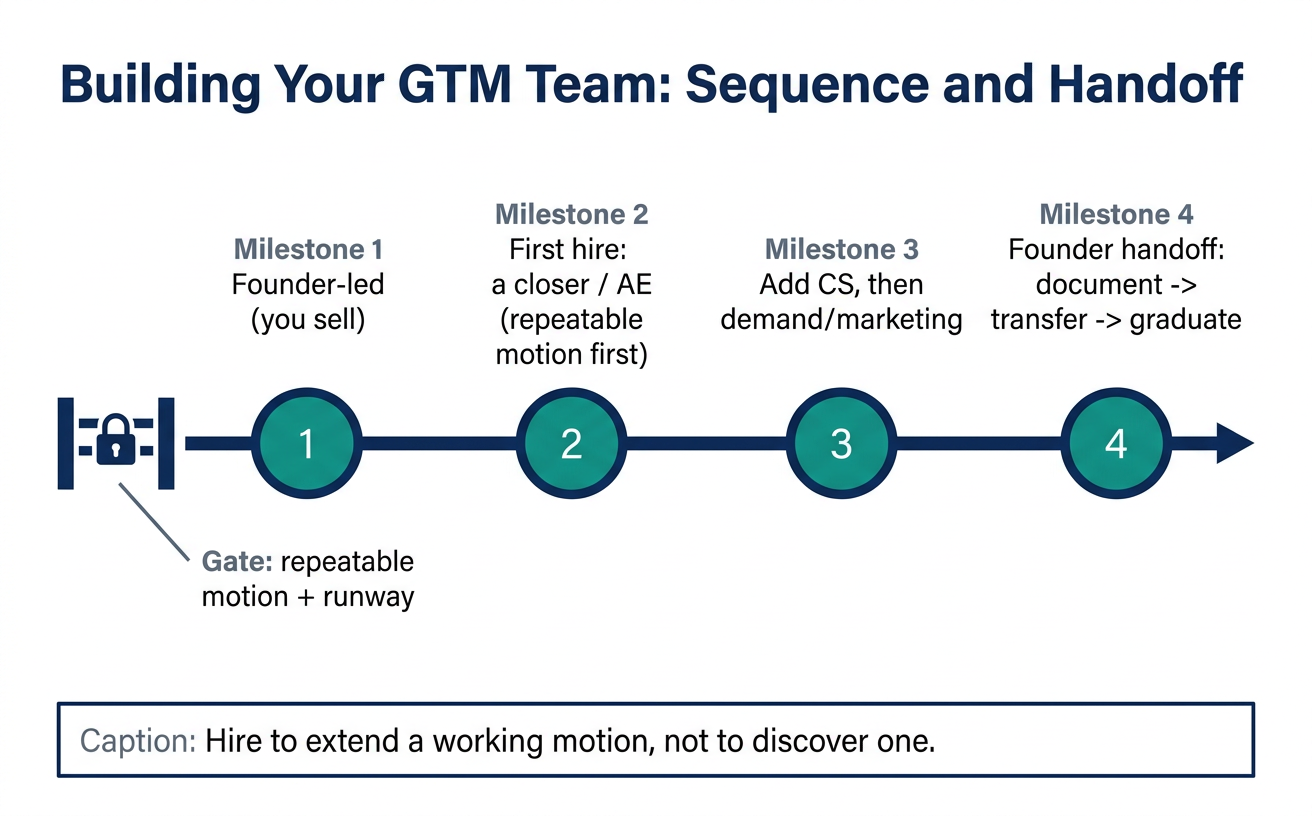
Figure 21.1: The hiring sequence and the founder handoff. Pass the four-signal gate before the first hire, document the playbook alongside it, and time each later role to the bottleneck it relieves.
You start founder-only, from zero to somewhere around $500K ARR, doing all of it yourself: prospecting, discovery, demos, closing, onboarding, even renewals. The only outside help at this stage is contractors and fractional specialists for design, copy, content, and light demand-generation experiments, the episodic work that doesn't require living inside the product every day.
The first sales hire, somewhere around $500K-$1.5M ARR (often after you have personally closed 10-30 customers), is a full-cycle AE, the founding seller. This person owns net-new revenue but does it scrappily, running their own outbound and inbound, closing, and feeding what they learn back into the motion. You don't disappear. You stay on the complex deals and you keep owning the core messaging, while the hire takes over the repeatable spine of the work. This hire should be an AE, not an SDR. Early deals need end-to-end ownership, and a meeting-booking SDR with no closer behind them produces meetings that bounce between calendars and frustrate buyers.
An SDR-first move makes sense only in the narrow case where you're a strong closer with open calendar time who can't generate enough first meetings despite a clear ICP and outbound motion.
The first customer success or onboarding hire comes around $750K-$2M ARR, and the signal is concrete: you or your AE are spending more than 40-50% of your time on onboarding and support, or churn and slow time-to-value are actively dragging on growth. This person owns time-to-value, renewals, and expansion, and builds the early onboarding playbooks and QBR rhythm. The reason CS lands this early in the sequence, ahead of marketing, is that retention compounds underneath everything else: a leaky bucket makes every later hire work harder for less, which is the whole argument of the onboarding and activation chapter.
The first marketing generalist, around $1M-$2M ARR, is a full-stack B2B marketer who owns positioning, the website, core content, early demand generation, and attribution. This often starts as agency or part-time help before it becomes a full-time hire, because before you have proof of what resonates, marketing spend is mostly guesswork.
SDRs come last, around $1.5M-$3M ARR, and only once two things are true at the same time: your ICP and talk tracks are clear, and at least one AE is reliably closing the founder and inbound pipeline. Before you add SDR headcount, look hard at whether AI outbound tooling can do the prospecting work instead, which is increasingly the case.
Founder-Type Note: If you're selling high-ACV enterprise deals rather than the $5K-$50K mid-market range this sequence assumes, your first specialist may not be a second seller at all. When your constraint is qualifying and supporting complex, multi-stakeholder deals, a sales engineer or solutions consultant alongside you can be the more valuable first hire, because the bottleneck there is technical depth in the room, not raw selling hours.
Compensation, Demystified
Founders consistently underprice or overpromise here because the numbers feel opaque, so it helps to put concrete 2025-26 US ranges on the table, with the understanding that geography, ACV, and funding move them.
The first AE or founding seller typically carries an OTE around $180K-$260K in primary markets like San Francisco and New York, lower in secondary markets, split roughly 50/50 between base and variable. Commission tends to run 10-15% of ARR closed, with accelerators around 1.5 to 2 times once they clear 110-120% of quota, and equity for the very first AE often falls in the 0.25-1.0% range. Quota usually lands at three to five times OTE, so $600K-$1M or more in ARR.
Plan for a 3-6 month ramp, with something like 50% of quota in the first three months and full productivity by months four to six. Expect 60-80% first-year attainment while the motion is still being refined; that's normal.
To make that tangible: a founding AE on a $200K OTE might carry a quota near $750K in ARR, and if they land around 70% of it in year one while you're both still sharpening the motion, they're on track, provided your CAC and LTV justify the cost of the seat.
An SDR or BDR runs an OTE around $70K-$110K, weighted more toward base at roughly 60/40 to 70/30, with the variable tied to qualified opportunities created rather than raw meetings booked, which is the distinction that keeps an SDR honest. Quota is usually 10-20 qualified opportunities a month, on a short 1-3 month ramp.
A CSM or onboarding hire typically lands around $90K-$130K total comp at 70-90% base for a pure CS role, rising toward $130K-$160K OTE if they carry a renewal or expansion quota, on a 2-3 month ramp.
What to Keep In-House, and What to Rent
The line between a full-time hire and fractional or agency help depends on the work, not on seniority: does it need daily product nuance and cultural embedding, or is it specialized and episodic?
Three roles belong in-house because they live inside the product and the customer every day: you, owning GTM strategy, the key sales conversations, and discovery; the founding AE, who has to be close enough to the product and to you for feedback to move fast; and the first CS hire, who needs deep product and workflow knowledge and high trust with customers.
The rest you can rent, especially early. A fractional CRO or CMO can give you GTM architecture, pricing and packaging help, org design, and early forecasting discipline without a full-time salary. Agencies and contractors cover performance marketing, SEO and content, conversion copy, creative, SDR-as-a-service, brand, and complex integrations. RevOps contractors can stand up your early CRM, reporting, and routing, which is the fractional-then-full-time path the operations chapter describes for ops headcount. In short, daily product nuance plus cultural embedding means full-time, while specialized and episodic means fractional or agency.
Hiring a Builder, and Ramping Them in 90 Days
The most important filter for an early GTM hire is builder versus operator. You want someone who has succeeded at a similar stage and ACV, not only someone who carried a number at a big, late-stage company with a known brand and a full marketing engine feeding them leads. The builder can both sell and design the process, runs their own experiments on sequences, decks, and ICP, shows high initiative by creating materials rather than waiting for marketing to hand them collateral, is curious about their own funnel and win-loss data, and is comfortable with ambiguity.
The people to avoid are the big-company sellers who only know brand-led inbound and the playbook-followers who need established collateral and brand before they can function, because you have neither yet.
Once you hire well, ramp deliberately over ninety days rather than expecting instant return. Before they start, share the ICP doc, the messaging, call recordings, your funnel and metrics, and the playbook even in its messy state. In the first thirty days, they immerse in the product and customers, shadow ten to twenty calls, restate your ICP, pain, and value back to you until it's clearly internalized, and start running discovery with you observing.
From days thirty-one to sixty, they own deals end-to-end on smaller accounts, you run a weekly pipeline review together, and they begin proposing changes to talk tracks, pricing, and objection handling. From sixty-one to ninety, they carry a growing share of quota and co-author updates to the playbook, while you pull back to only the high-value and complex deals. A founding AE near 50% of quota by the end of month three is on track, with full productivity expected by months four to six.
The Founder Handoff: Document, Transfer, Graduate
The handoff itself has three parts, and skipping any of them is how a good hire still fails.
First, document the playbook, ideally before or in parallel with the first hire rather than after. Write down the ICP, the use cases, and the buying committee. Capture the messaging: the problem narrative, the discovery questions, the value proposition, and your differentiation. Write the process: the CRM stages, the exit criteria for each, and the required artifacts like mutual action plans. Assemble the assets: decks, one-pagers, an ROI calculator, a proposal template. And record the objections and stories: the top ten objections with your responses, and five to ten detailed accounts of deals you won and why.
Call recording plus AI summaries make this far less painful than it used to be, automatically surfacing the patterns and objections across your real calls.
Second, transfer relationships rather than dropping them. Start with joint ownership, running calls together and introducing the AE explicitly as the main point of contact going forward. Send written introductions that frame the AE as someone with the authority to act on the account. For your most important accounts, keep a light executive-sponsor touch, a quarterly check-in, so the relationship with the founder doesn't vanish overnight.
Third, stay involved on a graduated curve. You keep ownership of the top five to ten accounts, the strategic partnerships, and pricing and packaging decisions. You run a weekly pipeline review with the AE and CS, and a monthly or quarterly retro on the playbook. Over time your role moves from primary seller to deal partner to executive sponsor. You stay in selling, but in a different shape, so that the company's growth is no longer rate-limited by your hours.
What AI Changes Here
As of 2025-26, AI lets a tiny team reach further, but you still need credible human sellers. It extends your reach in prospecting and research, enriching and building target lists. It does real outbound SDR work through AI platforms like 11x, Artisan, and Relevance that research accounts, draft bespoke emails, follow up, and book meetings. And it sharpens enablement and analytics through tools like Gong, Clari, and People.ai that surface deal risk and coaching points.
The practical implication is that you can delay a full SDR team, running founder plus first AE plus AI outbound, and a team can reach $1M-$2M or more in ARR with one AE, one CS, and AI support, especially with mid-market ACV and an inbound or product-led motion.
There's a limit, though. As of September 2026, buyers are increasingly insulated from low-quality AI spam and, partly because of that, they value a credible, consultative human more. AI improves throughput and pre-work: the research, the drafting, the note-taking. It doesn't build trust, set deal strategy, or forge consensus across a multi-stakeholder buying committee. The motion you're scaling, the one from the GTM motions chapter, still has a human at the center of every deal that matters.
Common Mistake: Pointing AI at a Message That Hasn't Been Validated
A common failure is to take an AI SDR tool, fire a hundred-plus emails a week, watch replies come back near nothing, and conclude the problem is targeting. Usually the problem is that the message itself was never validated, and the tool has sent an unproven message faster and to more people. Prove your outbound message by hand on a small batch of real deals before you let automation scale it.
Six Ways Founders Get GTM Hiring Wrong
- Handing off too early. Hiring a seller before the ICP, pricing, and objections are clear hands a stranger a problem you haven't solved yet.
- Hiring a big-company VP of Sales first. They're built to scale an existing playbook, and at your stage there isn't one yet.
- Over-rotating on a rolodex. Overpaying for a network without checking for stage and ACV fit and a builder's mindset usually buys you a name and not results.
- Under-investing in onboarding and playbooks. Expecting a hire to figure it all out, then blaming them when they can't, is a failure of your preparation, not their ability.
- Hiring SDRs before a working top-of-funnel narrative. Without a message that converts, SDRs generate activity and low-quality meetings, and the whole team gets discouraged.
- Ignoring customer success until churn hurts. By the time post-sale neglect shows up as churn, you're paying to replace revenue you could have kept.
How the Pattern Plays Out
The clearest lesson from companies that did this well is that strong B2B products often stay founder-led longer than founders expect, and then build the team around a motion that already works rather than outsourcing the discovery of that motion to a first hire.
Linear stayed extremely lean on formal sales for a long time, leaning on a product-led, founder-driven motion before layering in formal sales and customer success roles. They added the specialists around a motion that was already working. Superhuman shows the same shape from the high-touch side, with the founder personally hands-on in onboarding and sales for the first thousands of users, learning the discovery and activation patterns directly before introducing scalable GTM roles. In both cases the founder did the hard, unglamorous work of making the motion real first, and only then hired people to carry it.
Don't Hire Yet If You Can't Pass the Gate
The simplest way to use this chapter is as a sequence of gates rather than a shopping list. If you can't pass the four-signal readiness checklist, don't hire a full-time seller yet; stay founder-led, use fractional help where you need a specific skill, and go finish finding the motion. If you can pass it, then write the playbook first, hire a builder rather than a manager or a playbook-follower, ramp them deliberately over ninety days, and graduate your own role from primary seller to deal partner to executive sponsor.
Your first GTM hire is one step in a system that also includes the motion you're scaling, the operations that make it legible, and the customer success that keeps the revenue you win. Skip the gate and you'll repeat the same failed hire with new faces, losing cash and time each cycle. Respect it, and you free yourself for the work only a founder can do, while a small, well-built team runs the rest of go-to-market.
Sources
[1] https://hsbcinnovationbanking.com (building your early GTM function) [2] https://highalpha.com/blog/how-early-stage-founders-build-winning-gtm-teams [3] https://elefanterevops.com/blog/go-to-market-plan [4] https://youtube.com/watch?v=o4DQdjqkeE4 (buyers value human interaction) [5] https://clearout.io/blog/b2b-gtm-execution [6] https://unboundb2b.com/blog/go-to-market-strategy-2026 [7] https://effiqs.com/resources/b2b-saas-gtm-strategy-2026 [8] https://amplifyscales.com/solutions/b2b-startups-founders