
Chapter 12: Maintaining Momentum: Building Sustainable Habits
Habits form through repetition in a stable context: in Lally and colleagues' study of people building a new daily habit, reaching automaticity took a median of 66 days, with individual times ranging from 18 to 254 [1]. Burnout among founders is common:
| Burnout Metric | Percentage | Description |
|---|---|---|
| Past Year Burnout | 54% | Founders who experienced burnout in the past year [2] |
| High Stress | 83% | Founders reporting high stress in the past year [2] |
| Anxiety | 75% | Founders reporting anxiety [2] |
| Poor Mental Health | 46% | Founders rating their mental health as "bad" or "very bad" [2] |
One survey cited by researchers at Lehigh University found 87% of founders reporting anxiety, depression, or burnout, or all three [3]: people running companies and meeting objectives while suffering psychologically. Exhaustion also hurts the selling itself: in a Baylor University study of 123 B2B salespeople and their managers, emotional exhaustion made unethical sales behavior more likely, and unethical behavior lowered sales performance [4].
For founders and small teams without a large organization to share the load, the strain builds faster. As Chapter 1's identity-threat framework showed, selling conflicts with your builder identity, and that strain grows with every rejection until, without sustainable systems, it becomes burnout.
Many founders stall a few months in, after the early enthusiasm has worn off and acquisition has turned into routine maintenance. Long-term success depends mostly on continuing when you don't feel like it.
Relapse Is Normal (And Recovery Is What Matters)
You will have bad weeks. You'll skip your routine, let your pipeline go cold, fall off the wagon for days. That's normal. What separates founders who build sustainable businesses from those who burn out is how fast they recover.
Case Study (composite, relapse and recovery): A marketing consultant had a perfect rhythm until her father got sick and acquisition stopped for two weeks. She returned feeling "everything is ruined," but instead of catching up in a burst, she resumed where she'd left off. Three prospects had responded during the pause; one became a client. The pause itself did little damage; what would have hurt was a week of paralysis or a frantic catch-up binge, and she avoided both.
The relapse-recovery framework: Expect relapse. Illness, emergencies, and transitions will interrupt your rhythm, so plan for it. When they do, resume rather than restart: you don't start from zero, since contacts stay warm and infrastructure stays. After a break, do one thing (one follow-up, one call), because momentum builds from small actions. And skip the shame spiral; beating yourself up only delays recovery. Aim for a quick return: a founder who maintains 80% consistency over two years outperforms one who maintains 100% for three months before burning out.
The Motivation Myth
Motivation is unreliable (great weeks where everything clicks, terrible weeks where nothing works), and inconsistency kills pipelines. So build systems that work when you're not motivated, and move from "I'll do acquisition when I'm motivated" to "I do acquisition because it's Tuesday."
The Sustainable Rhythm
The systems that last run on a fixed rhythm. A rhythm means less time deciding and reacting and more time executing. You don't decide each morning whether to brush your teeth; the decision is already made. Acquisition needs the same treatment.
The Daily Rhythm
The daily level needs activities small enough to finish in 30 minutes, even on your worst days. The "Morning 30" approach: before email, Slack, or product work, spend exactly 30 minutes on acquisition (not "as long as it takes"). Pick from a short menu: a few personalized messages, a handful of follow-ups, some engagement with target accounts, and replies to inbound. Most days you won't do all four. Thirty minutes daily beats four hours once a week, and daily contact keeps the pipeline from going cold.
Case Study: GummySearch's 10-Minute Daily Routine. Fed, the solo founder of GummySearch, marketed it with a short daily routine: "By setting up proper keyword tracking using GummySearch, I can market for just 10 minutes a day by responding to relevant conversations on Reddit. It has proven to be an incredible ROI on marketing time spent" [5]. The product grew to more than 135,000 founders, marketers, and investors before winding down in 2025, when GummySearch could not agree on a commercial license for Reddit's data API [6]. The case shows two things: a small daily rhythm compounds, and a business built on one platform's API depends on that platform's decisions.
The Weekly Rhythm
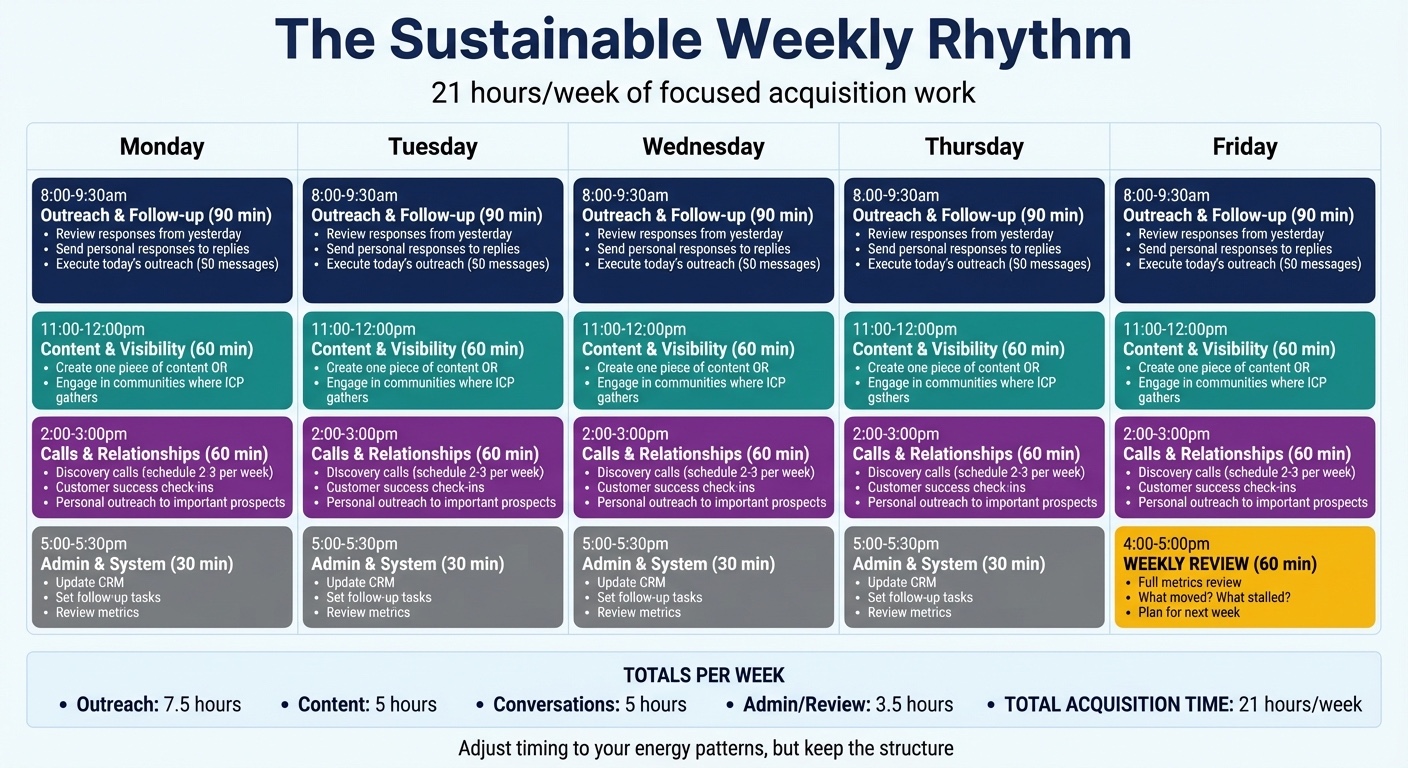
Figure 12.1: The Sustainable Weekly Rhythm. This framework shows how daily, weekly, and monthly activities stack into a sustainable system. The "Morning 30" daily block, "Pipeline Friday" weekly review, and "First of Month" strategic assessment create consistent momentum without burning out.
The weekly rhythm handles what doesn't fit into a 30-minute block. The "Pipeline Friday" approach: every Friday afternoon, spend 60-90 minutes reviewing every active opportunity, updating stages, flagging stuck deals, planning next week, and reviewing metrics. Start with Chapter 8's 15-minute numbers check, then spend the rest of the block on deals. This keeps deals from slipping. Pick a day and protect it. On a small team, this is where a rep or first GTM hire co-owns the pipeline so the playbook doesn't live only in your head.
The Monthly Rhythm
The "First of Month" review: calculate last month's metrics, compare against prior months to spot trends, identify what's working, adjust sparingly, and set targets. Without this review, you can spend three months on a failing strategy before you notice.
Protecting Your Acquisition Time
Rhythms only work if protected. Founders face constant time pressure (product, support, admin), and it's easy to let acquisition slide. But everything else in your business depends on having customers.
The calendar block. Put acquisition time on your calendar as an immovable appointment, not "try to prospect in the morning" but "Acquisition Block 8:00-8:30 AM." Treat it like a meeting with your most important customer; you wouldn't cancel that for an admin task. Then signal you're unavailable: close email and Slack, put your phone in another room, tell family you're in a work block. Eliminate the interruptions that give you an excuse to stop early.
The "Bad Day" Protocol
You'll have days when you can't do the full routine. Plan a "minimum viable acquisition day" (MVA) that takes 10 minutes: one follow-up email, one comment on a prospect's content, one pipeline update. The value is symbolic rather than productive: you're telling yourself acquisition matters even when everything else is falling apart, so the streak continues and you can return to the full routine as soon as you're able. (One founder kept the habit alive during a family emergency with three emails from a hotel lobby, and was back to his full routine within a week.)
Managing Energy, Not Just Time
Not all hours are equal. In a program described in Harvard Business Review, Wachovia Bank employees trained to manage their energy (regular breaks, sleep, doing their most demanding work at their best times) outperformed a control group on financial metrics such as loans generated [7]. Schedule acquisition during your high-energy windows. For many people that means mornings, but test it on yourself: the popular "ego depletion" explanation of willpower running down has not held up in large replication attempts [8]. "Morning 30" is the default; if your energy peaks later, move the block there and keep it fixed.
Energy Replenishment
You also have to replenish energy. Sleep, movement, and real breaks (away from screens) directly affect your capacity for work that demands resilience.
Case Study (composite): When the System Breaks You. A consultant ran 60+ hour weeks for 7 months with no real breaks. Results were good ($180K), but warning signs (dreading calls, avoiding follow-ups, quality slipping) culminated in a month-8 panic attack on a client call. His recovery protocol: 40-hour weeks, one day off weekly, quarterly 5-day breaks. He dropped from 12 to 8 clients per 6 months, but client satisfaction rose from 7.8 to 9.2 out of 10, referrals rose from 1 to 4 over a comparable stretch, and higher rates on fewer clients kept revenue roughly flat. The bigger result: he was still in business.
Staying Connected to Purpose
Mechanics alone won't sustain you through the hard stretches. You also need to stay connected to why you're doing this. The reasons founders start (freedom, impact, income) fade during the daily grind. When acquisition feels pointless, trace the why chain: emails → calls → customers → revenue → the life you're building. And spend time with current customers: real conversations about how they use what you built. Their results remind you that every prospect is a person you can help.
Building in Accountability
Founder-led businesses often lack a boss checking whether you hit targets. That's freedom, but also risk, since without external accountability standards slip.
The accountability partner. Find someone who will hold you to your commitments (another founder, a coach, a mastermind group) and won't accept your excuses. Share weekly targets, report results, and call each other out when you fall short. Some founders make targets public for added pressure, though that can create anxiety. On a small team, a weekly standup serves the same function. Your metrics dashboard (Chapter 8) is self-accountability too: track numbers weekly and you can't lie to yourself about the work.
The Isolation Factor
Isolation and blurred boundaries both raise the risk. In the Lehigh-led study of 308 entrepreneurs, those with access to mentors and emotional support were 50% more likely to report higher resilience, and those who didn't keep work/non-work boundaries were nearly three times as likely to report high burnout (67% versus 23%) [3]. That support doesn't have to come from a cofounder. It can be anyone who understands what you're building and can offer perspective when you're too deep in the weeds.
Preventing Burnout
Burnout happens when you push too hard for too long without recovery, and founders are vulnerable because there's no one to tell them to slow down. The warning signs: dreading activities you used to enjoy; declining outreach quality; shorter temper on calls; difficulty focusing; persistent fatigue or sleep problems. If you notice these, you need more recovery.
Sustainable pace. Figure out the pace you can maintain indefinitely, which is slower than your sprint pace. Most people can work 60-hour weeks for a month; almost no one can for a year. Be honest about your number, then defend it, and build recovery in as a requirement: daily breaks between work blocks, one full day off weekly, longer quarterly breaks, and annual vacations with no email.
Practical Tools for Sustainability
Automation That Preserves Authenticity
Use automation to remove the friction that makes consistency hard, and keep the personal work for yourself. Automate: email warmup (Instantly, Smartlead), follow-up sequences, stale-deal reminders, and data enrichment. Don't automate: the first outreach message, discovery calls, and relationship building. Automated "checking in" feels hollow. The test: would the recipient know it's automated? If so, you've gone too far.
The "Systems Not Goals" Mindset
A goal says "I want 10 new customers this quarter"; a system says "Every weekday I send 10 personalized emails and follow up with 5 prospects." The goal depends on factors outside your control; the system runs regardless, and if you run it consistently, it usually hits the goal. Justin Welsh, who has written about passing $10 million in total revenue as a one-person business [9], describes his days the same way: the same core behaviors on a schedule, with automation handling the repetitive work. He doesn't decide what to work on each morning; the schedule already says.
The Weekly Planning Ritual
At the end of Pipeline Friday, spend 15 minutes planning the week ahead: What three outcomes would make it successful? What activities will drive them? When will I do them? Write it on a single index card and keep it on your desk all week. Keep it simple enough that you'll use it.
When Results Don't Match Effort
The hardest sustainability challenge comes when you're doing everything right and still not seeing results. Acquisition involves factors outside your control: market conditions, competition, ICP shifts, luck. Most founders give up too early, concluding "cold email doesn't work" on insufficient data; real patterns take months to emerge. Persisting without adjusting is stubbornness, though, so diagnose the problem and adjust before you continue.
The diagnostic questions. When results lag effort, answer these with data, not intuition: Is my volume sufficient (fifty emails a month won't generate meaningful data)? Is my targeting accurate (wrong ICP defeats even perfect execution)? Is my message resonating (low response rates suggest it isn't landing)? Is my timing off (some markets are seasonal)? Is the channel wrong (after enough testing, it's reasonable to shift)?
Then make one change at a time. Change targeting, messaging, and channel at once and you won't know which mattered. Change one variable, run it 2-4 weeks, evaluate, then decide on the next.
The Long Game
Customer acquisition takes years. The relationships, reputation, and skills you build compound over that time.
Compound Effects
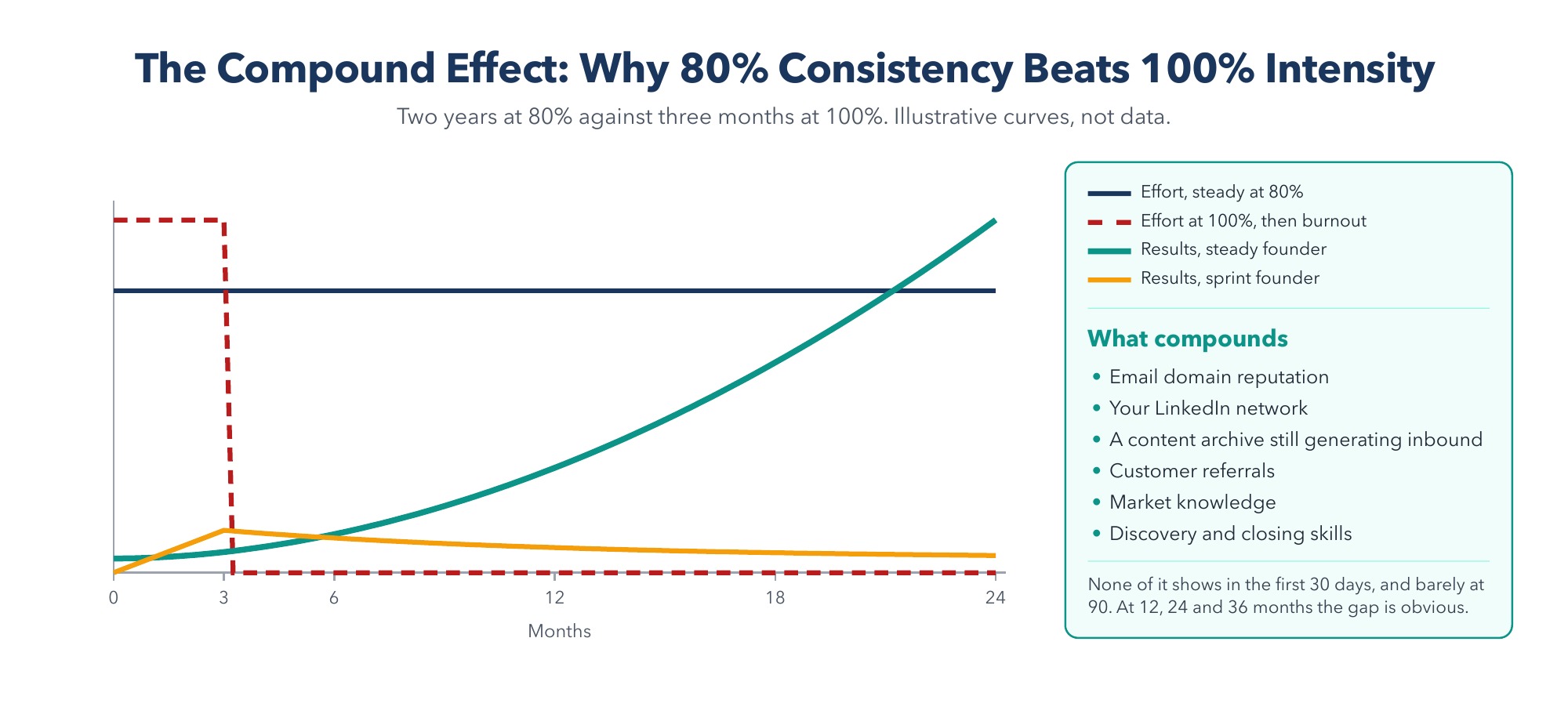
Figure 12.2: The Compound Effect. Why 80% consistency beats 100% intensity. Email domain reputation, LinkedIn network, content archive, customer referrals, market knowledge, and skills all compound over time, but only if you stay in the game.
Email domain reputation, your LinkedIn network, an archive of content still generating inbound, customer referrals, market knowledge, and your skills at discovery and closing all compound. None are visible in the first 30 days, barely at 90, but at 12, 24, 36 months the gap between consistent and inconsistent founders becomes obvious.
Playing Infinite Games
Philosopher James P. Carse distinguished finite from infinite games [10]. A finite game has an end point: someone wins, the game ends. An infinite game has no end point; the goal is to keep playing. Customer acquisition is infinite: as long as you run a business, you need customers, so the aim is to stay in the game.
Why Big-Team Advice Doesn't Transfer
Most advice about sales momentum comes from contexts that don't match yours. Sales managers: "Your reps should make 100 calls a day," but you're also the product, support, and accounting person. VC-backed founders: "We had SDRs doing outbound while I focused on strategy," but you don't have SDRs. Corporate training: "Keep your pipeline full," which is true, but assumes a marketing team generating leads and ops maintaining the CRM.
The challenge for founders and small teams is structurally different. Large orgs distribute the work: when one person is exhausted, others carry the load. You have far less buffer. The founders who burn out are often the ones who tried to run a big-team playbook alone; the ones who last accept that they need an approach built for one person or a few, which is more than a smaller version of the big-team one.
AI as Sales Memory
When you're energized, you remember everything: a prospect's worry about Q2 budget, that they tried Competitor X and hated the onboarding. When you're depleted, that context evaporates and you show up to a follow-up blank. AI can serve as your external sales memory.
Automated capture. Fireflies, Otter.ai, and Fathom auto-transcribe calls and extract insights; CRMs with built-in AI (Attio, HubSpot) and enrichment tools like Clay create summaries and surface relationship context. On low-energy days these maintain continuity for you. Or paste a conversation into an AI with "What does this person care about? What should I remember next time?" and get a profile you can review in two minutes.
Pattern recognition. After a dozen conversations, ask "What objections keep coming up?" The AI surfaces what you'd miss ("Four of your last six prospects mentioned 'implementation complexity'"), and many CRM platforms now build this into their dashboards.
None of this replaces the human work; the discovery call is still a conversation between two people. What AI does is keep the burden of remembering every detail across dozens of relationships from crushing you during the inevitable hard weeks.
Chapter Summary: TL;DR
The core insight: Motivation fades, so build systems you can keep running. The founders still acquiring customers years from now will be the ones who built systems they could maintain, more than the ones who worked hardest.
Key takeaways:
- 54% of founders experienced burnout last year; 87% report anxiety, depression, or burnout (or all three)
- Founders with mentors are 50% more likely to report higher resilience; those without work-life boundaries are nearly 3x as likely to report high burnout
- Habits take a median of 66 days to become automatic (range 18-254), not the mythical 21
- Energy management beats time management: do high-stakes work at peak energy
- Rhythms beat willpower: decide once, then execute
- Relapse is normal; recovery speed matters more than perfect streaks
- 80% consistency over two years beats 100% for three months followed by burnout
Next chapter: Chapter 13 brings everything together: creating your personal acquisition playbook that integrates all the frameworks from this book.
The Exercise: Design Your Sustainable System
Before moving on, design your personal sustainability system:
- Rhythms: What 30-minute daily block, what weekly pipeline-review slot, and what monthly strategic-review time will you protect?
- Protect your time: How will you signal you're unavailable, and what's your "minimum viable acquisition day" for bad days?
- Energy: When are you at peak energy, and what recovery practices will you build in?
- Accountability: Who will hold you accountable, and how often will you report?
- Purpose: Finish "I'm doing customer acquisition because…" and schedule a monthly check-in with a current customer.
- Sustainable pace: How many hours per week can you work indefinitely, and what are your burnout warning signs?
Write these down, share them with your accountability partner, and review them monthly.
Chapter Checklist
Before moving to Chapter 13, complete:
- Defined your minimum viable daily rhythm (the baseline you can maintain indefinitely)
- Identified your peak energy hours for high-stakes activities
- Set up weekly and monthly review cadences
- Established accountability (partner, public commitment, or structured review)
- Identified your support network (mentor, peer group, or community) to combat isolation
- Documented your burnout warning signs and recovery protocol
- Defined clear work-life boundaries (when work ends, what's off-limits)
- Created your relapse recovery plan (what to do when you fall off)
Self-assessment questions:
- Am I building a system I can maintain for years, or sprinting toward burnout?
- Do I know my sustainable capacity versus my maximum capacity?
- Have I scheduled recovery, or am I hoping it happens naturally?
- What's my plan for when (not if) I fall off the wagon?
[1] Lally, P., van Jaarsveld, C. H. M., Potts, H. W. W., and Wardle, J., "How are habits formed: Modelling habit formation in the real world," European Journal of Social Psychology 40(6), 2010, pp. 998-1009. https://doi.org/10.1002/ejsp.674
[2] Sifted, "More than half of founders experienced burnout last year," February 2025. https://sifted.eu/articles/founders-mental-health-2025. Survey of 138 founders.
[3] "We studied entrepreneurs' well-being," Fortune, September 12, 2025 (Lehigh University with the Nasdaq Entrepreneurial Center and TU Dortmund; 308 entrepreneurs). https://fortune.com/2025/09/12/we-studied-entrepreneurs-burnout-anxious-depressed-wellbeing/. The 87% figure is quoted there from an earlier survey.
[4] Lussier, B., Hartmann, N. N., and Bolander, W., "Effects of Emotional Exhaustion on Ethical Behavior," Keller Center Research Report, Baylor University, March 2021. https://kellercenter.hankamer.baylor.edu/news/story/2021/effects-emotional-exhaustion-ethical-behavior
[5] Famewall, "How Fed built a successful business with GummySearch." https://famewall.io/en/blog/how-fed-built-a-successful-business-with-gummysearch/
[6] GummySearch, "The Final Chapter for GummySearch." https://gummysearch.com/final-chapter/
[7] Schwartz, T., and McCarthy, C., "Manage Your Energy, Not Your Time," Harvard Business Review, October 2007. https://hbr.org/2007/10/manage-your-energy-not-your-time
[8] Hagger, M. S., et al., "A Multilab Preregistered Replication of the Ego-Depletion Effect," Perspectives on Psychological Science 11(4), 2016, pp. 546-573. https://doi.org/10.1177/1745691616652873
[9] Welsh, J., "My complete $10M journey (all 23 steps)," June 2025. https://justinwelsh.me/essays/my-10m-journey
[10] Carse, J. P., Finite and Infinite Games, Free Press, 1986.