
Chapter 14: The Future of Customer Acquisition: Getting Found When Search Changes Everything
In Chapters 3-5, you learned outreach, discovery, and closing. In Chapter 6, you built retention and referrals. But those chapters didn't address one thing: every prospect researches you before responding.
They'll Google your name, ask ChatGPT about your company, and check that you're legitimate before booking a call. What they find affects whether your outreach works. If AI systems describe you as a recognized expert, your cold emails land differently. The founder whose name appears when prospects research their problem has a structural advantage over the founder who doesn't.
Search itself is also changing. In SparkToro's 2024 study, 58.5% of US Google searches already ended without a click on any result (a "zero-click" search) [1], and on queries that show an AI Overview, Similarweb data compiled by Click-Vision puts the zero-click rate around 83%, against about 60% for queries without one [2].
When an AI Overview appears, organic click-through drops: Ahrefs measured a 34.5% lower click-through rate for the #1 result [3], and Seer Interactive found organic CTR on informational queries with AI Overviews fell from 1.76% in June 2024 to 0.61% by September 2025 [4]. Google's AI Mode, a fully conversational search tab, has existed since 2025, and in January 2026 Google made Gemini 3 the default model for AI Overviews and let people move from an AI Overview straight into an AI Mode conversation [5].
Even SEO leaders are exposed: third-party tools estimated HubSpot's organic traffic fell sharply at the end of 2024, with analysts reporting blog-traffic drops of 70% or more [6]. Gartner predicted in 2024 that traditional search-engine volume would fall 25% by 2026 as people shift to AI chatbots and virtual agents [9].
The goal has moved from getting the click to getting cited. This chapter shows you how to get cited, as a solo founder or a small team without a brand department, PR firm, or ad budget.
The work has three layers, in order: (1) Performance: if your site doesn't load, nothing else matters; (2) Technical SEO: if engines can't crawl or index you, they can't show you; (3) AEO (Answer Engine Optimization): if AI can't understand and cite you, you lose the zero-click search. This chapter builds all three without requiring you to become a full-time developer.
The Zero-Click Reality
For about twenty years, content marketing worked like this: create content, rank, and receive traffic. That no longer works the way it did. More than half of all searches are now satisfied on the results page itself: featured snippets, knowledge panels, AI Overviews. If people get answers without visiting your site, traditional content marketing weakens. But AI systems still need sources to cite. If you become one of those sources, you get mentioned in the answer whether anyone clicks through or not.
What Answer Engine Optimization Is
Traditional SEO optimizes for rankings: appear high on a list of links with a compelling title, and the user decides what to click. Answer Engine Optimization (AEO; see Appendix: Glossary) optimizes for citation: AI synthesizes one answer from multiple sources, and the user often never sees the sources, or sees them only as small citations. Your goal becomes being a source the AI trusts and quotes. ChatGPT Search, Perplexity, Claude, and Google AI Mode are growing fast.
Google AI Mode is different from AI Overviews, which sit atop traditional results and still show the familiar blue links. AI Mode is a conversational interface with no traditional results, only AI answers with citations in a sidebar. Powered by Gemini, it uses "query fan-out" (up to 16 simultaneous searches) to synthesize answers [10][11]. Only 53% of domains cited in AI Mode match Google's traditional top 10, and just 35% show exact URL overlap [11]. Ranking well no longer guarantees visibility.
AI Mode is Google's bet on conversational, personalized search that handles follow-up questions. When a prospect uses it to research you or your category, they read one synthesized answer instead of scanning a list of links, and either you're in that answer or they don't see you. The same AEO principles still apply (schema, structured content, original data, topical authority), with higher stakes. And AI Mode can now use opt-in Gmail/Photos data for personalized answers [12], which makes the public content everyone else sees (your site, LinkedIn, schema) more important as the baseline.
Why This Matters for Founders and Small Teams
If you do outbound and LinkedIn, search may seem beside the point. It matters because of the founder constraint from earlier chapters. You don't have a brand team building awareness, a PR department managing reputation, or budget to win on paid ads. What you have is expertise, content, and the ability to be findable when prospects look. AEO turns those into visibility.
It also reuses everything you've already built. Your Chapter 2 ICP work (the intersection of who you can help, who will pay, and who's a joy to work with) tells you which topics to own. Your Chapter 3 outreach content becomes raw material for citation. Your discovery frameworks (Chapters 4-5) become named methodologies AI can reference. Your Chapter 6 retention case studies become the proof points that establish authority. (On a small team, this is also your most valuable shared asset: one well-built authority footprint works for every rep, and it doesn't leave when a rep does.)
- B2B founders: When a prospect asks AI "What's the best [category] tool for [use case]?", you want to be named. In Forrester's 2025 buyer survey, 94% of B2B buyers used AI in their buying process [15], and in Gartner's 2025 survey 67% preferred a rep-free buying experience [16]. Buyers are also comfortable buying without talking to anyone: in McKinsey's late-2021 survey, most B2B decision-makers said they would make large purchases through remote or self-serve channels [17], and at founder price points the bar is far lower.
- Creator founders: When someone asks "Who should I learn [topic] from?", you want your name to appear. What AI says about you does some of your selling for you.
The Dual Entity Problem
AI systems do more than rank pages; they try to understand entities (people, companies, products, concepts). For founders that creates the dual-entity problem: you need authority for both yourself (the person) and your offering (the product/service).
For the person, AI looks for consistent information across platforms (LinkedIn, X, website, podcast appearances), credentials and experience markers, content that demonstrates expertise, and references from other authoritative sources. Ask AI "Who is [your name]?" right now. If it returns nothing useful, you have an entity problem: you exist in the real world but not in AI's model of it.
For the offering, AI looks for a clear description of what you provide, comparisons to alternatives, reviews and testimonials from trusted sources, and documentation. When someone asks "What is [your product]?" your offering should surface in the relevant answer.
| Focus | B2B Founder | Creator Founder |
|---|---|---|
| Primary entity | The product/company | The person |
| Validation sources | G2, Capterra, integration partners, docs | Social profiles, podcasts, books, newsletters |
| Target questions | "Best [category] for [use case]?" | "Who is [name] and are they legit?" |
Both need topical authority: better to be the obvious expert on a small topic than a minor voice on a broad one.
The Technical Foundation
Getting cited requires technical signals that establish trust.
For non-developers: The code below is optional. You can add meta tags and schema via plugins (Yoast, Rank Math) or your CMS with no coding required. The concepts matter more than the syntax.
Traditional SEO basics still apply. AI systems often train on search results. Every core page needs a unique, keyword-aware <title> (under 60 characters), a human-written <meta name="description"> (under 160 characters), a <link rel="canonical"> to prevent duplicate-content issues, and Open Graph / Twitter Card tags so links preview well when shared. These let engines understand and rank you, and AI references those results.
Schema markup is code that tells AI explicitly what your content is. Without it, AI has to guess; with it, AI knows: "This is a Person," "This is an FAQ," "This is a Product." The types that matter most for founders: Person (you, with credentials and social profiles), FAQPage (authoritative answers to specific questions), Product (your offering's attributes), and Organization (your business as a recognized entity). You don't need to hand-code it: Schema.org generators and the plugins available for most modern CMS platforms produce the JSON-LD for you.
Content structure matters because models read predictably. They weight the beginning heavily and look for clear structure. The 2026 principles:
- Answer-first: Put the direct, quotable answer at the top for AI extraction rather than burying it. Not "In this article we'll explore…" but "Cold email still works for founders when the list is tight and the first line is specific." Lead with the statement that answers the implied question.
- Entity clarity: AI assistants prioritize clear entity definitions. Define your brand, name, and key concepts consistently across platforms; use schema to link Person → Organization → Product.
- Question-formatted headers: H2s as questions ("How do you reduce CAC?") with the answer in the next paragraph. This mirrors how AI training data is structured and increases extraction probability.
- Lists and tables: These are easier to extract than long prose.
- Specific data: AI systems look for citable facts, and they can't make up your original data. Publishing even modest research creates citation opportunities.
One founder restructured several existing blog posts along these lines and saw them start appearing in AI answers within weeks. The content was the same; the structure made it machine-readable.
A Real Example: Graph Schema. AI uses schema best when entities are linked in a graph: Organization → founder (Person) → author of Course and Book, with an FAQPage answering common questions. Using @id to connect them builds E-E-A-T. AI sees who you are, what you offer, and how they relate. Below is an illustrative graph for a founder-led business like SoloFrameHub (my company; GTM OS is its platform, where this book's course lives; see Chapter 15). Replace the details with your own.
<script type="application/ld+json">
{
  "@context": "https://schema.org",
  "@graph": [
    {
      "@type": "Organization",
      "@id": "https://soloframehub.com/#organization",
      "name": "SoloFrameHub",
      "url": "https://soloframehub.com",
      "founder": { "@id": "https://soloframehub.com/#founder" },
      "sameAs": ["https://www.linkedin.com/in/mikejsullivan/", "https://x.com/soloframehub"]
    },
    {
      "@type": "Person",
      "@id": "https://soloframehub.com/#founder",
      "name": "Mike Sullivan",
      "description": "Founder, author, and go-to-market strategist for solo and semi-technical founders.",
      "url": "https://soloframehub.com/about",
      "sameAs": ["https://www.linkedin.com/in/mikejsullivan/", "https://x.com/soloframehub"]
    },
    {
      "@type": "Course",
      "@id": "https://soloframehub.com/academy#course",
      "name": "GTM OS",
      "provider": { "@id": "https://soloframehub.com/#organization" },
      "author": { "@id": "https://soloframehub.com/#founder" }
    },
    {
      "@type": "FAQPage",
      "@id": "https://soloframehub.com/academy#faq",
      "mainEntity": [
        {
          "@type": "Question",
          "name": "Who is this for?",
          "acceptedAnswer": { "@type": "Answer", "text": "Solo technical founders and small teams who need a sales engine without a sales department: high-leverage systems, not high-volume burnout." }
        },
        {
          "@type": "Question",
          "name": "Do I need sales experience?",
          "acceptedAnswer": { "@type": "Answer", "text": "No. Sales here is a system, not a personality trait: scripts, templates, and AI workflows replace the need for sales extroversion." }
        }
      ]
    }
  ]
}
</script>
When someone asks Perplexity or ChatGPT "Who created SoloFrameHub and is it worth it?", the AI sees the Person linked to the Course and the FAQ answering "Who is this for?", and can cite you with confidence because you provided the map. Start with Organization + Person (linked via @id) plus one content type and an FAQPage; it takes 30-60 minutes and persists for years. Validate with the Google Rich Results Test.
Site performance is both an SEO signal and a crawl-budget issue. Google's Core Web Vitals (LCP, CLS, INP) are ranking signals, and AI crawlers (OpenAI's OAI-SearchBot, Googlebot) have limited resources. Slow, heavy sites get crawled less and indexed less often. When I built SoloFrameHub.com, designed on Aura.build and hosted on Hostinger, the initial PageSpeed score was 70; after four rounds of AI-assisted optimization (self-hosted WOFF2 fonts with font-display: swap, WebP images with explicit dimensions, Brotli compression, no external CDN), it hit 98 on mobile and 100 on desktop. Page speed is fixable without hiring a developer.
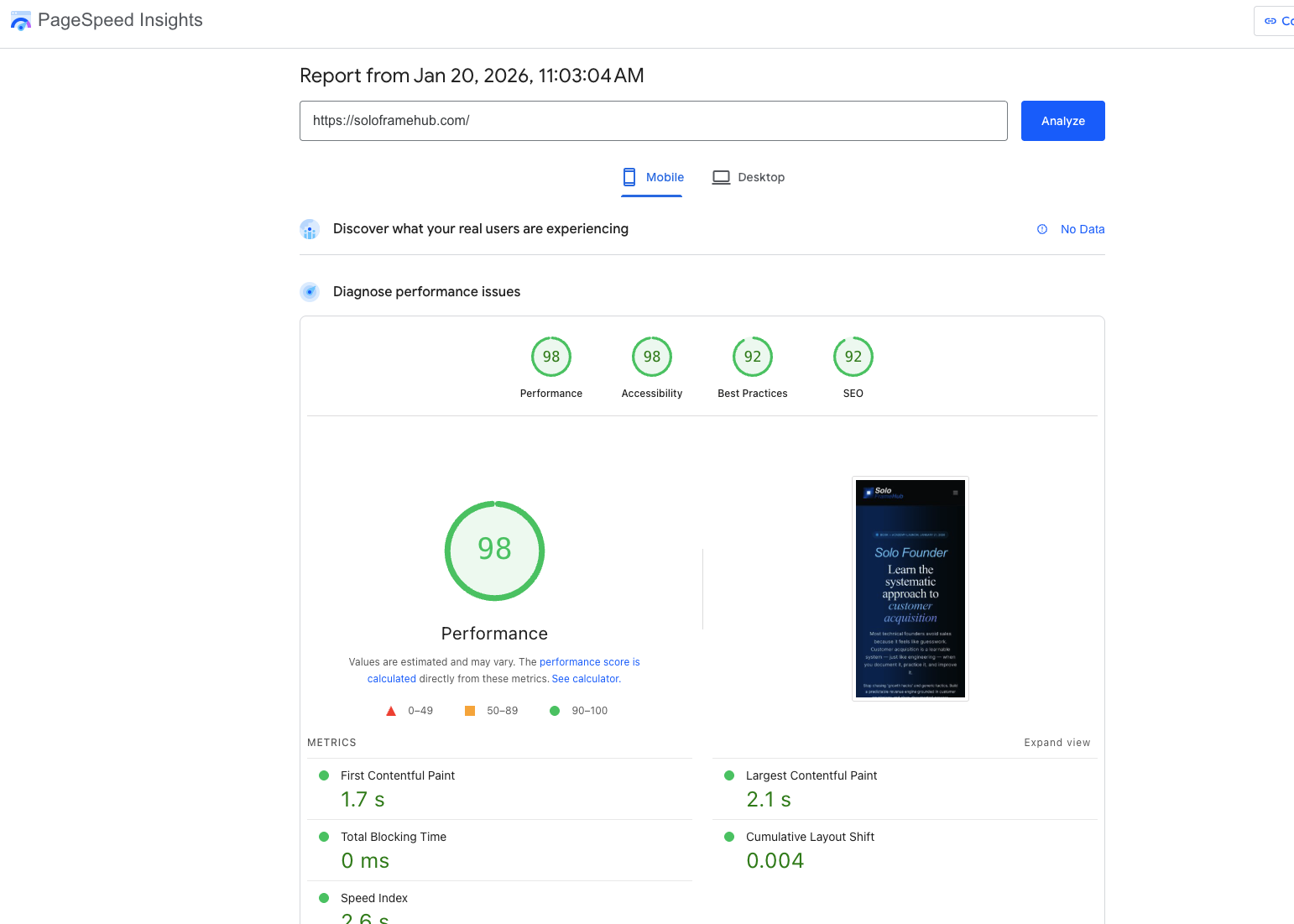
Figure 14.1: PageSpeed Insights for SoloFrameHub.com after optimization. Mobile: Performance 98, Accessibility 98, Best Practices 92, SEO 92.
Your website is the source of record: the canonical version of your expertise that engines and AI point back to. At minimum, host: an Offer page per core offer (written in the diagnosis-first language you use on discovery calls); a Results/Proof hub of case studies and testimonials you can link from outreach and social; a living Resources section for frameworks, benchmarks, and tools too dynamic for a book; a credibility-driven Founder page (who you help and why your approach works, not a generic bio); and topic hubs around your niche problems with internal links that give models the "map" of your expertise.
A rule of thumb for what belongs on-site first: anything highly changeable (tool screenshots, setups), heavily linkable (checklists, templates, calculators), or too long-form for the book (full case studies, extended essays). The goal: when someone searches your name, offer, or specialty, they land on pages you control, not random social posts.
For technical founders: building with a modern stack (Astro, Next.js, static HTML + Tailwind) gives AEO advantages over traditional CMS. You add JSON-LD programmatically without plugins; static sites ship minimal code and skip the database queries that slow page load; tools like Claude Code or Cursor update schema, add pages, and restructure content in minutes rather than hours of clicking through a WordPress admin; and you avoid the plugin tax of running 5-10 add-ons for SEO, schema, caching, and performance, each adding maintenance and conflict risk. The tradeoff is higher initial setup, but for founders already comfortable with code the long-term efficiency compounds as AI coding tools improve.
Getting indexed tells engines you exist, so don't wait to be found. AI systems inherit from traditional search indexes. ChatGPT Search (launched October 2024 from the SearchGPT prototype, now on all tiers [13]) uses Bing's index plus OpenAI's OAI-SearchBot; Perplexity runs PerplexityBot and lets Pro users submit URLs and publish indexable Perplexity Pages [14]; Claude draws from Brave among others; Google's AI Overviews and AI Mode use Google's index. So getting indexed in Google and Bing covers most AI citation; Perplexity and Brave are worth a separate check.
| Search Engine | Global Share | Why It Matters for AEO |
|---|---|---|
| ~90% | Primary training source for most AI; powers AI Overviews + AI Mode | |
| Bing | ~4-5% | Powers ChatGPT Search and Yahoo results |
| DuckDuckGo / Yahoo | ~2% | Use Bing's index |
| Brave | <1% | Used by Claude's web search, among other sources |
The steps: (1) Google Search Console (search.google.com/search-console): add your site, verify via a meta tag in your <head> (fastest for most founders) or a DNS record (a domain property covers all subdomains), then submit your sitemap.xml; the Pages report shows what got indexed in 2-3 days. (2) Bing Webmaster Tools (bing.com/webmasters): if GSC is set up, use the one-click import to pull verification and sitemap automatically; Bing matters because it powers ChatGPT Search. (3) IndexNow: Bing's open protocol that pings engines instantly on publish; enable it if your platform supports it (Cloudflare, Wix, WordPress via Yoast/RankMath), or ping the API manually.
A sitemap is an XML list of your URLs with lastmod dates. Most frameworks (Next.js, Astro, WordPress) auto-generate it, so you rarely write it by hand.
There's no "ChatGPT Search Console" or "Perplexity Webmaster Tools" yet, so map the coverage instead: ChatGPT Search appears via Bing's index; Google AI Mode and AI Overviews via Google's (though AI Mode selects sources differently, so ranking well doesn't guarantee citation); Perplexity via its own crawl, with Pro users able to submit URLs and publish Pages; Claude via Brave, which has its own webmaster tools at search.brave.com/webmasters if you want to verify there. In practice, Google and Bing indexing covers most of it. Total time: 30-60 minutes, then it runs automatically.
Building Citation Worthiness
The technical work makes you findable. To get quoted, you need content worth citing.
- Original research. AI can't make up data it doesn't have. Publish a benchmarks report or survey (even from your own customers or sending data) and you become a source AI can cite. This needs no research budget: survey your email list, analyze your own data, publish specific numbers that don't exist elsewhere. One solo founder's simple report on cold-email subject-line response rates gets cited constantly because few sources have original, specific numbers.
- Proprietary frameworks. Naming a method builds entity recognition. Name your own approach the way this book names MVQ (Minimum Viable Qualification), the one-page acquisition system, and the 90-day commitment, and you own the term; when someone asks about it, AI is likely to cite you as the source. The named frameworks in this book were designed partly with this in mind: specific, referenceable approaches rather than generic advice.
- Comprehensive resources. A blog post says you said something once; a book or course establishes you as worth listening to on an entire topic, and AI weights comprehensive structured resources more heavily. This book exists partly for that reason: content marketing at book scale that no volume of LinkedIn posts could match. Deep expertise in a narrow domain plus a book or course moves you from "someone who talks about X" to "the person who wrote the book on X."
- Citation networks. AI trusts sources that other trusted sources cite. Mentions on Reddit, in newsletters, on podcasts, and in guest posts compound; each reinforces your entity.
The Generational Shift
How different generations use AI search changes how you optimize. Gen Z (born roughly 1997-2012) shows very high AI usage: Resume.org found that 77% of Gen Z workers who use ChatGPT use it for job tasks [7], and in another survey six in ten Gen Z workers said they talk to AI as much as or more than their coworkers [8]. Many treat AI as the starting point for product discovery and decisions. If AI doesn't mention you, much of this audience won't find you. Millennials (born roughly 1981-1996) triangulate: they check AI, then Google, then Reddit to verify, so consistency across sources matters most. Gen X and older still lean on traditional search, but increasingly hit AI Overviews in Google results without realizing it, so traditional SEO still matters, even as AI reshapes what those results show.
Measuring AI Visibility
Traditional metrics don't capture AI visibility, so track these instead:
- Share of Model: when AI answers questions in your domain, how often are you mentioned or cited? It's an emerging metric. Tools like ZipTie.dev, Keyword.com, and Relixir track your appearance in ChatGPT, Perplexity, and AI Overview answers for specific queries.
- AI referral tracking: AI traffic often shows up as "direct" because referral headers aren't passed correctly. In GA4, add custom filters for perplexity.ai, chatgpt.com, and claude.ai. Actual volume is usually higher than the default reports suggest.
- Citation audits: regularly ask AI systems the questions your customers ask, and note who appears instead of you. This manual check surfaces the gaps: if competitors show up and you don't, you have work to do.
Tools by Stage
Beyond the foundation, you need keyword research and content optimization, scaled to your stage.
- Free (start here, $0-5K MRR): Google Search Console (your source of truth for queries and indexing), Ahrefs Webmaster Tools (free site audits for sites you own), Answer Socrates (what questions people ask around a topic).
- Budget (roughly $20-60/mo, from about $5K MRR if you publish weekly): Mangools/KWFinder or KeySearch for keyword research; Neuronwriter for content optimization, the solo founder's alternative to Surfer and Clearscope, with comparable NLP analysis at a fraction of the price and a BYOK option that uses your own OpenAI key for near-free generation.
- Professional ($100+/mo, when content is your primary channel): Surfer SEO, Ahrefs, or Semrush. You rarely need more than one. Prices change often; check current plans before you commit.
The rule: at $0-5K MRR use free tools (GSC + Answer Socrates + manual competitor checks is enough to start); at $5-10K, add Neuronwriter or Mangools if you publish weekly; above $10K with content as a core channel, Ahrefs Lite pays for itself in gap analysis. The feature that matters most for cost is Neuronwriter's BYOK: instead of paying per-article AI fees you pay OpenAI API costs directly, typically $0.01-0.10 per article, which alone justifies the subscription if you're producing real volume (site, course, newsletter).
Real Implementation Examples
Pieter Levels, Nomad List. Levels built it solo: city pages with structured data (each location an indexable entity with cost-of-living, internet-speed, safety scores AI can extract); tools built on his data (Hoodmaps, comparisons) that generate citations naturally, engineering as marketing; proprietary data that doesn't exist elsewhere; and a build-in-public history that reinforced his entity everywhere. He runs these largely by himself and publishes his revenue openly (Chapter 7). Ask AI "best cities for remote work" and his properties appear because they're the definitive data source.
Justin Welsh, creator authority. Welsh has written about passing $10 million in total revenue as a one-person business built on organic LinkedIn and X, not ads (Chapter 12). His signals: person-entity dominance (large LinkedIn and X followings, a newsletter, courses, podcasts); named frameworks ("The Saturday Solopreneur," "Content OS") that AI attributes to him; weekly original-insight posts AI can't synthesize elsewhere; and published operating-system breakdowns that become reference material. Ask ChatGPT "How do I build a solopreneur business?" and he appears consistently, so buyers arrive pre-sold.
Deivy H., from "I can build it" to "How do I get anyone to find it?" I met Deivy at a language exchange in Bogotá. He introduced himself as an AI engineer, and when I told him I build AI products, he asked: "What do you do once you build the product?" That question is the problem this book is about. For technical founders, building is often the comfortable part. The harder work starts afterward: positioning, distribution, demand generation, sales, and learning what the market responds to.
Deivy became an early GTM OS user, worked through the SEO and AEO material, and applied it to his own website. The next time we met, he was excited about the results he was getting compared with what he had been doing before. In his words: "Building the product is only part of the challenge. Distribution is where most of the work begins. GTM OS has helped me understand that side of the business, especially SEO and AEO."
The numbers are small, and I include them because they are real. His Google Analytics for the last 90 days showed 95 active users, 94 of them new, with a spike in mid-August. Among sessions with a known source, Google sent 11 and ChatGPT sent 10. An AI assistant was already a referral channel almost equal to search. When I asked what he would have done without the system, his answer was blunt: keep "wasting a lot of money on Meta ads."
His story is early, and that is why I include it: it isn't a polished case study reconstructed after the fact. It shows the loop this book is built on (learn what the problem in front of you requires, execute it, measure what the market does, refine, and run the next iteration) in the hands of a technical founder moving from builder mode into market mode. He started with "What do you do once you build the product?" Now he's doing it.
Common Mistakes
- Optimizing for AI at the expense of humans: content still needs human readers, or engagement signals suffer.
- Focusing only on ChatGPT: Perplexity, Claude, and AI Overviews matter too; optimize for cross-system principles (clear structure, original data, authority).
- Expecting immediate results: AI updates its knowledge periodically; treat AEO as a long-term investment.
- Neglecting the human citation network: if you're not in podcasts and newsletters, you're missing the signals that train AI's authority assessments.
- Ignoring existing content: many founders chase new AEO-optimized pages while their existing library stays unoptimized. Restructure and add schema to your best-performing existing pages first; that's often faster than creating new ones from scratch.
- Optimizing only for the 10 blue links: AI Mode has no traditional results, and only 53% of its cited domains match the traditional top 10 [11]. Ranking well is no longer enough.
The Content Shift
AEO changes what to create. Less valuable: generic "What is X?" definitions AI summarizes easily; listicles without insight; keyword-coverage content. Generic "How to X" tutorials are especially exposed, because AI answers them without sending traffic. More valuable: original data and research; unique frameworks; personal experience and case studies; detailed technical documentation, content AI can't synthesize because the source data doesn't exist elsewhere. This favors founders: you can't match content farms on volume, but your specific failures and wins are material AI can't invent.
This maps to Google's E-E-A-T framework (Experience, Expertise, Authoritativeness, Trustworthiness), which originally guided human quality raters and now influences AI's source selection. Experience: AI prefers sources that have done the thing. "I tried this and here's what happened" beats generic advice from someone with no evident track record, so document yours publicly. Expertise: narrow depth over broad coverage. Better to be recognized for "cold email for B2B SaaS founders" than for "marketing."
Authoritativeness: recognition from others. Get on podcasts, write guest posts, get quoted in industry publications. Trustworthiness: accuracy and transparency over time. Don't make claims you can't support, cite your sources, be honest about limitations. Trust builds or erodes with every piece you publish.
The Practical Playbook
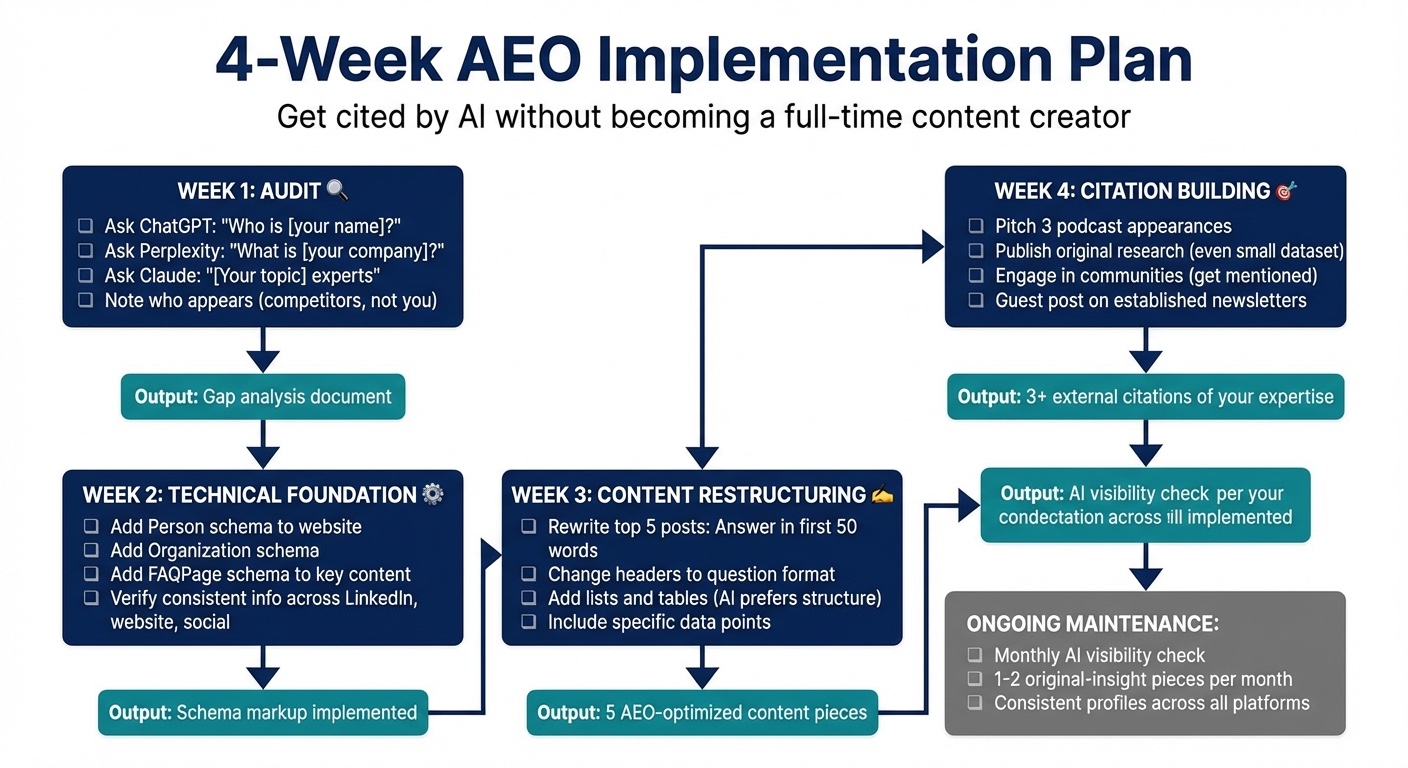
Figure 14.2: The 4-Week AEO Implementation Plan: Week 1 audit & performance, Week 2 indexing, Week 3 schema, Week 4 content & citation.
- Week 1, Audit & performance: Run PageSpeed Insights and fix red flags. Give every core page a unique title and meta description. Ask ChatGPT, Perplexity, and Claude questions in your domain; note who appears and where you're absent.
- Week 2, Indexing: Set up Google Search Console and Bing Webmaster Tools; submit your sitemap to both (Bing powers ChatGPT Search). Fix coverage errors. Enable IndexNow if supported.
- Week 3, Schema: Implement graph schema (Organization + Person linked via
@id, plus Course/Product and FAQPage) using the template above. Validate with the Rich Results Test. Ensure consistency across LinkedIn, website, and socials. - Week 4, Content & citation: Rewrite your top 5 pages' intros to be answer-first (direct answer in the first 50 words); add lists/tables and specific data. Publish one piece of original research. Pitch three podcasts or communities.
- Ongoing: Track AI mentions monthly; publish 1-2 original-insight pieces per month; keep all public profiles consistent.
AEO is ongoing work: AI systems keep updating what they know about the web, so your visibility depends on continued signals.
Chapter Summary: TL;DR
Core insight: In the AI era, being found requires a three-layer stack: Performance (slow sites get crawled less), Technical SEO (submit sitemaps to Google and Bing), and AEO (structured data + answer-first content so AI can cite you). Gartner predicted traditional search volume would fall 25% by 2026 as people turn to AI [9].
Key takeaways:
- Build in order: Performance → indexing → schema/AEO.
- Most searches already end without a click: 58.5% in 2024, and above 80% on queries with an AI Overview [1][2].
- Google AI Mode has no blue links; if it doesn't cite you, searchers don't see you [10][11].
- Bing powers ChatGPT Search, so submit your sitemap there too.
- Schema should be a graph: link Organization, Person, and Course/Product with
@idfor E-E-A-T. - Answer-first content and FAQ schema help AI extract and cite you.
Next chapter: Chapter 15 covers community-led growth and social proof: credibility through real participation.
The Exercise: Your AEO Baseline
Before implementing anything, establish your baseline:
- Ask AI about yourself in ChatGPT, Perplexity, and Claude. What appears? Is it accurate and useful?
- Ask AI about your domain: the questions your customers ask. Who appears? Are you there?
- Check entity consistency across LinkedIn, website, and profiles. Inconsistency confuses AI.
- Audit content structure: do key pages answer the question in the first 50 words?
- Identify your data gap: what original data could you publish that doesn't exist elsewhere?
Document your findings to measure progress as you implement the playbook.
Chapter Checklist
Before Chapter 15:
- Validated site speed (green Core Web Vitals in PageSpeed Insights)
- Submitted sitemaps to Google Search Console and Bing Webmaster Tools
- Implemented graph schema (Organization + Person + Course/Product via
@id) - Validated schema with the Google Rich Results Test
- Audited top pages for answer-first structure
- Set up monthly AI-citation monitoring
Self-assessment:
- Does my site load quickly on mobile? (Crawl-budget issue for AI.)
- Does my schema link me (Person/author) to my brand and offerings?
- Am I using FAQ schema to own answers to common questions?
- Is my content structured for AI extraction (lists, tables, clear answers)?
- Am I monitoring whether AI cites me?
[1] Fishkin, R., "2024 Zero-Click Search Study," SparkToro, July 2024. https://sparktoro.com/blog/2024-zero-click-search-study-for-every-1000-us-google-searches-only-374-clicks-go-to-the-open-web-in-the-eu-its-360/
[2] Click-Vision, "Zero Click Search Statistics," 2025 (a compilation of third-party data; the AI Overview figures are Similarweb's). https://click-vision.com/zero-click-search-statistics
[3] Ahrefs, "AI Overviews Reduce Clicks by 34.5%," 2025. https://ahrefs.com/blog/ai-overviews-reduce-clicks/
[4] Seer Interactive, "AIO Impact on Google CTR: September 2025 Update." https://www.seerinteractive.com/insights/aio-impact-on-google-ctr-september-2025-update. 3,119 informational queries across 42 organizations, June 2024 to September 2025.
[5] Google, "AI Mode in Google Search and AI Overviews get Gemini upgrades," January 27, 2026. https://blog.google/products-and-platforms/products/search/ai-mode-ai-overviews-updates/
[6] Search Engine Land, "HubSpot's SEO collapse: What went wrong and why?" 2025. https://searchengineland.com/hubspot-seo-organic-traffic-drop-451096. Traffic figures are third-party estimates (Semrush, Ahrefs), not HubSpot's own.
[7] Resume.org. (2025). Majority of Gen Z Workers Use ChatGPT to Slack Off at Work. Survey reports 77% of Gen Z workers use ChatGPT for job tasks. https://www.resume.org/majority-of-gen-z-workers-use-chatgpt-to-slack-off-at-work/
[8] AllWork. (2025). Six in Ten Gen Z Workers Talk to AI More Than Coworkers. Reports 60% of Gen Z talk to AI as much or more than coworkers. https://allwork.space/2025/10/six-in-ten-gen-z-workers-talk-to-ai-more-than-coworkers/
[9] Gartner. (2024, February 19). Gartner predicts search engine volume will drop 25% by 2026 due to AI chatbots. https://www.gartner.com/en/newsroom/press-releases/2024-02-19-gartner-predicts-search-engine-volume-will-drop-25-percent-by-2026-due-to-ai-chatbots-and-other-virtual-agents
[10] SEO.com. (2025). Google AI Mode: What SEOs Need to Know Before 2026. https://www.seo.com/ai/google-ai-mode/
[11] Semrush. (2026). Google AI Mode: What It Is and How It Works. Reports 53% domain overlap with traditional top 10; query fan-out. https://www.semrush.com/blog/google-ai-mode/
[12] PhoneArena. (2026, January 22). Google Search's AI Mode just got a new superpower involving your personal info. https://www.phonearena.com/news/google-searchs-ai-mode-just-got-a-new-superpower-and-it-involves-your-personal-info_id177628
[13] Search Engine Land. (2024, October 31). ChatGPT search officially launches. Reports on ChatGPT Search launch and SearchGPT prototype evolution. https://searchengineland.com/chatgpt-search-officially-launches-447919
[14] Perplexity. (2024). Perplexity Pages. Allows Pro users to create and publish shareable content for indexing. https://www.perplexity.ai/hub/blog/perplexity-pages
[15] Forrester, "B2B Buyers Make Zero-Click Buying Number One," January 2026 (Buyers' Journey Survey, 2025). https://www.forrester.com/blogs/b2b_buyers_make_zero_click_buying_number_one/
[16] Gartner, "Gartner Sales Survey Finds 67% of B2B Buyers Prefer a Rep-Free Experience," March 9, 2026 (646 B2B buyers surveyed August-September 2025). https://www.gartner.com/en/newsroom/press-releases/2026-03-09-gartner-sales-survey-finds-67-percent-of-b2b-buyers-prefer-a-rep-free-experience
[17] McKinsey & Company, "B2B sales: Omnichannel everywhere, every time," December 15, 2021 (B2B Pulse survey). https://www.mckinsey.com/capabilities/growth-marketing-and-sales/our-insights/b2b-sales-omnichannel-everywhere-every-time