
Chapter 6: After the Sale: Retention, Referrals, and Growing Revenue
Depending on the study and the industry, acquiring a new customer costs anywhere from 5 to 25 times more than retaining one, and Bain & Company research by Frederick Reichheld found that a 5% increase in retention can raise profits by 25% to 95% [1].
Most founders still treat what happens after the sale as an afterthought. For founders and small teams without dedicated customer-success staff, the math is even more lopsided: you can't outspend competitors on acquisition, but you can pay closer attention to your existing customers than they do. A customer who stays, expands, or refers adds revenue without added acquisition cost, which makes the retention flywheel one of the best places to spend your time.
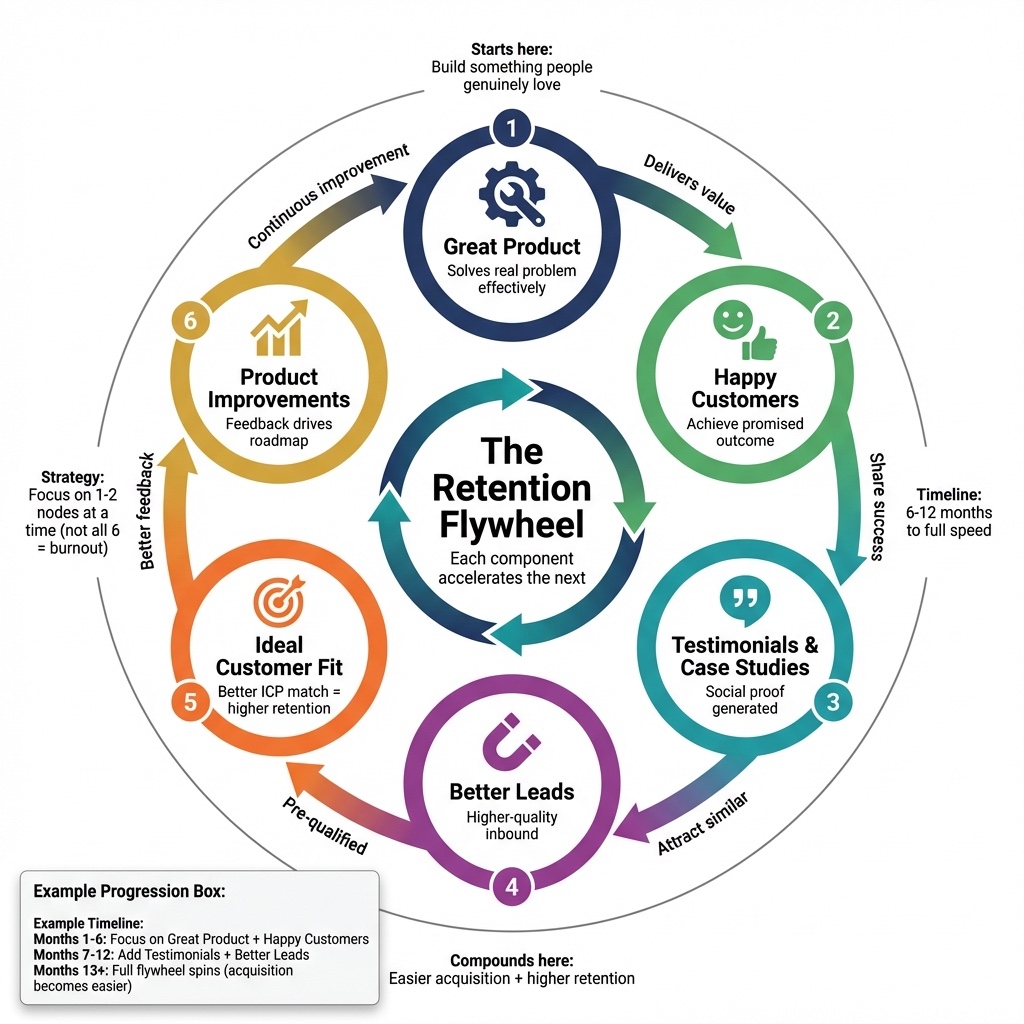
Figure 6.1: The Retention Flywheel. Great Product → Happy Customers → Testimonials & Proof → Better Leads → Ideal Customer Fit → Product Improvements → back to Great Product. Each component accelerates the next, creating compounding growth. Focus on 1-2 nodes at a time.
This chapter covers what happens after someone says yes: onboarding well, keeping customers successful, expanding revenue from existing accounts, and turning happy customers into salespeople.
The Economics of Retention
Three metrics matter most.
LTV:CAC ratio (see Appendix: Glossary) measures lifetime value against acquisition cost. The most common benchmark is 3:1: at least three dollars earned for every dollar spent acquiring a customer [2]. Below 3:1, you're spending too much on acquisition, charging too little, or losing customers too quickly.
Net Revenue Retention (NRR; see Appendix: Glossary) measures revenue from existing customers over time, including expansions, contractions, and churn. NRR above 100% means existing customers are worth more this year than last. In SaaS Capital's 2025 survey of private SaaS companies, median NRR was 101% (104% for bootstrapped companies), and products with lower contract values retained less revenue than higher-priced ones [3]. Elite companies grow revenue even if they stop acquiring.
Churn is the percentage of customers (logo churn) or revenue (revenue churn) you lose in a period. In the same survey, median gross revenue retention was 91%: the typical company lost about 9% of its revenue each year before any upsells, and SaaS Capital treats 90% as the floor for keeping pace with peers [3]. For benchmark ranges by segment, see Chapter 8.
Founder-Type Note: Retention metrics differ by business model. B2B SaaS founders focus on churn, LTV:CAC, and NRR. For coaches and creators, "retention" means repeat purchases, upsells, and referrals. A customer who buys a $500 course, then a $2,000 group program, then refers three friends has much higher lifetime value than one who buys once and disappears. The principle (retention is cheaper than acquisition) applies to everyone; only the measurement differs.
Onboarding: The First 48 Hours
Customers are most engaged right after purchase, and most likely to churn if they don't see value fast. Customers who reach their first "success moment" quickly are far more likely to stay, which is why time-to-value is one of the metrics product teams watch most closely. The same applies to courses and coaching: if someone buys and doesn't engage within two days, the odds they ever finish drop sharply.
Case Study (composite, B2B SaaS): A founder selling analytics tools found customers who completed core setup within 24 hours had 67% 6-month retention versus 23% for those who took 7+ days. He added a step-by-step wizard and pre-populated sample data to deliver a first insight in under 15 minutes; 6-month retention rose from 34% to 58%.
Case Study (composite, creator): A creator selling a $497 LinkedIn marketing course found students who completed Module 1 within 48 hours had 72% completion versus 18% for those who took 7+ days. She added an immediate welcome video, a Module 1 that delivered a result in under 2 hours, and daily check-ins during the first week; completion rose from 28% to 61%.
For B2B products: Welcome email within minutes; clear next steps; a quick win in their first session; a check-in at 24-48 hours ("Did you hit [first milestone]?").
For creator products: Completion rates for self-paced online courses are famously low: across 221 free online courses (MOOCs), the median completion rate was 12.6% [4]. Paid courses face the same problem, and the fix is engagement. Front-load value and build momentum: a welcome video; a Module 1 that delivers a tangible win instead of theory; daily emails during the first week; and a community or accountability mechanism for social pressure.
For coaching programs, set up structure from the start: a kickoff call, clear expectations, a first homework assignment immediately (before they can procrastinate), and a check-in mechanism (email, Slack, Voxer) from day one.
The "Implementation Intent" Question. Ask: "When specifically are you going to work on this?" Research on implementation intentions ("I'll work on Module 2 on Tuesday at 7 a.m.") backs this up: a meta-analysis of 94 studies found that if-then plans like this had a medium-to-large effect on reaching the goal, compared with good intentions alone [5]. Get them to commit to a specific time, put it on their calendar, and send a reminder.
Health Scoring: Knowing Who Needs Attention
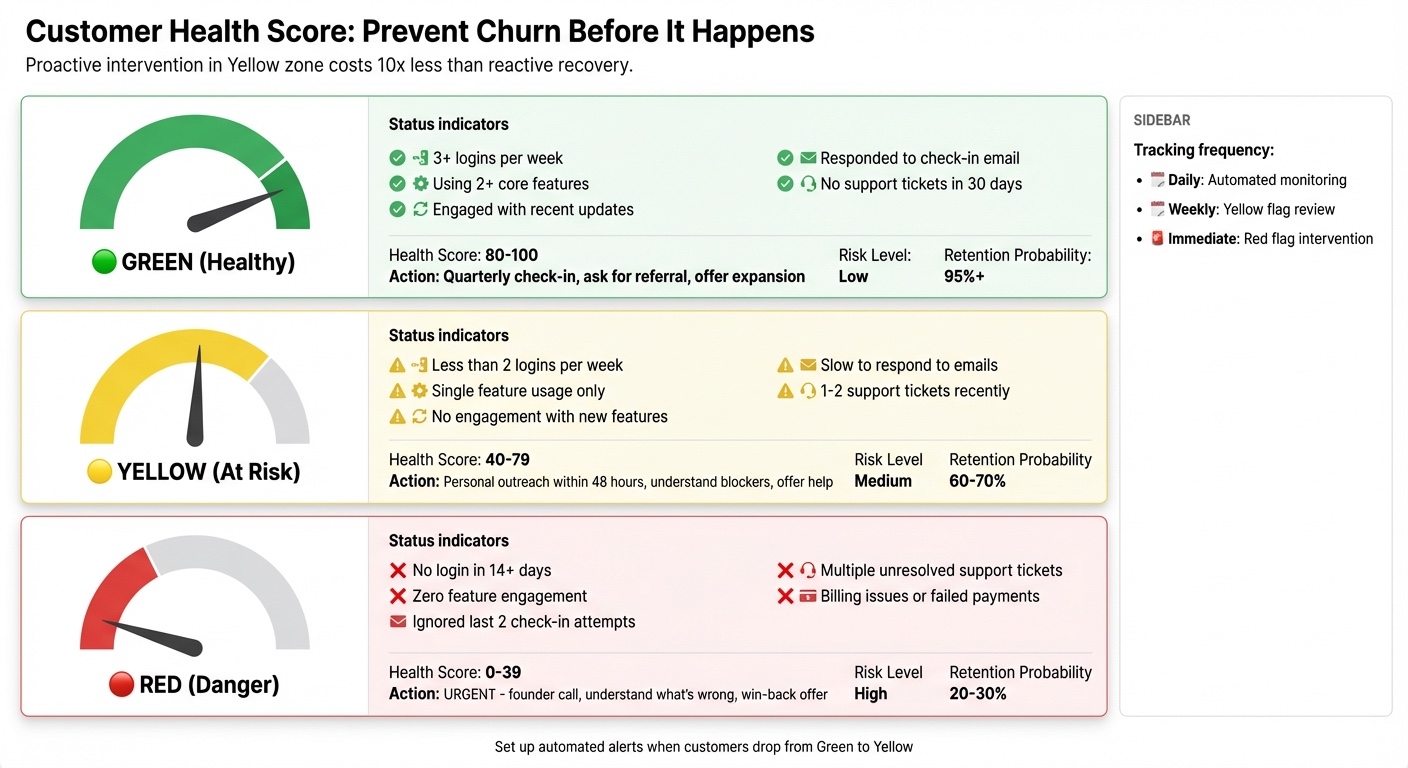
Figure 6.2: Customer Health Score Framework. Scores of 75-100 indicate healthy customers ready for expansion; 40-74 means at-risk; below 40 requires immediate intervention.
You don't need an elaborate enterprise health score, only a way to know who's at risk and who's thriving.
The Founder Health Score. Track four factors in a spreadsheet or Airtable:
- Usage (50% weight): Login frequency, core action completion, active seats (B2B) or course progress, module completion, coaching attendance (creators). More than 7 days of inactivity is a red signal.
- Sentiment (20%): Support ticket tone (B2B) or community engagement and direct feedback (creators).
- Financial (20%): Payment reliability, recent upgrades or downgrades. Failed payments are a red signal.
- Engagement (10%): Email opens, community participation, feature adoption.
The Traffic Light System makes the score actionable:
- Green (75-100): Healthy. A candidate for referrals, case studies, or expansion; focus on growth opportunities.
- Yellow (40-74): At risk. Schedule a check-in within 1-2 weeks and trigger automated nurture.
- Red (0-39): Churn imminent. Reach out personally, immediately.
The tooling can stay basic. Use Zapier to feed Stripe and product-analytics data into an Airtable base; a formula field calculates the score, and an automation fires a Slack alert when a key account drops into "Red." This "management by exception" approach keeps your time on the interventions that matter most. Review weekly for high-touch products, monthly for low-touch.
The "Absence of Signal" Paradox. A quiet customer is often a warning sign. A customer with zero support tickets may have failed to adopt, not succeeded; one who hasn't logged in for 30 days is higher risk than one submitting feature requests. Count "time since last contact" inside the Engagement factor: the longer the silence, the lower the score.
Yellow Zone Outreach. When a customer shows warning signs (reduced usage, missed sessions, unanswered emails), don't wait until they cancel. A short message works: "I noticed you haven't logged in for a while. Everything okay? Anything I can help with?" It comes across as concern, and sometimes you'll surface a problem you can fix. That you noticed matters more than the exact wording.
Track Wins, Not Just Problems. When a customer achieves something meaningful (completes a module, closes their first deal with your methodology), acknowledge it, automated ("You're ahead of 80% of customers at this stage") or personal. These moments are also good times to ask for testimonials, referrals, or the next offer.
Preventing Churn: The Exit Interview
Some customers will leave despite your best efforts. Learn from every departure.
When someone cancels, ask: What prompted this? What could we have done differently? Would you recommend us despite leaving? Is there anything that would bring you back? Most people tell the truth if the question is sincere.
Common reasons for churn: they never got started (an onboarding problem); they got what they needed (consider a next step to offer); their situation changed (often nothing you could do); the product didn't work for them (wrong fit or a real product issue); or they found a better alternative (learn what the competitor did better). Track these. If 60% of cancellations are "never got started," put your effort into onboarding; if 40% are "found a better alternative," study your competitors.
Service Recovery Paradox. Customers whose problems get resolved well can end up more satisfied than those who never had a problem. A meta-analysis found the effect holds for satisfaction but not reliably for repurchase or word of mouth [6], so treat a great recovery as damage control, not a growth strategy. When something goes wrong: acknowledge it immediately, take responsibility, fix it faster than expected, and follow up to confirm. A founder whose team caused a significant implementation problem owned it personally, fixed it over a weekend, and followed up daily until stable. That client stayed, and in this case even became a reference, but don't count on that outcome; count on keeping the account.
Expansion Revenue: Growing Without New Customers
Selling to an existing customer who already trusts you is far easier than winning a stranger, and you can watch usage to know when to try: a customer approaching a plan limit, or inviting colleagues who then become active, is signaling readiness to expand. If you focus only on new acquisition, you leave that revenue uncollected.
Timing note: Expansion only matters once you have customers to expand. If you're pre-revenue or have only a handful of customers, focus on acquisition and exceptional results. Expansion becomes relevant once you have 10+ customers, and only after you've proven you can keep them happy.
For B2B products, expansion comes from seat expansion, usage expansion, tier upgrades, and add-on products. Make it feel natural rather than pushy. Usage-based pricing does this automatically: usage gates feel like success ("you're growing so fast you need more capacity"), while feature gates feel punitive. When someone hits 80% of a limit, send a helpful email: "You're using 80% of your monthly credits. Great progress! Here's how to upgrade." Make it frictionless: one click, no sales call.
B2B example (composite): A SaaS founder selling project-management software landed a single user at a design agency, who later invited two colleagues and hit collaboration limits. Instead of a generic prompt, he sent a personal note: "Saw your team is growing. Congrats! Happy to show you the team-plan features." That led to a 3x expansion, and six months later the customer introduced him to two similar agencies.
For creator products, the "backend offer" is where most of the revenue comes from. A $500-course buyer is pre-qualified for your $3,000 group program; a group-program graduate is a candidate for your $5,000 mastermind. The frontend offer partly exists to identify people ready for the backend. Not everyone buys the next tier, but those who do account for most of your lifetime value.
Present the next offer right after they post a win: "Two clients in three weeks. Amazing! You'd be perfect for my group coaching program where we go deeper on scaling. Quick call?" One coach turned a $497-course buyer into a $2,000 program member, raising that customer's lifetime value to about $2,500; the three colleagues she later referred brought total revenue traced to her to over $6,000.
An offer that continues progress the customer has already made doesn't feel like a hard sell. They buy because they trust you and got results.
Referrals: Your Best Acquisition Channel
Referred customers arrive already trusting you, because someone they trust vouched for you. Double-sided programs (rewarding both referrer and referee) are the common default because they give both people a reason to act, but most founders leave referrals to chance instead of systematizing them.
The Referral Timing Principle. Don't ask randomly. Ask right after the customer gets value: a milestone, a specific result, a posted win, a renewal or upgrade. A request then feels natural; one sent two weeks after a frustrating support ticket feels tone-deaf.
Simple Referral Structures. You don't need a complex affiliate system. For B2B, use "Give $50, Get $50": both parties get a credit when a referred customer signs up. For creators, try "Unlock the bonus module by referring one friend"; exclusive content sometimes works better than cash. Tools like Rewardful integrate with Stripe and track automatically; at small scale, a spreadsheet and manual credits work fine.
Asking for Referrals. Most founders never ask. After a positive interaction, say: "I'm glad this worked for you. Do you know anyone else who might benefit? I'd love an introduction." Specificity matters: "Do you know any early-stage SaaS founders struggling with customer acquisition?" gives them a person to picture, where "anyone who might benefit?" is too vague.
Building Advocates: Your Unofficial Sales Team
Beyond one-off referrals, some customers become advocates: people who promote you without being asked.
The Client Advisory Board (When You're Ready). With fewer than 10 paying customers, skip this and serve the ones you have. Once you have 10+, pick your 5-10 best and invite them into a private group: "I'm planning my roadmap for next quarter. I want your input before anyone else." They get a sense of ownership over your product's direction; you get direct access to your most engaged users and a steady source of testimonials and referrals. The investment is small: a quarterly call and occasional swag. For creators, the equivalent is a private Slack or WhatsApp "Inner Circle" with early access to new content.
Testimonials That Work. Generic testimonials ("Great product!") do little; specific ones convert. Good ones include the problem the customer had before, the result they achieved, the quantified impact (time saved, revenue gained), and why they chose you over alternatives. Prompt for that specificity directly. Video testimonials are stronger still, because they are harder to fake and more emotionally engaging.
Where to Display Social Proof. Don't hide testimonials on a page nobody visits. Put them on your home page near the call-to-action, in sales emails matched to likely objections, and on your pricing page.
The "Anti-Testimonial." Another option is the balanced review, a testimonial that acknowledges limitations: "The onboarding took longer than I expected. But once we got it set up, we saved 15 hours a week." Perfect 5-star reviews make people skeptical; a 4.8-star review with honest caveats is easier to believe.
Communication Cadence: Staying in Touch Without Being Annoying
For subscription products, the worst thing you can do is only contact customers at renewal or when something breaks. They should hear from you regularly, in ways that add value.
Monthly check-in email: "Here's what's new," "Here's how others are using [feature]," and helpful resources. Keep it brief, and don't sell in every issue.
Quarterly business review (lite): For higher-touch products, hold a 15-minute call to review progress, identify opportunities, and catch problems early. With fewer than 10 customers, replace formal QBRs with informal "how's it going?" calls; don't create process complexity before you have scale.
Milestone celebrations: Automated emails when they hit achievements ("You just saved your 100th hour!") reinforce value.
The "Personal Touch" at Scale. Type a real welcome email to new customers, mentioning something specific about them. This doesn't scale forever, but early on it sets you apart from competitors who send form letters; later, reserve personal outreach for your highest-value customers and automate the rest. Automate the predictable, personalize the meaningful. A handwritten note when someone renews for a second year is memorable.
For creator products, the email list is your retention mechanism: 1-2 emails per week mixing useful content with occasional offers, at least 3:1 value-to-ask.
When to Let Customers Go
Not every customer is worth saving. Some are net negative: they consume disproportionate support, drain your energy, never become advocates, and cost more to keep than they pay. Letting the wrong customers go is part of retention work, because it frees time to serve the right ones well.
Signs a customer isn't worth the effort: constant complaints with no willingness to work toward solutions; demands far beyond what they pay for; hostility toward you or your team; refusal to follow your process; 3x+ average support time at below-average rates.
Before firing, make sure the problem isn't you. Did you set clear expectations? Have you had a direct conversation? Many "difficult" customers have unaddressed concerns. Is this temporary, a customer in a crisis who will be valuable later? Fire a customer only after you've made a real attempt to fix the relationship; but if the pattern continues, don't let guilt keep you in a draining situation.
The Graceful Exit. Handle it professionally: frame it as a fit issue rather than a failing on the customer's part; offer a clean exit (prorated refund, transition time); and recommend an alternative when possible, even a competitor, as a show of good faith.
Case Study (composite): A consultant noticed 3 of her 18 clients consumed 40% of her support time while representing 12% of revenue: scope creep, missed meetings, out-of-retainer requests. After direct conversations about expectations, two improved and one didn't. She offered that one a graceful exit with a partial refund and a better-fit referral. Afterward she recovered 15 hours a month, took on two better-fit clients, and increased monthly revenue by $3,400.
A Self-Serve Support Example: FeedbackPanda
Arvid Kahl and Danielle Simpson built FeedbackPanda, a tool that helped online English teachers write student feedback faster, to more than five thousand customers without hiring a single employee, and sold it to SureSwift Capital two years after starting it for what Kahl calls "a life-changing amount of money" [7]. At the time of the sale it was bringing in about $55,000 a month [8].
Instead of hiring, they documented. Whenever they answered a support question for the first time, they wrote it up as a knowledge-base article; after a few months they had over a hundred, and most questions were resolved by suggesting those articles automatically [9].
The lesson: documentation and automation let two people support thousands of customers, because customers could help themselves at any hour. Kahl is candid about the cost, too: every question that got past the knowledge base landed on him immediately, and he describes it as a very stressful time [9]. Automate what you can, and plan for the part that can't be automated.
Chapter Summary: TL;DR
The core insight: Acquiring a new customer can cost 5 to 25 times more than retaining one. The retention flywheel (great product, happy customers, proof, better leads, better-fit customers, product improvements) runs on onboarding, success, expansion, and referrals, and that is where founders and small teams get the most return for their time.
Key takeaways:
- The first 48 hours are critical: customers who reach their first "success moment" quickly are far more likely to stay
- Health scoring (usage, sentiment, financials, engagement) flags churn before renewal; silence often signals danger
- Expansion: selling to customers who already trust you is far easier than winning strangers; watch usage for the moment to offer more
- Referrals: ask at high-value moments, and make it easy for both sides with a double-sided reward
- Service recovery: a problem fixed well can leave customers more satisfied than before, though not reliably more loyal
Next chapter: Chapter 7 covers scaling with AI and automation.
The Exercise: Build Your Retention System
Set up the foundation of your retention operation:
-
Map your onboarding sequence. Write out every touchpoint in the first 48 hours (emails, calls, resources, milestones) and identify where customers get stuck.
-
Define your health indicators and baselines. Pick the 3-5 metrics that tell you whether a customer is thriving or at risk, then track current churn, expansion revenue, and LTV:CAC in a simple system (even a spreadsheet).
-
Draft your check-in templates for welcome, 7-day check-in, monthly update, early-warning outreach, and referral request. Having them ready means you'll send them.
-
Plan your expansion path. What's the natural next step for customers who succeed with your current offer, and how and when will you introduce it?
-
Create your referral ask. Write out exactly what you'll say, and practice it until it feels natural.
-
If you have 10+ customers, identify your 5-10 best, the seeds of your advocacy program, and reach out this week. If you have fewer, list the ones you'd pick and serve them well.
Chapter Checklist
Before moving to Chapter 7, complete:
- Mapped your onboarding sequence (first 48 hours)
- Defined 3-5 health indicators for at-risk vs. thriving customers
- Created check-in email templates (welcome, 7-day, monthly, warning, referral)
- Identified your expansion path (next offer for successful customers)
- Listed your 5-10 best customers for advocacy outreach (if you have fewer than 10, the ones you'd pick)
- Calculated baseline retention metrics (churn rate, LTV:CAC, NRR if applicable)
Self-assessment questions:
- Do I know which customers are at risk before they cancel?
- Have I asked my best customers for referrals in the last 30 days?
- Does my onboarding get customers to a first win within 48 hours?
[1] Gallo, A., "The Value of Keeping the Right Customers," Harvard Business Review, October 29, 2014. https://hbr.org/2014/10/the-value-of-keeping-the-right-customers. Cites Frederick Reichheld of Bain & Company for the 5% retention / 25-95% profit finding.
[2] First Page Sage, "The LTV to CAC Ratio Benchmark." https://firstpagesage.com/seo-blog/the-ltv-to-cac-ratio-benchmark/
[3] SaaS Capital, "2025 B2B SaaS Retention Benchmarks," research brief, September 2025. https://www.saas-capital.com/wp-content/uploads/2025/09/RB32WS1-2025-B2B-SaaS-Retention-Benchmarks.pdf. Median NRR 101% and GRR 91% across private SaaS companies; bootstrapped companies 104% NRR and 92% GRR.
[4] Jordan, K., "Massive open online course completion rates revisited: Assessment, length and attrition," International Review of Research in Open and Distributed Learning 16(3), 2015. https://doi.org/10.19173/irrodl.v16i3.2112. 221 MOOCs; completion rates from 0.7% to 52.1%, median 12.6%.
[5] Gollwitzer, P. M., and Sheeran, P., "Implementation Intentions and Goal Achievement: A Meta-analysis of Effects and Processes," Advances in Experimental Social Psychology 38, 2006, pp. 69-119. https://doi.org/10.1016/S0065-2601(06)38002-1
[6] de Matos, C. A., Henrique, J. L., and Rossi, C. A. V., "Service Recovery Paradox: A Meta-Analysis," Journal of Service Research 10(1), 2007, pp. 60-77. https://doi.org/10.1177/1094670507303012
[7] Kahl, A., "From Founding to Exit in Two Years: The FeedbackPanda Story," The Bootstrapped Founder. https://thebootstrappedfounder.com/from-founding-to-exit-in-two-years-the-feedbackpanda-story/
[8] Startups for the Rest of Us, episode 492, "From Zero to $55k MRR to Exit (in 2 Years) with Feedback Panda," April 14, 2020. https://www.startupsfortherestofus.com/episodes/episode-492-from-zero-to-55k-mrr-to-exit-in-2-years-with-feedback-panda
[9] "Balancing the Grind with Arvid Kahl, Founder of FeedbackPanda," Balance the Grind, 2020. https://balancethegrind.co/interviews/arvid-kahl-founder-feedbackpanda-bootstrapped-founder/