
Chapter 19: Onboarding and Activation: The First 90 Days
Some of the deals that hurt most look like wins at first. A prospect you worked for weeks signs the contract, you close the tab with a small private celebration, and then nothing happens. They log in once, maybe, poke around, and drift. No setup, no real use, no complaint. Ninety days later the renewal quietly doesn't happen, or the card declines, and you tell yourself it was a bad fit. Then it happens again, and again, and you start to see the shape of it: a meaningful slice of the customers you fought to win never reach the thing your product does. They churn before you get to ask why.
This failure is easy to miss because it doesn't show up where you're looking. Your MRR went up when they signed. The loss arrives later and somewhere else, and by the time it's visible in your churn numbers the cause is months in the past. For a small team this is the most important ninety-day window there is, because it's where a new customer either settles into regular use or drifts away in a way that's almost impossible to recover.
It's also where the right health metrics aren't revenue at all. Early on, activation rate and first-90-day retention tell you more about whether you have a business than MRR growth does, because they measure whether the customers you win stick.
This chapter is about getting a new customer to value fast and reliably: finding the specific moment where your product clicks, designing the path that gets people there, and catching the ones who stall before they're gone. It follows the channel chapter on purpose. That chapter covered how buyers find you; this one covers what happens after they sign, which is where a lot of hard-won pipeline is lost.
Four Words That Get Used Interchangeably and Shouldn't
Before any of this is actionable, four terms need to be separated, because teams blur them and then can't act on any of them.
Activation is a behavioral milestone: the minimum set of actions a new account or user takes that reliably predicts they'll stick around and get value. It's something they did in the product that the data says matters, which rules out "signed up" and "had a demo." For Slack, the classic version is a team exchanging a meaningful volume of messages. For a project tool it might be creating a project, adding tasks, inviting teammates, and completing one task. Either way, it's a specific behavior you can observe in the product.
The aha moment, or first value, is the first time the user feels and sees the core value in their own context. It's emotional and experiential where activation is behavioral, and it usually maps to one or two in-product actions. Activation is how you measure the aha moment from the outside.
Time-to-value (TTV) is the elapsed time from signup or contract to that aha moment. Shorter TTV correlates with higher retention and expansion, which is why it's worth treating as a primary metric in its own right rather than a footnote.
Onboarding is the whole journey, not the milestone. It runs from pre-boarding through setup and training into early-usage monitoring, typically across thirty to ninety days. Activation is a specific point inside that journey. Design onboarding around reaching activation quickly and reliably, and treat anything that doesn't serve that as a candidate to cut.
Finding Your Activation Moment
You can't improve what you haven't defined, and most teams have never defined their activation event. They have a vague sense that "engaged users stick around," which is true and useless. Here is a five-step loop to find the real one.
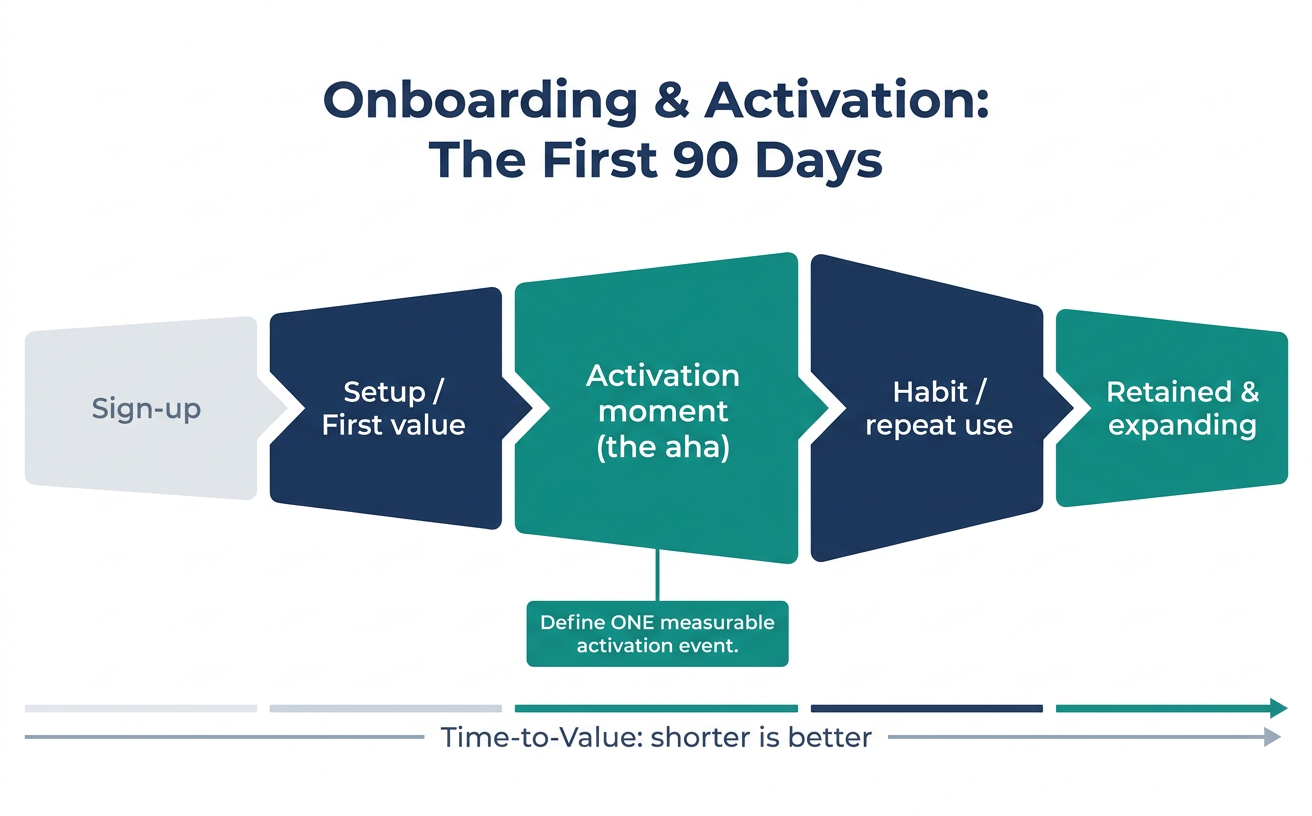
Figure 19.1: The first 90 days. Everything points at one measurable activation moment, the aha that predicts retention. Shorten the time it takes to reach it.
First, go qualitative. Interview three to ten happy accounts and ask a version of the same question: when did you realize this was working, and what had you just done right before that? You're listening for repeated patterns in the answers, the "oh, it was after we imported our data" or "it clicked once three of us were in the same project." The exact words matter less than the recurrence.
Second, go quantitative. In whatever product analytics you have (Mixpanel, Amplitude, PostHog, or even careful event logging), compare 90-day retention between users who did and didn't take each candidate early action within their first fourteen days. You're hunting for the smallest set of actions that produces the biggest jump in retention, not a long checklist of everything engaged users happen to do.
Third, define a candidate activation event from where the interviews and the data agree. Something concrete and compound, like "created at least one dashboard and shared it with at least one teammate," or "connected at least one integration and ran at least one workflow." Compound matters: a single shallow action rarely predicts anything.
Fourth, turn it into a metric: the number of new accounts that reach the event within some window, divided by the total number of new accounts. The window depends on motion, roughly seven to fourteen days for product-led SMB and twenty-one to forty-five days for mid-market and enterprise, where setup legitimately takes longer.
Fifth, validate it over time. Track your activation rate against 90-day retention month over month. If the correlation is strong, you've found a real threshold. If it's weak, your event is probably too shallow (something close to "just logged in"), happening too late to be a leading indicator, or not central to the value. Adjust and recheck.
It helps to keep a north-star metric in view above all of this: the single measure that best captures value created (weekly active teams, invoices processed, API calls served). Your activation event is the early, behavior-based leading indicator of that north star, the thing that happens in days and predicts the retention you won't see for months. The sentence you want to be able to say out loud is something like: "Once a customer has done X and Y within Z days, they're two to three times more likely to still be here at ninety." When you can say that with data behind it, the rest of onboarding has a target to aim at.
Matching the Onboarding Pattern to Your Motion
There is no universal onboarding flow. The right pattern follows your ACV, the complexity of setting the product up, and how your buyers expect to be treated. Five patterns cover most of the ground.
Self-serve checklists of roughly three to seven interactive steps fit product-led, low-touch, SMB products with good UX. The discipline is to keep them short and include only activation-driving steps, show progress, and celebrate completion. A checklist that walks through every feature defeats its own purpose.
Product tours and empty states fit products that are new to their category, where the value isn't obvious until someone sees it in motion. Learning by doing beats a long linear tour, so contextual nudges triggered by inaction tend to outperform a guided slideshow nobody finishes.
Milestone or setup wizards that chain configuration (connect integrations, then import data, then set permissions, then create the first project) fit products that require real technical setup or admin decisions. Two rules help here: separate the admin setup from the end-user onboarding, since they're different people with different jobs, and offer a "save and finish later" path for enterprise buyers whose setup spans days.
Human-assisted onboarding, a kickoff call plus one or two check-ins layered on top of self-serve, fits low-five-figure to low-six-figure ACV where churn is expensive and the change touches multiple stakeholders. Spend the human time at the moments that matter most (kickoff alignment, data mapping, go-live) and automate the scheduling, reminders, and pre-work around them.
White-glove implementation, project-managed with milestones and possibly professional services, fits enterprise: multi-stakeholder, deep integrations, compliance-heavy. Run it like a small project with a clear owner on both sides, a timeline, and named risks, and tie the milestones to business outcomes rather than technical tasks, so "first agreement processed" rather than "step seven complete."
Underneath the five patterns is the deeper split between product-led and sales-led onboarding, and it's worth being explicit about because it changes most of what follows.
In a product-led entry, the customer arrives via signup or free trial, the primary "customer" is an individual or a small team, and the goal is to drive usage to self-serve activation. The patterns are checklists, tours, and nudges; the metrics are activation rate, TTV, and product-qualified leads.
In a sales-led entry, onboarding begins post-contract, the customer is a buying committee plus admins plus end users, and the goal is time-to-live and proof of value across an organization. The patterns are kickoffs, implementation plans, and training; the metrics are time-to-live, first value, and stakeholder sentiment.
In practice, most B2B products are a hybrid: a product-led entry for individuals and small teams, with a higher-touch onboarding for the teams that convert. Knowing which you are tells you which pattern to reach for first.
Cutting Time-to-Value and Catching Early Churn
The customer also has to reach the aha moment quickly, because every day before activation is a day the customer can quietly decide it isn't worth it. A handful of tactics do most of the work.
Simplify the first run. Cut mandatory fields and steps that sit between signup and first value, let users skip non-critical setup, and prefer a pre-configured template over a blank slate.
Pre-board before the official start. The moment a contract is signed, send an intake form that captures goals, technical context, and the right contacts, propose specific kickoff slots rather than waiting for them to book, and share a short "what you'll achieve in the first thirty days" video. Done well, pre-boarding shrinks TTV by days or weeks because setup is already in motion before the kickoff call.
Align on what success means. At kickoff, ask the buyer directly: what would make you say, ninety days from now, that this was worth it? Translate the answer into two or three KPIs tied to their outcome ("run the first automated invoice process") rather than your process ("complete step seven").
Instrument and monitor early usage so you can see trouble coming. Track the few signals that matter (has the admin logged in, are integrations connected, has the core action happened) and build risk flags off them: no login in three days, no core action in seven, no teammate invited. Each flag triggers a response, whether that's an automated email, an in-product prompt, or a human reaching out.
Run a day-by-day intervention calendar for the first fourteen days, because for product-led products a large share of churn happens in exactly that window, often among trials that never activate at all. A workable cadence:
- Day zero or one: a welcome plus the first one or two steps and an in-app checklist.
- Days three to five: a nudge that names the gap ("noticed you haven't run your first report; here's a sixty-second video, or reply and we'll do it with you").
- Day seven: an escalation to a CSM or a founder Loom for the accounts still stalled.
- Days ten to fourteen: a push toward the collaborative or expansion actions (invite teammates, start the first real project) paired with a reminder of the value already achieved.
Design for collaboration where it applies. Many B2B tools aren't sticky until more than one person uses them, so bake "invite teammates" into the activation path (though not as the only step), auto-suggest likely teammates, and use sharing features that naturally require adding others. When only one person uses a multiplayer tool, the account is easy to lose.
Finally, celebrate the milestones. In-app confirmations, emails, and badges that mark an early win help: small visible wins raise a user's commitment and sense of progress, which carries them to the next action.
Founder-Type Note: For enterprise and higher-ACV products, resist the urge to measure activation as full rollout, because full rollout takes thirty to forty-five days or longer and you'll have no early signal for that whole period. Measure first value as your early milestone instead. A contract management tool's first-value event is "uploaded and processed the first agreement," not "trained fifty lawyers." The full rollout still matters, but you need a signal that fires in the first couple of weeks, while you can still do something about a stalled account.
Where AI Helps with Onboarding
A few uses of AI pay off for a small team, and they're worth doing in roughly this order.
The most tangible is an onboarding copilot that answers "how do I do X?" from your own docs and UI context. It means fewer blocked users, cheaper support, and faster TTV, and for a tiny team it covers basic support questions at any hour.
Proactive risk scoring is the next most useful: a model that estimates each new account's likelihood of activating or churning from early usage, email engagement, and firmographics, so the humans you do have can spend their limited attention on the accounts most likely to slip.
Personalized setup comes after that: a short three-to-five-question intake that maps a new account to the right templates, integrations, and copy for their segment, which avoids the one-size-fits-all flow that serves no one well. AI is also good at drafting change-management content, such as the champion's internal rollout email and role-specific quick-start guides. That unglamorous work often determines whether a tool gets adopted across a team.
There are also things to avoid. A generic chatbot with no product context frustrates more than it helps. Over-automated onboarding with zero human touch correlates with lower satisfaction at mid-market and above, where people expect a human at the important moments. And AI that guesses instead of asks (over-personalizing on flimsy data) adds friction rather than removing it. For a small team the right sequence is an AI help-center or copilot and risk scoring first, then personalization once you have the data to do it well.
Benchmarks to Sanity-Check Against
Treat these as rough guardrails. Compare your own trend over time more than you chase an industry average, but it helps to know the rough bands.
| Metric | Bottom quartile | Average | Top quartile |
|---|---|---|---|
| Activation rate (B2B SaaS) | Under 25% | ~35-42% | 50-60% and up |
| TTV (product-led SMB) | Over 14 days | 7-14 days | Under 7 days |
| First-90-day logo retention | Under 90% | 92-95% | 96-98% |
A few notes on reading them. The activation average comes from Userpilot's benchmark of 547 SaaS companies, where sales-led products averaged 41.6% and product-led ones 34.6% [9]; the other bands are rules of thumb.
As targets, a short-trial product-led motion should aim to move from the roughly 35% average toward 40-50% of qualified signups activated, while a sales-led motion, which averages about 42%, should aim for 50-60% within thirty to forty-five days, since a human is already guiding setup. On TTV, speed matters because a customer who hasn't reached value has no reason to stay once the first invoice or renewal arrives. Aim for first value inside the first session or day in product-led SMB, and full activation in under seven days, never more than fourteen; if first value itself takes a week, revisit the motion choice from Chapter 16. For mid-market, aim for fourteen to thirty days, and first value within the first two to three weeks for enterprise, even when the full rollout runs thirty to forty-five days or longer.
On retention, a large share of logo churn happens in the first thirty to ninety days (often the first fourteen for trials that never activate), so a first-90-day retention below roughly 90% is usually an onboarding and activation problem, not a deeper product-market-fit problem. That distinction matters, because the two have very different fixes.
Common Mistake: Drowning Day One in Information
The instinct, especially when you're proud of the product, is to show new users everything: every feature, a long tour, a dense help doc. It backfires, because a person trying to get one job done doesn't want to learn every feature first. The fix is just-in-time learning: show only the next one or two actions that move them toward activation, and reveal the rest as they need it.
Six Mistakes That Quietly Kill Activation
- One-size-fits-all onboarding. The same flow for admins and end users, for SMB and enterprise, serves none of them well. Segment the flow by role and profile.
- Information overload on day one. Covered above: every feature at once instead of the next one or two steps. Fix it with just-in-time prompts.
- No activation definition or metric. Celebrating signups and closed-won while never defining a behavioral activation event means you're managing the thing you can't see. Define it and track the rate.
- No human touchpoints where they matter. Fully automating onboarding even at higher ACV leaves customers feeling abandoned at exactly the moments they need a person. Add strategic human touchpoints at kickoff, day seven, and go-live.
- Ending onboarding too early. A one-week tour is not onboarding for a thirty-to-ninety-day journey. Phase it (pre-board, setup, adoption, transition) and only graduate an account on activation and outcomes, not on elapsed time.
- Vanity metrics over behavior. Tracking email opens and webinar attendance instead of in-product actions measures activity rather than value. Instrument the value-actions: integrations connected, core action completed, teammates invited.
How the Pattern Plays Out
The companies usually cited on activation earned the reputation by being precise about the moment that mattered.
Slack is the canonical case that value appears when a team uses the product, not when a lone user does. The often-cited signal is a team exchanging on the order of two thousand messages in a short period, which predicted retention well enough to organize onboarding around it. The activation pattern follows from that: invite teammates, create channels, exchange messages, and start replacing email. The lesson for a small team is that if your product is multiplayer, your activation event almost certainly has to be multiplayer too.
Dropbox built its onboarding around a single moment: seeing the same file appear on a second device. Activation was installing the desktop app, saving a file, and watching it sync, with sharing as the next step that pulled in other people. A clear demo video and a referral program existed largely to drive people to that one sync moment as fast as possible. The lesson is that when the aha moment is a single thing the user can see, the whole onboarding can be organized around reaching it.
Duolingo is a consumer product, but the principle transfers cleanly. Its aha is completing a short lesson and getting immediate feedback and reward, and streaks, XP, and visible goals sustain the habit afterward. The B2B parallel is the milestone-celebration and visible-progress work from earlier in this chapter: show people they're moving toward their own goal, and the early wins compound into a habit.
In each case, the company found the specific behavior that predicted retention and bent the entire first experience toward reaching it quickly.
Define One Activation Event This Week
A customer who never reaches value can't be retained, expand, or refer anyone, so the work of the first ninety days sets the ceiling on all of it. The next step is concrete and small enough to start now: interview a handful of happy customers this week and define a single behavioral activation event, build the minimal flow that drives a new account to it, pick the onboarding pattern that matches your motion, stand up a fourteen-day intervention calendar for the accounts that stall, and instrument activation rate and 90-day retention so you can see whether any of it is working.
This connects directly to the rest of the book. The motion you chose in Chapter 16 decides whether your onboarding is product-led toward self-serve activation or sales-led toward time to go-live across an organization. The ICP work earlier decides who you're onboarding and what success means to them. And activation is the literal precondition for the retention and expansion that the operations chapter ahead will teach you to measure, because net revenue retention depends on customers activating first.
The Constraint Triangle applies here as plainly as anywhere: the hours you spend building a flow to drive one well-chosen activation event will return more than the same hours spread across features no new customer has reached yet. If you get the first ninety days right, some of the growth you're chasing through new channels may come from the customers you already won.
Sources
[1] https://qatalys.com/blog/90-day-gtm-plan [2] https://solvspot.com/blog/idea-to-paying-users-90-days [3] https://allianceresourcegroup.com (first 90 days) [4] https://learnybox.com/en/blog/digital-customer-onboarding-complete-guide (2026) [5] https://eastridge.com/blog/the-first-90-days-matter-more-than-ever-in-2026 [6] https://digitalapplied.com/blog/customer-onboarding-time-to-value-2026-saas-metrics-framework [7] https://buildmvpfast.com/blog/b2b-saas-churn-first-14-days-onboarding-activation-2026 [8] https://thoughtlytics.com/blog/fixing-high-churn-activation-gap-audit [9] https://userpilot.com/blog/product-metrics-benchmark-report (547 SaaS companies)