
Chapter 18: Channel Strategy: Building Your Demand Engine
Channel advice is overwhelming. You can think of fifteen things to do, and a confident voice somewhere online swears by each one. Someone built a company on cold email. Someone else says cold email is dead and it's all founder-led LinkedIn now. A third person ran a webinar series, a fourth went all-in on SEO, a fifth insists the only thing that ever worked for them was showing up in the right Slack community for two years. They might all be telling the truth. The problem is that the advice belongs to someone else, shaped by their market and their motion, and you can't run all of it with three people and a finite month.
So most small teams do a little of everything. A few LinkedIn posts this week, a batch of cold emails, a blog post drafted by an AI tool, a small ad experiment, a Slack group joined and then mostly ignored. The pipeline stays flat, and it's tempting to conclude that you need a sixth channel. Usually the problem is that none of the five ever got the volume or the iterations it needed to prove itself either way.
A demand engine is one channel that reliably produces pipeline, run hard enough that you can predict roughly what comes out the other end, with one or two supporting channels layered on once the first one holds. This chapter is about how a team of one to ten picks that first channel, tests it cheaply in a fixed window, and decides on real evidence whether to kill it, scale it, or add another. The frame is the same constraint that runs through this book: your scarcest resource is attention, and splitting it across channels wastes it.
The Channel Portfolio: An Honest Read for a Small Team
Every channel sounds useful in isolation. The question for a tiny team is whether a channel can work for your ICP, at your deal size, with the hours and cash you have. Here is the trade-off on each, and where a small team should focus if it picks that channel.
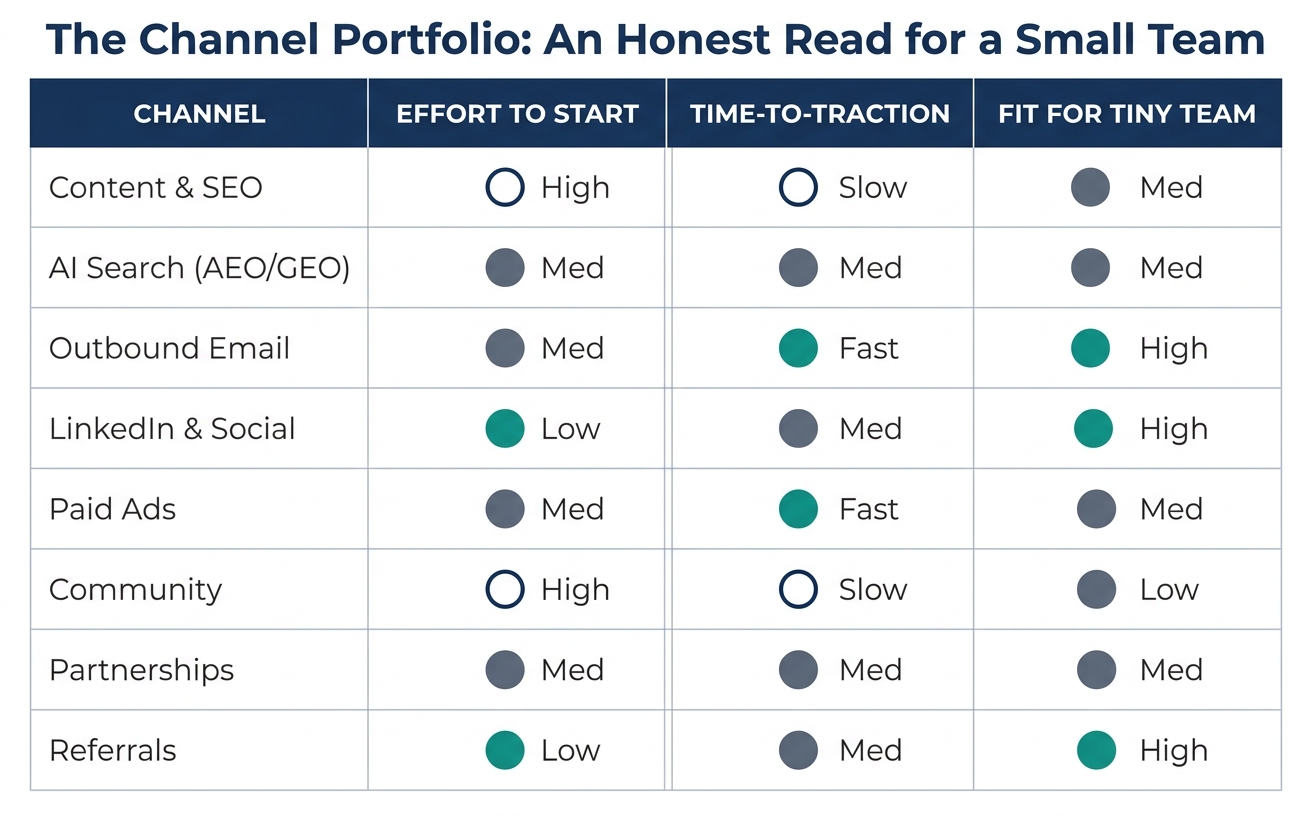
Figure 18.1: An honest read on each channel for a small team. Favor channels that pair fast time-to-traction with a high fit for how you sell.
Content and SEO
When it works, content compounds. A page that ranks for a bottom-funnel query like "[category] alternative" or "best X for [use case]" keeps pulling in high-intent readers long after you wrote it, and that defensibility is hard to buy any other way. The cost is patience and consistency. Non-brand organic traffic tends to take three to nine months to show up, it rewards steady publishing and the technical basics, and it's hard to break into a crowded set of search results where established players already own the terms.
A small team should resist the generic blog calendar and instead write three to five specific bottom-funnel pages tied to questions real prospects keep asking in sales conversations, plus a couple of deeper posts built on something only you have.
AI Search (AEO and GEO)
A growing share of buyers now start a search inside an assistant like ChatGPT, Perplexity, Gemini, Copilot, or a Google AI overview, and these tools tend to favor content that is clearly structured and easy to cite. That creates an early-mover opening on category and comparison questions for teams willing to write for it. The downsides: attribution is immature, so a deal that started in an AI answer often shows up in your data as "direct" or "unknown"; the tools change quickly; and without some existing authority, you're hard to surface. The practical move is to treat this as an extension of SEO rather than a separate project: skimmable headings, FAQ sections, comparison tables, schema markup, and data-backed posts other people quote.
Outbound Email and SDR
Outbound is the fastest way to reach a precise ICP on purpose. It works when buyers aren't searching for you yet, which is common for new categories and narrow verticals, and it gives you a volume knob you control. It's also saturated. Reply rates have fallen as AI-generated email floods inboxes, deliverability and compliance (GDPR, CAN-SPAM) are real constraints, and lazy outbound damages your brand. For a small team, keep it tight: lists of hundreds rather than tens of thousands, short sequences of three to five touches, triggered by something real, with AI used for research and first drafts but a human owning the final copy and the targeting.
LinkedIn and Social
Organic LinkedIn, with a little paid support, is good for educating a category and building a founder or subject-matter brand at low cash cost, and it's particularly strong for sales-led and account-based motions. The downsides are algorithm volatility, attribution that's hard to pin down, and a runway of months before it reliably produces inbound. The way a small team makes it work is to pick one or two people to be the visible faces, post three to five times a week on ICP pains and insights and customer stories, treat comments and DMs as a form of prospecting, and repurpose what performs into emails and ads.
Paid Ads
Paid search, social, and retargeting work best early on as a way to test. They let you put messages, audiences, and offers in front of people fast, capture high-intent search, and re-engage warm visitors. The risk is spending real money before your positioning and landing pages are good enough to convert it, against B2B costs per click that keep rising and with constant optimization required to hold performance. Start narrow: your brand terms and a few high-intent search phrases, LinkedIn targeted by title and firmographics with social-proof creative, and retargeting on everyone who already touched you warm.
Community
Community builds the deepest trust and the highest-quality referrals, especially in tight verticals, and it doubles as a feedback loop on product and messaging. It's also slow, time-intensive to run if you build your own (someone has to moderate and host), and impossible to fake. For a small team, the sequence is to engage deeply in communities that already exist (RevGenius, Pavilion, the niche Slacks and forums where your ICP already gathers) before considering your own, and to launch your own micro-community only once you've seen people repeatedly ask for it.
Partnerships and Ecosystem
Partnerships borrow someone else's trust and distribution, and an integration or marketplace listing can put you in the "recommended tools" inside a platform your ICP already lives in. The catch is the ramp. These pay off after you have some traction, they require partner enablement that small teams chronically underinvest in, and a partner with bigger customers can deprioritize you. Aim for a few keystone partners (a couple of implementation agencies, or one solid platform integration) with a clear shared ICP and the co-marketing materials to make the partnership easy to act on.
Events and Webinars
A well-run event produces high-signal conversations, and a session co-hosted with a known brand can accelerate mid- and bottom-funnel deals while giving you content to repurpose. The cost is the heavy prep, promotion, and follow-up, and the low intent you get if you run a generic "lead-gen webinar" with no real offer. Keep it to roughly one a month at most, always co-hosted with a partner or customer who brings their own audience, and aim for ten to fifty live ICP attendees rather than a vanity registration count. Design the follow-up before the event runs, not after.
Referrals and Word-of-Mouth
Referrals are the best deals you'll get: highest quality, fastest to close, lowest CAC, and a strong signal that you've found product-market fit. The limit is that you can't schedule them by the dozen, they plateau without a deliberate motion, and it's easy to lean on your early network until it runs dry. To make them more than luck, ask explicitly at a moment of proven value or after a strong NPS response, keep a lightweight customer advisory group close, and above all make one segment so successful that its customers can't help talking about you.
Founder-Type Note: These channels reward different founder temperaments, and that is a real input to the decision. If you enjoy writing and have a point of view, content and LinkedIn will get the consistency they need to work. If you'd rather have direct conversations, outbound and partnerships will. If you dread a channel, you'll probably under-resource it, however well it scores on paper. Weight the choice toward the one you'll sustain for three months.
Channel-Market Fit: Knowing When You Have It
You have channel-market fit when a channel reliably produces profitable pipeline from your ICP at a CAC and a founder-time cost you can sustain. The clearest sign is predictability: you can say "X amount of this activity produces roughly Y qualified opportunities a month," your CAC payback sits inside your target band and is trending down rather than up, and conversion holds or improves without heroics. Until you can say something like that, you're in channel search mode, and the worst thing you can do in search mode is spread thin.
A useful map for the search is the Bullseye framework from Gabriel Weinberg and Justin Mares in Traction, adapted for a team that can only run one real test at a time. The outer ring is a wide brainstorm: list plausible tactics across every channel without judging them. The middle ring is a shortlist of three that fit your ICP and deal size. The inner ring is the commitment: after small, time-boxed tests, you pick the one channel showing the best signal and pour your attention into it. The hard part is the narrowing: most teams can brainstorm, but few cut the list to three and then commit to one.
Once you have a working primary, the next question is when to add a second. The rule is "one channel until it breaks." Drive your primary channel until you hit a real ceiling: you've maxed out the reachable ICP audience or the available ad inventory, CAC starts rising as you spend more, or your downstream operations (onboarding, support, customer success) can't keep up with what the channel already produces. Hitting that ceiling means the channel worked well enough to outgrow, and that's when a second channel is worth your attention.
Which channels belong in your middle ring depends heavily on the motion you chose in Chapter 16. A product-led or low-ACV motion (under roughly $15K, including the sub-$1K offers many readers start with) leans toward content, SEO, AI search, in-product loops, communities, light paid search, and review sites, because the buyer needs to find and try you without a salesperson. A sales-led mid-market motion (roughly $15K-$100K) leans toward outbound and SDR work, founder and AE presence on LinkedIn, targeted paid, webinars, and ecosystem partnerships. An enterprise motion (over $100K) leans toward account-based marketing, executive events, strategic partnerships, community, high-touch outbound, and thought leadership. If a fashionable channel doesn't fit your motion, it doesn't belong in your three, however well it worked for someone selling differently.
The Cheap, Intense Channel Test
To avoid betting a quarter on a hunch, a small team time-boxes every channel test: a short, fully committed window with the kill, iterate, and scale thresholds written down before you start. A short, intense test works better than a broad, tentative one, because most channels only show results above a certain minimum volume, and a half-hearted test produces ambiguous data you'll argue about later.
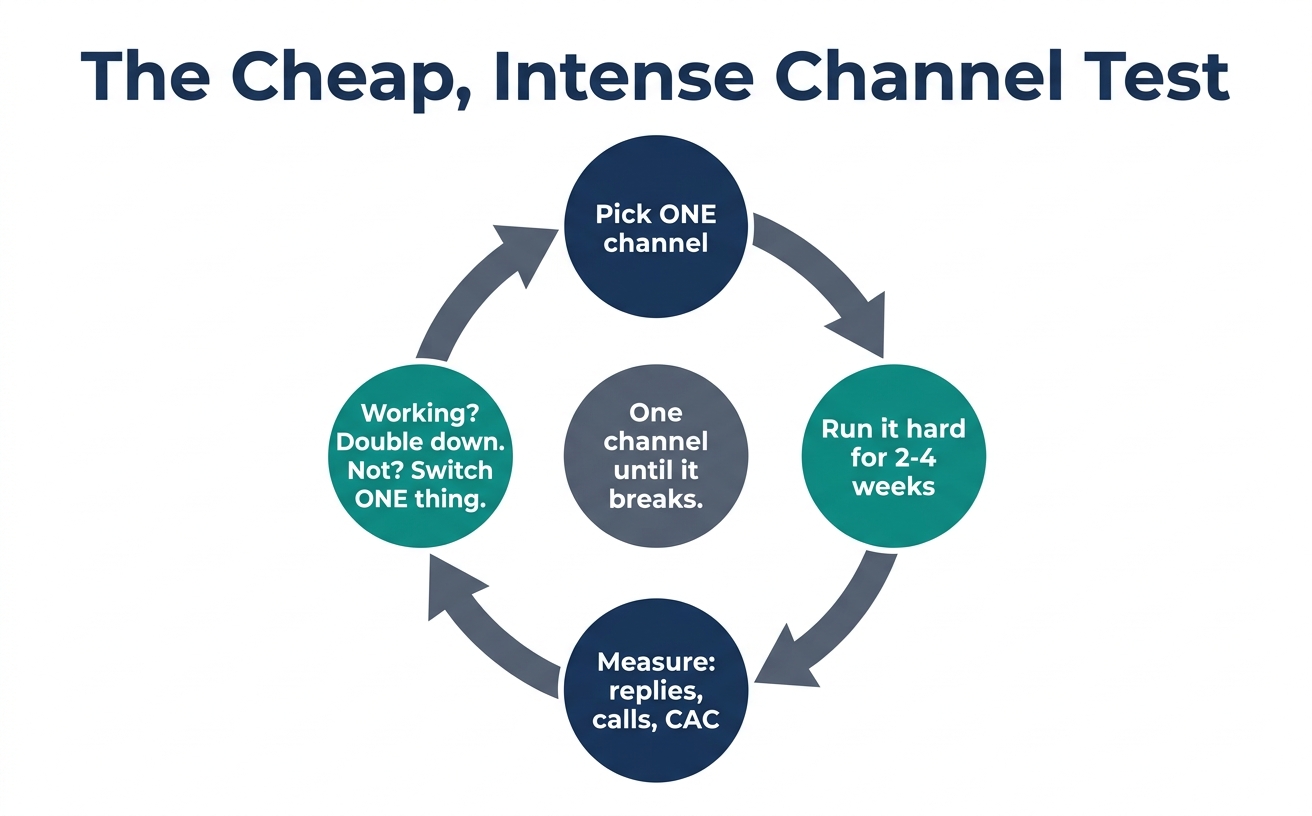
Figure 18.2: One channel until it breaks. Commit fully for the channel's test window (six to eight weeks for outbound, longer for content and partnerships), measure, then scale up or change one thing at a time.
The windows and signals differ by channel:
- Outbound: six to eight weeks against a list of 300-1,000 highly qualified prospects, with tooling around $100-300 a month plus founder or part-time SDR effort. Healthy signals are open rates above 50%, positive reply rates of 3-5% of prospects contacted across the full sequence (per-email rates run far lower; see Chapter 8), and meeting rates of 1-3%. Kill it if you're under a 1% meeting rate after 600-1,000 well-targeted sends with no discernible pattern in who responds. Scale it when your cost per opportunity sits well below your CAC target.
- LinkedIn organic: eight to twelve weeks with one or two people posting three to five times a week and commenting daily, at $0-500 a month. The signals are softer and slower: rising DMs and inbound questions from ICP accounts, comments from the titles you're targeting, and a few opportunities that cite your content as the reason they reached out. Don't kill this one quickly; it's a long game. But if three months of sustained, iterated effort produce zero ICP engagement, reduce it or shift the effort.
- Paid search or paid LinkedIn: four to eight weeks on a $2K-$8K test budget. Look for search click-through rates of 3-6% on high-intent terms, LinkedIn rates of 0.5-1.5%, landing-page conversion of 5-15% on high-intent traffic or 1-5% on cold, and a handful of real ICP SQLs. Kill it when your cost per sales-qualified opportunity trends toward a payback well beyond the target band for your motion (beyond 12 months for low-ACV, beyond 24 for sales-led) even after you've tried multiple creatives and landing pages.
- Content, SEO, and AI search: three to six months before you should expect a signal, built on three to ten high-intent pages (anywhere from $0 in-house to $3K-$8K outsourced) plus $50-200 a month in tooling. The leading indicators are rising non-brand impressions and clicks in Google Search Console, pages climbing into the top 20-30 results, and ICP buyers referencing your content. This is the one channel you rarely kill outright; keep a baseline even when it isn't your primary.
- Partnerships, community, and events: three to six months, mostly time plus $1K-$5K a quarter. Watch for on-ICP introductions, co-hosted webinars that draw more than 30-50 real ICP registrants, and opportunities where a partner shows up as the first touch. Scale these by investing in enablement, not by adding more partners.
All five tests share a pre-committed definition of failure. If you decide in advance what "this isn't working" looks like, you can stop on evidence instead of stopping on the day you happen to lose your nerve, or worse, never stopping at all.
Common Mistake: Spreading one to three people across five or more channels
This is the default failure mode, and it rarely feels like a mistake from the inside, because you're busy and every channel is technically "in progress." Under-resourced channels all produce the same result: not quite enough signal to tell whether they could have worked. You end up with five ambiguous experiments and no decision. Pick one primary channel and give it the volume the test windows above require; keep any supporting channel to maintenance effort (no more than 20-30% of your capacity) until the primary holds, and let the others wait. Focus is the main advantage a small team has over a large one.
CAC, Payback, and Conversion: Numbers to Sanity-Check Against
Use benchmarks to sanity-check, not as targets. Your own channel-over-channel comparison will always teach you more than an industry average, because it's measured on your ICP and your price. Still, knowing the rough shape of good performance helps you tell when a channel is structurally expensive rather than early.
Target CAC payback runs by motion: roughly 6-12 months for product-led and low-ACV, 12-24 months for sales-led mid-market, and 18-30 months or more for account-based and enterprise. Within that, channels sort fairly consistently by how expensive they are and how long they take to pay back.
| Channel | Relative CAC | Typical payback |
|---|---|---|
| Referrals / word-of-mouth | Lowest | Under 6 months |
| Founder warm intros | Very low | 6-12 months |
| Content / SEO / AI search | Low to medium | 6-12 months once working (after a 6-12 month ramp) |
| Organic LinkedIn | Low cash, high time | 9-18 months |
| Paid search | Medium to high | 9-18 months |
| Outbound | Medium to high | 12-24 months |
| Partnerships | Medium | 12-24 months after ramp |
| Events | Medium to high | 12-24 months or more |
| Paid social / LinkedIn | High | 12-30 months |
For conversion, rough norms give you a way to spot a leak: visitor-to-lead runs about 3-15% on high-intent paid or SEO traffic and 1-5% on cold paid social; lead-to-SQO runs 20-40% on inbound and 10-25% on outbound; and SQO-to-won runs 20-35% inbound, 15-30% outbound, and 30-50% or higher on referrals. If one of your stages sits far below these, that's where to look before you blame the channel as a whole.
What AI Changed About Channels
AI changed B2B channels in 2025 and 2026 in four concrete ways.
First, AI search became a discovery surface in its own right. A meaningful share of B2B buyers now ask an assistant before they ask a search engine, and those assistants reward content that is clear, well-structured, and frequently cited. Practically, that means schema, FAQ sections, comparison tables, and original research are now basic requirements for getting surfaced. Treat answer-engine optimization as part of core SEO.
The second change is a risk. Cheap AI writing flooded the generic "thought leadership" space and dragged the average quality of content down, and both buyers and engines have started penalizing shallow posts. To stand out, use the things AI can't manufacture: proprietary data, a distinct point of view, real customer examples and screenshots, and human stories. Use AI for drafts, outlines, research, and repurposing, but keep a human in the loop to add the original insight.
The third is AI-assisted outbound. Tools like Clay and Apollo let a small team research at a scale that used to require headcount and build dynamic, personalized snippets. This works when it's pointed at small, targeted lists of 100-1,000 accounts and the personalization is semi-manual and anchored to a real trigger (a funding round, a relevant job posting, a tech-stack change). It backfires when it's pointed at thousands of contacts with fake personalization, which trips spam filters and damages your brand faster than no outreach at all.
The fourth is creative velocity. AI can generate ad variants, landing-page copy, email tests, and short video, which lets a small team test five to ten messages a week instead of one or two. Faster iteration doesn't fix bad positioning, though. It only helps if you pay attention to what the tests tell you about the underlying message.
Budgeting Attention and Money
For a three-to-seven-person company under $1M ARR, combined sales and marketing spend often runs 20-40% of ARR early, with cash marketing somewhere in the $20K-$150K a year range depending on motion. Once you've chosen a primary channel, put roughly 60-70% of the budget on it, matching the 60-70% of effort Chapter 13 recommends; split the rest between content and answer-engine work, one supporting experiment, and the analytics that let you measure any of it. If you are still a solo founder on a few hundred dollars a month, the same ratios apply to your hours.
Time is the budget that matters more. A founder at a three-to-seven-person company typically spends 30-50% of their time on GTM, split between customer conversations and public content and well above the 5-7 hours a week a solo founder starts with, while a GTM generalist spends 50-70% of theirs executing the primary channel. One rule protects all of it: until one channel reliably produces opportunities, don't spread more than 20-30% of your GTM capacity onto secondary channels.
Common Mistake: Confusing motion-fashion with ICP fit
Many B2B teams chase whatever channel is having a moment (a consumer-style push on a new social platform, say) before they've come close to saturating the channels their buyers use, like LinkedIn and search. The fix is to start from buyer behavior, not from what's trending. If your ICP researches purchases by reading analyst content and comparison pages, your effort belongs in SEO and answer engines, however unglamorous that feels next to the channel everyone's posting about this quarter.
Six Ways Small Teams Get Channels Wrong
- Spray-and-pray. Running five to ten channels lightly instead of committing to one or two. The most common and most expensive mistake, because it disguises a lack of focus as productivity.
- Ignoring ICP and channel fit. Chasing a fashionable channel that doesn't match how your buyers discover and evaluate tools.
- Overinvesting in generic content. Pumping out AI blog posts with no ICP specificity and no bottom-funnel assets like case studies and comparison pages, then wondering why none of it converts.
- Under-investing in measurement. No clear per-channel definition of an "opportunity," no CAC or payback tracking, no UTM parameters or CRM source fields, so you can't tell which channel is working.
- Copy-pasting enterprise tactics pre-PMF. Standing up account-based marketing, display campaigns, and big field events before you have the product-market fit and pipeline to justify them.
- Treating AI as a magic bullet. Handing AI your voice and strategy, which produces messaging indistinguishable from everyone else's and erodes trust.
How the Pattern Plays Out
The teams worth learning from generally built their growth on one channel they ran very well.
ProfitWell (acquired by Paddle in 2022) built its engine on content and media as a primary channel rather than a support one. It published proprietary benchmark research drawn from its subscription data and produced shows like the "Pricing Page Teardown," and that depth built real category authority and a steady inbound stream. The lesson is that deep, proprietary content can be a primary channel in its own right when it's tied to outcomes your buyers care about, which is a different thing from a generic blog.
Gong made a channel out of LinkedIn and thought leadership by putting its own data to work. Its executives and sales leaders posted anonymized insights drawn from the platform itself, and broad employee advocacy multiplied the reach of that content well beyond the company's own following. Turning internal data into public insight can power a social channel that competitors can't easily copy, since they don't have your data.
Linear leaned on product-led growth, developer community, and content. Its design-centric documentation, its public changelogs, and its active presence in developer and product communities drove organic word-of-mouth and referrals that mattered more than paid acquisition. In a technical market, a strong product and presence in the right communities can do more than traditional marketing, because buyers there trust each other more than they trust ads.
Each company led with one channel that fit its motion and its buyers (proprietary content for ProfitWell, data-driven LinkedIn for Gong, community word-of-mouth around a strong product for Linear), committed to it past the point where it was clearly working, and only then layered on the rest.
Choose One Engine, Then Earn the Second
A demand engine is one channel that works well enough to be predictable, plus one or two supporting channels added after the first holds. Building one takes the discipline this book keeps returning to: brainstorm wide, narrow to three that fit your motion and ICP, time-box a cheap and intense test of the most promising one with kill and scale thresholds set in advance, and commit your attention to the winner instead of dividing it across the field.
This choice builds on earlier ones. The channels that belong in your shortlist come straight from the motion you picked in Chapter 16 and the ICP you defined in Chapter 2, and the price those buyers can bear (Chapter 17) is what decides whether a given channel's CAC and payback can ever make sense. The Constraint Triangle applies here as plainly as anywhere: every hour spent dabbling in a fifth channel is an hour not spent giving your first channel the volume it needs to prove itself. Chapters 2 and 3, on finding the right people and on outreach, hold the execution detail once you've chosen. But choose first, and run one channel hard before you add a second.
Sources
[1] https://unboundb2b.com/blog/go-to-market-strategy-2026 [2] https://youtube.com/watch?v=WM7Tk8W9B08 [3] https://youtube.com/watch?v=Lsz3wdPmxV0 [4] https://theb2bplaybook.com/b2b-demand-generation-strategy-2026 [5] https://belkins.io/blog/b2b-marketing-channels [6] https://journeyh.io/blog/b2b-social-media-marketing [7] https://revgeni.ai/best-2026-gtm-strategies-for-b2b-saas [8] https://wf-vision.com/advertising-and-marketing-tips (2026 B2B budget)