
Chapter 3: Cutting Through the Noise
Your ideal customer is drowning in messages: email, LinkedIn requests from strangers pushing webinars, DMs full of "quick question" pitches. Most of that outreach gets ignored because the approach is wrong, even when the product is good.
The lesson is that volume without relevance doesn't work. Infrastructure that can send 1,000 emails a week still gets almost no replies if the messages are generic; the same infrastructure, pointed at 30-50 highly targeted messages a week, can reliably generate real conversations, and you scale only once your messaging and ICP are dialed in.
The data backs this up. Belkins analyzed 7.5 million cold emails it sent for clients in 2025 and found an average reply rate of 0.45% of emails sent, fewer than one reply per 200 emails. Who you send to moves that number: founders and owners replied more than any other seniority group (0.57%), and companies with 10 or fewer employees replied at 0.72%, more than three times the rate of enterprises with 10,000+ employees (0.22%) [1]. Those are averages across professionally run campaigns. Even when cold email is done competently, most of it goes unanswered, so each message needs to give the recipient a reason to reply.
Founder-Type Note: Cold email works best for B2B SaaS founders and consultants selling to businesses. For coaches and creators, LinkedIn engagement and community participation often generate better results than cold email.
A four-stage AI-assisted workflow (prospecting tool → enrichment → AI personalization → sending platform) adds layers beyond basic targeting: ICP-based segmentation, AI analysis of posts and career trajectories, behavioral-style-matched messaging, and human-refined personalization. Personalization consistently lifts reply rates. Mass-blast outreach is mathematically inefficient: you burn your domain reputation reaching people who don't care. Prove a message works on a targeted batch, then scale it to more of the right people.
Common Mistake: Volume over Personalization
Volume feels productive, but generic messaging gets ignored. Test with 30-50 highly personalized messages first, prove you can get replies, then scale that working approach gradually (100/week, then 500, then 1,000+), using AI-assisted personalization to hold quality at volume.
With the ICP framework (the intersection of who you can help, who will pay, and who's a joy to work with), you defined your ideal customers. This chapter answers three questions: how do you find them, how do you reach them, and how do you start conversations that convert? Most of the answers come from thinking like the person receiving your message.
Why Most Outreach Fails
Most outreach dies for four reasons:
- It's about you, not them. "I'd love to show you how we can help..." signals a sales pitch immediately.
- It's generic. "Hi [First Name], I noticed you work at [Company Name]..." The merge tags show, and nothing signals that you know anything about them.
- It asks for too much too soon. "Would you have 30 minutes this week?" asks a stranger to commit significant time based on a cold message.
- It doesn't earn the right to ask. Most messages are all ask, no give.
The Warmup Principle
Cold outreach to a stranger almost always underperforms warm outreach to someone who's already encountered you. When you get a LinkedIn request from a name you recognize (someone whose content you've seen, or who commented on your post), you're far more likely to accept. The warmup principle: create a few touchpoints before you make the ask, so you are a familiar name by the time you message them. It takes longer than blasting cold emails, and it works far better.
Three-step LinkedIn warmup (Weeks 1-3):
- Week 1: Engage with their content (1-2 thoughtful comments).
- Week 2: Send a short connection request referencing something specific.
- Week 3: Send a value-first message (question, insight, or resource).
Case Study (composite): A business coach's cold LinkedIn requests were stuck around 22% acceptance, and almost none turned into conversations. She warmed up 50 prospects over two weeks with thoughtful comments, then sent personalized requests. Acceptance rose to 78% (39/50), and those connections produced 5 discovery calls and 2 clients in 60 days ($8,000 from ~10.5 hours of work).
LinkedIn: A High-Leverage Channel
For many B2B SaaS founders and consultants, solo or small-team, LinkedIn is the most productive outreach channel. For creators and coaches, it can work, but community engagement or other platforms may serve you better, depending on where your customers gather.
Recent algorithm changes have shifted the rules. LinkedIn does not publish its ranking formula, but practitioners consistently report the same practical implications:
- External links reduce reach: put the value in the post; move links to comments.
- Comments outweigh likes: prioritize posts worth discussing.
- Pods backfire: authentic engagement beats coordinated activity.
These changes favor value-first content over promotional tactics, which suits founders posting from a personal profile.
Set up your profile first. Before you send a single message:
- Headline: who you help and the outcome you deliver
- Featured: proof (case study, testimonial, best content)
- About: your prospect's problem, written in the second person
The connection request. Keep it short and specific. Reference something relevant, skip the pitch, and make it easy to say yes.
Sales Navigator vs. free. Free LinkedIn search works for basic prospecting: filter by title, company, location. Sales Navigator (see Chapter 2 for pricing) adds advanced filters (company size, job changes, recent activity) and InMail credits. If you're budget-constrained, free LinkedIn is viable; once you're doing 20+ prospecting sessions per month, Sales Navigator pays for itself in time saved. Either way, start smaller than you think: a tight list of 20-30 people per week beats a loose list of 200.
The follow-up message. Once connected, wait a few days. Lead with a question or useful resource, not a pitch. A low-friction way to engage: "I'm interviewing [role] leaders about [problem]. Open to a 2-minute perspective question?" or "I put together a short checklist on [topic]. Happy to send if useful."
Weekly cadence (lightweight): Monday, identify 20-30 new prospects; Tuesday-Thursday, engage with 1-2 posts each; Friday, send 15-25 connection requests to last week's warmed prospects and 5-10 value-first messages to the batch before that. Stay under 100 connection requests per week to avoid LinkedIn restrictions.
Cold Email: Still Effective When Done Right
Cold email still works, but it demands more technical setup than it did five years ago.
Google and Yahoo introduced stricter sender requirements in February 2024, and in November 2025 Gmail began ramping up enforcement, with non-compliant messages facing temporary and permanent rejections [2]. Without proper authentication (SPF, DKIM, and DMARC) your emails land in spam or bounce. Anyone sending 5,000 or more messages a day to Gmail counts as a bulk sender and faces extra requirements, and Google asks every sender to keep its spam rate below 0.1% and never let it reach 0.3% [2]. Microsoft followed for Outlook/Hotmail in May 2025. These are hard requirements. Founders routinely spend months building lists only to land in spam because they skipped the setup.
The infrastructure requirement. Never send cold outreach from your primary domain. If it gets blacklisted, your transactional emails (invoices, receipts) fail too. Set up at least one separate domain. If you're sending 30-50 personalized emails weekly (typical early on), one dedicated outreach domain with proper authentication is enough. Multi-domain infrastructure (3-5 domains) becomes relevant only at 200+ cold emails weekly, once you've validated your messaging. Until then it's overkill.
For most founders starting out:
- One outreach domain (e.g., "get[company].com" or "try[company].com")
- Proper SPF, DKIM, and DMARC authentication
- 3-4 week warmup before real campaigns
- Conservative volume: 30-50 emails/day/domain
Setup sequence: buy a look-alike domain and create one dedicated inbox (hello@trycompany.com); authenticate (SPF/DKIM/DMARC) and test with a deliverability checker; turn on warmup for 3-4 weeks while you build a small, high-quality list (30-50 perfect-fit people); write one strong message and personalize the first line per prospect; send small batches (10-20/day), monitor replies, and iterate weekly on replies, not opens.
The process is slow on purpose: you want proof that people reply before you add volume.
When you've proven the approach and need to scale:
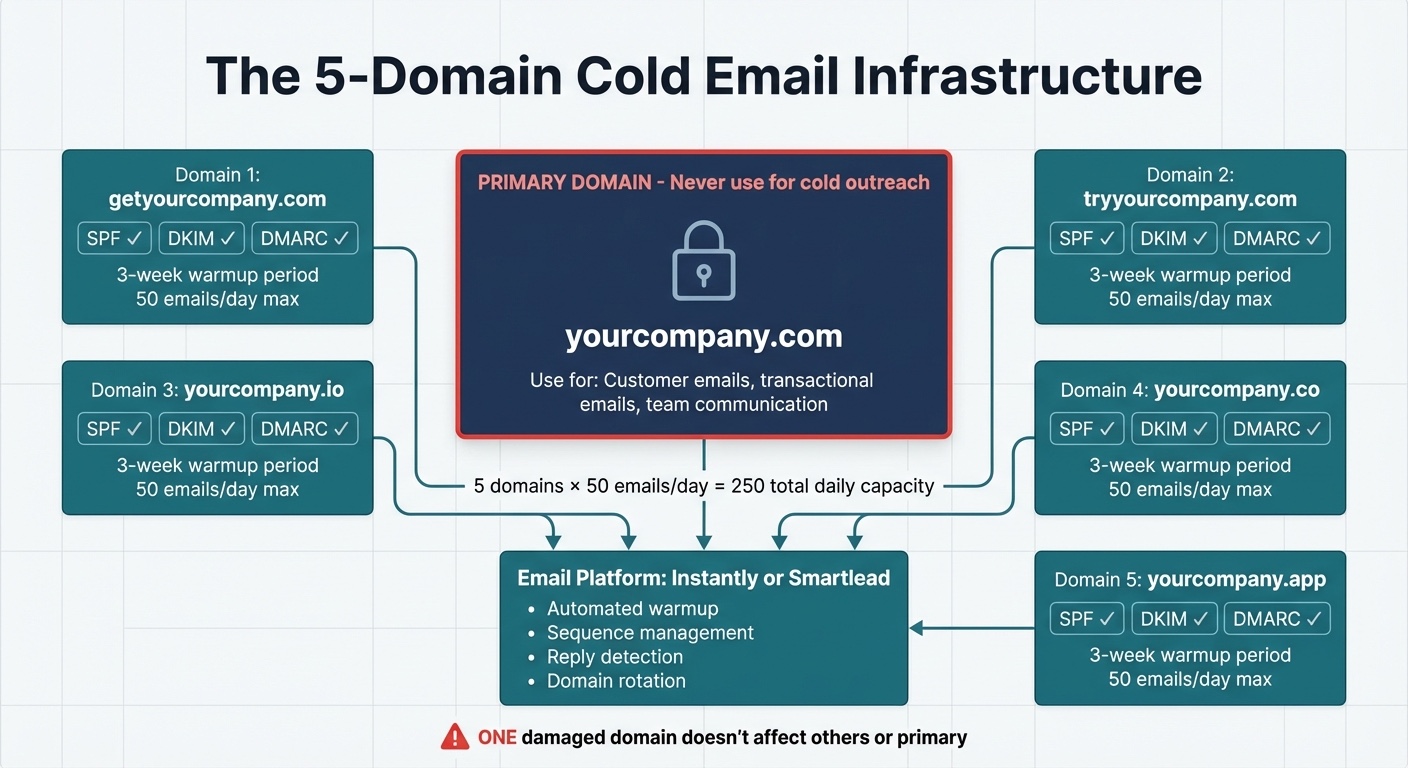
Figure 3.1: Multi-domain setup for scale; most founders won't need this complexity.
Per-domain checklist: SPF/DKIM/DMARC authentication, one-click unsubscribe, and CAN-SPAM/GDPR compliance (accurate sender info, easy opt-out, removals honored immediately).
Critical for EU/UK: GDPR restricts unsolicited B2B email more than US law. You generally need "legitimate interest" or prior consent; cold emailing EU prospects without a defensible basis can mean significant fines. If targeting EU/UK, use LinkedIn first (different rules), get warm introductions, or focus on inbound lead magnets, and consult a GDPR specialist when in doubt.
Domain warmup: Start at 5-10 emails/day, ramp over 3-4 weeks to 30-50/day. Warmup trains providers to trust your reputation and reduces spam complaints. Skip it and you'll burn your domain before you get signal.
Case Study: Michel Lieben and "the list is the strategy." Lieben, founder of the outbound agency ColdIQ, has written that his first 4,000 cold emails produced a single lead; by April 2025 the agency was past $4M in annual recurring revenue [3]. The first lesson he draws: "Many spend little time building their lead list, and a lot of time figuring out what to say. Do the opposite."
For an HR SaaS client whose product reduced employee churn, his team looked for companies with bad Glassdoor reviews and average tenure under 18 months, building the list before writing the first email, so the research itself became the reason to reach out. The list only helps if you're solving a real problem; when you are, it deserves more of your time than the wording of the email.
The message itself. The first line matters most. The subject should be short, specific, and human. "Quick question about your [role/challenge]" works; "Transforming Your Operations with AI-Powered Solutions" goes straight to the trash. The opening line references something real, like a recent post or a company announcement. The body is brief: state the problem you solve, offer concrete value, and make a low-friction ask: "Worth a quick look?" instead of "Let's schedule a 30-minute call."
Subject: [Specific reference to their situation]

Hi [Name],

[One sentence referencing something specific about them or their company]

[One sentence about the problem you solve, framed in their world]

[One sentence offering value - a resource, case study, or insight]

[Low-friction ask]

[Short signature]
Common mistakes: over-explaining your product instead of naming the problem; making the first email a meeting request; generic subject lines; emailing people who don't fit your ICP; personalizing the wrong thing (school, hobbies) instead of business context.
Build the list with three filters: role fit (who owns the outcome you improve: the role that feels the pain, not the title you prefer), signal (what's happening that makes your solution relevant now: hiring, launching, posting about a pain, changing tools), and constraint (what size or stage makes the problem urgent and solvable).
Create tight segments: "B2B SaaS founders" is too broad; "founder-led B2B SaaS doing outbound without a repeatable email system" is usable. For every prospect, capture a one-sentence reason answering Why them? Why now? Why you? If you can't answer all three, remove them. A list of 40 great fits beats 400 "maybe" prospects, and a spreadsheet with name, role, company, signal, and personalization angle is enough.
A four-email sequence runs: (1) personalized opener + relevant problem + specific value + low-friction ask; (2) follow-up with a new angle: "if [problem] is on your radar this quarter, I can share a 2-minute breakdown of how teams like [peer company] are tackling it"; (3) a short proof story: "[peer company] fixed [problem] by [specific change]"; (4) a break-up: "Should I close the loop, or is there a better person to point me to?" Send midweek, when inboxes are lighter, and space follow-ups by a few days.
Subscriber-first variant (optional). Instead of asking for a meeting, use cold email to earn permission to send a useful resource, then nurture until they're ready to buy. The bar is lower for "send me the guide" than "book a call," and the list compounds. Pick one lead magnet unmistakably relevant to your ICP's core pain. "A 5-step checklist for technical founders to get their first five sales calls" converts; "general marketing tips" won't. Nurture over a few weeks (resource → insight → diagnostic question → case study → soft invite). Once someone engages multiple times, move them to a call-first path. Treat the subscriber path as a bridge to a sales conversation.
The "Building in Public" Advantage
Another approach is building in public. When you share what you're working on, learning, failing at, and winning, you attract people who like how you work. It works for B2B and creator founders. Polished marketing posts tend to get scrolled past, while specific stories about real problems get comments.
A reality check on engagement: Socialinsider's analysis of 1.3 million posts from LinkedIn company pages put 2025 average engagement at 7.00% for native document posts (the PDF carousels), 6.00% for video, and 4.50% for text posts [4]. Those are averages for established company pages, and they are close to meaningless for you right now. With a small network, your first 50 posts might get 3 likes and zero comments. That's normal; early on, the goal is to post consistently and notice what gets a response.
What matters early on:
- Post 1-2 times per week (not 3-4; you don't have time)
- Carousels for frameworks, text posts for stories and takes
- Document what gets responses over 90 days
- Engage with others' content more than you post your own
Pick one theme and rotate formats. Posts like "Here's the exact cold email that got me a 0% reply rate, and what I changed" invite conversation. People comment, share advice, and some become prospects. The buckets that work: progress (what you built or tested), lessons (what failed and why), proof (screenshots, metrics, customer quotes), and requests (ask your network for feedback on a specific decision).
Turning visibility into conversations. Post with one specific person in mind, notice who engages, then follow up with a low-pressure DM: "Thanks for the comment on the post about [topic]. Are you working on anything similar right now? If helpful, I can share the checklist I used." Over time this builds credibility: prospects often check your profile before replying, and a trail of thoughtful posts makes them more likely to respond. Creators like Justin Welsh built businesses this way, sharing wins, losses, and methodologies openly where their customers spend time.
Community-Based Outreach
Communities (Reddit, Slack groups, Discord servers, industry forums) are channels most founders use wrong. The wrong approach: join, immediately post about your product, get banned or ignored. The right approach: join, help consistently, build a reputation, and let opportunities come to you.
Community engagement checklist:
- Read the rules and watch how people talk before you post.
- Answer questions in your lane with detail and examples.
- Share frameworks or templates without linking out.
- Only mention your product when it directly solves a step.
Reddit is especially useful because answers get indexed by Google, so someone searching for your problem might find your answer from two years ago. Reddit members and moderators come down on self-promotion quickly, though. What works is answering thoroughly, giving a usable framework, and, if your product helps with one specific step, mentioning it plainly: "For step 2, I built a small tool that automates this. Happy to share if useful." Indie Hackers is good for B2B SaaS founders; for creator-focused products, communities like Superpath and niche Slack groups work well.
A query that finds threads where you can add value: site:reddit.com/r/[your niche] "how do I" OR "struggling with" OR "recommendation for". Set up alerts; when someone asks a question you can answer, show up and help. Don't pitch.
Start where your ICP already asks questions, lurk for a week to map recurring topics, then choose 2-3 communities to show up in consistently (3-5 helpful replies per week, 1 original post every other week). Expect little visible traction for the first few weeks. When someone thanks you or asks a follow-up, that's the moment to move private with permission-based language ("If helpful, I can share the template I use"), then ask one question about their situation before offering a call. It's slower than blast outreach, but the trust builds over time.
Partnerships and Cross-Promotion
One of the fastest ways to reach your customers is through people who already have their attention. Start with newsletter swaps or guest content for creators who reach your audience but don't compete; if you pitch podcasts, target niche shows and lead with a specific topic your ICP cares about. Partnership outreach follows the same principles: be specific, lead with value, make the ask easy.
"Loved your [newsletter/episode] on [topic]. I work with [ICP] on [problem], and I think your audience would value a short piece on [specific angle]. Happy to draft the content or do a 20-minute guest segment. If useful, I can feature you to my audience as well."
Outreach for Creators: Warm Audience First
Founder-Type Note: If you're a coach, course creator, or service provider selling to individuals, this section is for you. The principles above still apply, but your primary channel is often your existing audience, not cold outreach.
Creators have an advantage B2B founders don't: an audience that already knows and trusts them. The mistake is treating that audience like a cold list.
Warm outreach to your existing audience:
- Email launch sequences: your subscriber list is your first channel. A 5-email sequence (announce → value → social proof → urgency → final call) usually converts only a small share of even an engaged list, so the size and health of the list matter more than any single email.
- DMs to engaged followers: someone who comments or replies is signaling interest. "Thanks for the comment. Curious if you're working on [problem] right now?" opens conversations without feeling salesy.
- Pinned content and community posts: YouTube cards, pinned tweets, and Discord announcements drive traffic to offers without cold outreach.
Webinars and challenges as pre-qualification. Free events let prospects experience your teaching before buying. Attendees self-select as interested, making follow-up warm. Teach something valuable for 45 minutes, then offer a relevant paid solution for the last 15.
Even creators benefit from cold channels when launching to a new segment, when their audience is small (fewer than 1,000 subscribers), or when testing a new offer that needs faster signal. In those cases, LinkedIn engagement and community participation beat cold email. The hybrid: use cold channels to grow your warm audience, then convert from it. Cold outreach → lead magnet → nurture → offer builds a list you keep, so each launch doesn't start from zero.
The Follow-Up Imperative
Most founders give up too soon. Silence usually means "not right now" or "your message got buried." A polite follow-up is reasonable persistence. The rule of thumb for cold outreach: 5-7 touches across channels over 2-3 weeks before you move on (for example, the four-email sequence plus a LinkedIn comment and a connection request), ending with a final "Should I stop reaching out?" Then shift your energy elsewhere. After a real conversation, use Chapter 9's slower follow-up cadence instead.
Each touchpoint should add something new instead of repeating the ask: a different angle, a relevant insight, a helpful resource. Give prospects a few days between touches.
Value-add follow-up ideas:
- A short checklist they can use immediately
- A relevant stat or trend with a one-sentence takeaway
- A short comparison between two common approaches
- A "here's how others solved this" mini-story
The Metrics That Matter
Track results rather than activity: sending 500 emails means nothing if none convert.
- Connection/acceptance rate (LinkedIn)
- Response rate (email/DM)
- Meeting conversion (positive replies → booked calls)
- Pipeline velocity (how fast deals move)
- Bounce rate (use verification to protect deliverability)
Review weekly rather than daily, so you see trends instead of day-to-day noise. When a metric changes, diagnose in order: list quality → message relevance → timing → deliverability. Most founders jump to "the channel is dead" before checking whether they're targeting the right people with the right message.
Qualitative signals matter too: reply quality ("Not a fit" differs from "We already solved this"), repeated objections (your positioning is off), time-to-reply (fast often signals real pain), and referrals ("Talk to my colleague" is still a win). Each week, review a batch of replies like a researcher: highlight the phrases people use to describe their problems, then mirror that language in your next batch. Base your messaging on what people say in real conversations.
The Founder Outreach Stack
You don't need expensive tools for outreach. This is enough to start:
For LinkedIn:
- Sales Navigator Core for advanced search and InMail credits
- A scheduling tool like Buffer for consistent content posting
- Your profile, optimized as above
For cold email:
- One lookalike domain to start (add 2-3 more only past 200 cold emails a week; registrar pricing varies)
- Instantly or Smartlead (entry plans at $39-47 a month as of September 2026) for sending, warmup, and inbox management [5][6]. These deliverability-focused platforms work best when you have a clear offer and a good list. Outcomes depend far more on ICP fit, list quality, and offer strength than on the tool.
- A simple CRM or spreadsheet to track conversations
For community outreach:
- F5Bot (free) for Reddit keyword alerts
- A list of 5-10 communities where your customers gather
For partnerships: a list of newsletters, podcasts, and creators in your space, plus a customized outreach template.
Total investment runs roughly $50-$200 per month depending on whether you add Sales Navigator; free LinkedIn plus one sending tool keeps you near the $0-$100 starting budget. If you can only afford one channel: start with LinkedIn if your ICP is active there. It carries lower risk (no deliverability issues), builds your personal brand, and warms prospects before you message. Add cold email once LinkedIn is working and you need more volume; it scales better but requires more setup and has more ways to fail.
For small teams, this is where outreach delegates cleanly: a rep or contractor can co-own one channel end-to-end (the LinkedIn cadence, or the cold-email sequence) using the same templates and metrics above, while you keep the messaging and ICP decisions.
AI Personalization: Guardrails
AI tools can research prospects and draft personalized openers at scale (prospecting → enrichment → AI personalization → sending). But bad AI personalization is obvious and counterproductive.
Rules:
- Never reference facts you can't verify from a public source.
- Don't over-personalize with personal details (family, hobbies, schools); it feels creepy.
- Name a specific decision, post, or initiative, not generic praise like "love your company."
- If this message could be sent to 100 other people, it's not personal enough.
Triage your list: manually personalize the top 20%, lightly personalize the next 30%, skip the rest. Use AI for the research and write the persuasive parts yourself.
Treat outreach as a series of small experiments and every reply as information. No response usually means wrong fit or wrong time, so move on. You're looking for real conversations with people who have problems you can solve.
Chapter Summary: TL;DR
The core insight: Volume without relevance doesn't work. Personalization is primary; automation is secondary support. Prove you can get replies with 30-50 highly personalized messages, then scale that approach.
Key takeaways:
- Even professionally run cold email averages under half a percent in replies per email sent (0.45% across 7.5M emails in 2025), and founders and small companies reply most [1]
- Personalization beats volume: 50 personalized emails that get 5 replies beat 1,000 generic ones that get the same 5
- LinkedIn warmup: engage with content first, then connect, then message
- Cold email infrastructure: separate domain, SPF/DKIM/DMARC, warmup (3-4 weeks)
- Follow-ups matter: most deals require multiple touches
- For coaches/creators: LinkedIn engagement and community often work better than cold email
If you're dreading outreach or skipping it: See Chapter 12 (sustainability and recovery).
Next: Discovery calls that qualify prospects efficiently using the MVQ framework.
The Exercise: Set Up Your First Outreach Campaign
Before moving on, set up the foundation for at least one outreach channel.
If you're prioritizing LinkedIn:
- Audit your profile against this chapter: fix your headline, Featured section, and About.
- Create a saved search in Sales Navigator (or regular LinkedIn) for your ICP.
- Identify 10 prospects to warm up this week. Engage with their content before connecting.
If you're prioritizing cold email:
- Purchase at least one alternate domain.
- Set up SPF, DKIM, and DMARC.
- Sign up for a warmup service and start the 3-4 week process.
- While you wait, build your prospect list and draft your message templates.
If you're prioritizing community outreach:
- Identify 3-5 communities where your customers gather.
- Set up keyword alerts (F5Bot for Reddit, or equivalent).
- Commit to adding value for 30 days before mentioning your product.
Pick the one that makes most sense for your ICP and your strengths. Doing one channel well is better than spreading yourself across three.
Chapter Checklist
Before moving to Chapter 4, complete:
- Chosen your primary outreach channel (cold email, LinkedIn, or community)
- Set up infrastructure for your chosen channel (domain, authentication, warmup OR LinkedIn profile optimization)
- Built a prospect list of 30-50 verified, perfect-fit contacts matching your ICP
- Drafted 3-5 personalized message templates
- Set up a tracking system (spreadsheet or CRM)
Self-assessment questions:
- Am I focusing on quality (personalization) or quantity (volume)?
- Have I set up proper infrastructure to avoid deliverability issues?
- Do my messages reference something specific about each prospect?
- Am I following up consistently (5+ touchpoints)?
Outreach gets you conversations, but a conversation with the wrong person, or one handled poorly, doesn't convert. Chapter 4 covers the MVQ (Pain-Impact-Decision) framework for running discovery calls that qualify prospects efficiently and move real opportunities forward.
[1] Belkins, "What Are B2B Cold Email Response Rates? (2026 Study)," updated June 2026. https://belkins.io/blog/cold-email-response-rates. 7,530,489 cold emails sent January-December 2025; reply rate = unique replies divided by emails sent. Belkins notes that earlier editions divided by emails opened, so their figures are not comparable.
[2] Google, "Email sender guidelines" and "Email sender guidelines FAQ," Google Workspace Admin Help. https://support.google.com/a/answer/81126 and https://support.google.com/a/answer/14229414. The FAQ states that starting November 2025 Gmail is ramping up enforcement on non-compliant traffic, and that senders should keep spam rates below 0.1% and prevent them from ever reaching 0.3%.
[3] Lieben, M., "How it started: 4,000 cold emails sent. 1 lead generated. How it's going: $4M+ ARR," LinkedIn, April 2025. https://www.linkedin.com/posts/michel-lieben_how-it-started-4000-cold-emails-sent-1-activity-7320031280744603648-aMPN
[4] Socialinsider, "LinkedIn Organic Benchmarks 2026." https://www.socialinsider.io/social-media-benchmarks/linkedin. 1.3M posts from 16,645 LinkedIn business pages, January 2024-December 2025.
[5] Instantly pricing, accessed September 2026: Outreach Growth plan $47/month, or $37.60/month billed annually. https://instantly.ai/pricing
[6] Smartlead pricing, accessed September 2026: Base plan $39/month. https://www.smartlead.ai/pricing