
Chapter 20: GTM Operations and Forecasting: Running the Machine
A few months into selling, most founders are running their pipeline out of a spreadsheet and a feeling. The spreadsheet has a column for the deal and a column for a status that means whatever the founder felt the day they typed it. Some of the close dates are real and some are wishes. When an investor or a co-founder asks how the quarter looks, the honest answer is a guess, because the number lives in your head and you're optimistic.
Then comes the month it falls apart. Two or three of the deals you were sure about go quiet at the same time. The close dates you invented arrive and pass. The forecast you half-believed turns out to be off by half, and you're left explaining a miss you didn't see coming because you never had a system that could have warned you.
That miss comes from running a go-to-market machine without the small set of habits that make it predictable. Operations is that handful of boring practices, and you don't have to be bigger to start them. A small team doesn't need much: a small stack, crisp definitions, and processes dull enough to run every week without thinking about them.
This chapter is about how to run the machine; Chapter 8 covered what to measure. The two depend on each other: you can't measure your way out of messy data, and AI makes a clean system faster and a messy one more confusing.
The Minimal Stack, and the Longer List of What Not to Buy Yet
The temptation, the moment you have a little revenue, is to assemble the tooling you've seen at companies ten times your size. Resist it. Your stack has exactly four jobs: track relationships, add context to them, reach people, and show you what's happening. For a team of one to ten, three tools cover all four jobs, because the CRM handles analytics as well as relationships.
The CRM is the non-negotiable one, and it's the one decision you should expect to live with for twelve to twenty-four months, so choose for adoption over feature lists: the right CRM is the one your team will keep updated.
As of September 2026, three fit small B2B teams. HubSpot Sales Hub is the default all-in-one for founder-led selling, with email tracking, sequences, and reporting native to it, running roughly $20-$30 per user per month at the Starter tier and around $90 at Pro. Pipedrive is the simple visual pipeline for teams who want sales flow over automation, roughly $20-$60 per user. Close is built for outbound-heavy teams, with a dialer and SMS in the box, roughly $49-$129. Any of the three is a fine choice. The wrong choice is no CRM, or a CRM nobody updates.
Enrichment adds firmographic context so you're not hand-typing what a company does. Keep it simple and aim for six core fields: company name, website, address, revenue, employee size, and industry. Get those six right and you can segment and route. You don't need a data warehouse of attributes you'll never filter on. Apollo.io runs roughly $39-$99 per user per month and doubles as a sequencer. Clearbit covers deeper firmographics for a few hundred dollars a month. Crunchbase Pro sits around $49-$99. Pick one.
Sequencing is the one category where you should run exactly one tool. If you're doing outbound, you need a way to run multi-step touches, but running two sequencing systems in parallel is how contacts get double-touched and how your data splits across two sources of truth. If you're on HubSpot Pro, its sequences are native and save you a context switch. Apollo handles multi-channel. Instantly and Smartlead are email-only and inexpensive. Whichever you pick, it's the only one.
Analytics, for most teams below $3M-$5M ARR, should live inside the CRM. If your data is clean, native dashboards will show you pipeline by stage, opportunities created, win rate, and cycle time, which is most of what you need. External business intelligence, the Looker Studio or Power BI or Equals layer, earns its place only once you've outgrown the CRM's reporting. Standing it up early gives you a second set of numbers that won't match the first.
That's the whole stack: a CRM, an enrichment source, one sequencer, and the CRM's own dashboards. The longer and more useful list is what to leave alone until you're closer to $2M-$3M ARR or three to five sellers. Hold off on enterprise marketing automation and customer data platforms like Marketo and Segment. Hold off on advanced routing and workflow tools like Tray, Workato, and Openprise. Resist the best-of-breed-everything instinct, where a separate dialer, sequencer, intent tool, and conversation-intelligence tool get stitched into a fragile machine that breaks whenever one vendor changes an API. Skip dedicated attribution platforms like Dreamdata and Bizible for now. Skip the full SDR-team stack of SalesLoft plus Outreach plus four enrichment tools.
Common Mistake: Buying Tooling to Feel like a Real Company
The buying impulse usually arrives before the revenue does, and it's tempting because it feels like progress. A six-person team that buys conversation intelligence, marketing automation, and attribution before it has found a repeatable motion ends up with tools nobody has time to configure and a founder losing days to integrations that were never the bottleneck. The extra tooling often hides the fact that the product or the motion hasn't clicked yet, because it gives you dashboards to look at instead of an unclear ICP to fix.
Plain-Language Objects and a Pipeline Anyone Can Read
Your CRM is only as good as the agreement about what its words mean. Before any tooling, get four objects and one pipeline into language a new hire could read once and use correctly.
The four objects are simple if you say them plainly. A Lead is a person who might match your ICP but hasn't engaged. A Contact is a known person at an account, someone real with a role. An Account is a company. An Opportunity is a potential revenue event, and it's an Opportunity only when it has four things: a defined problem that fits your solution, an engaged buying role, an expected close date, and a value. If one of those is missing, it isn't an opportunity yet.
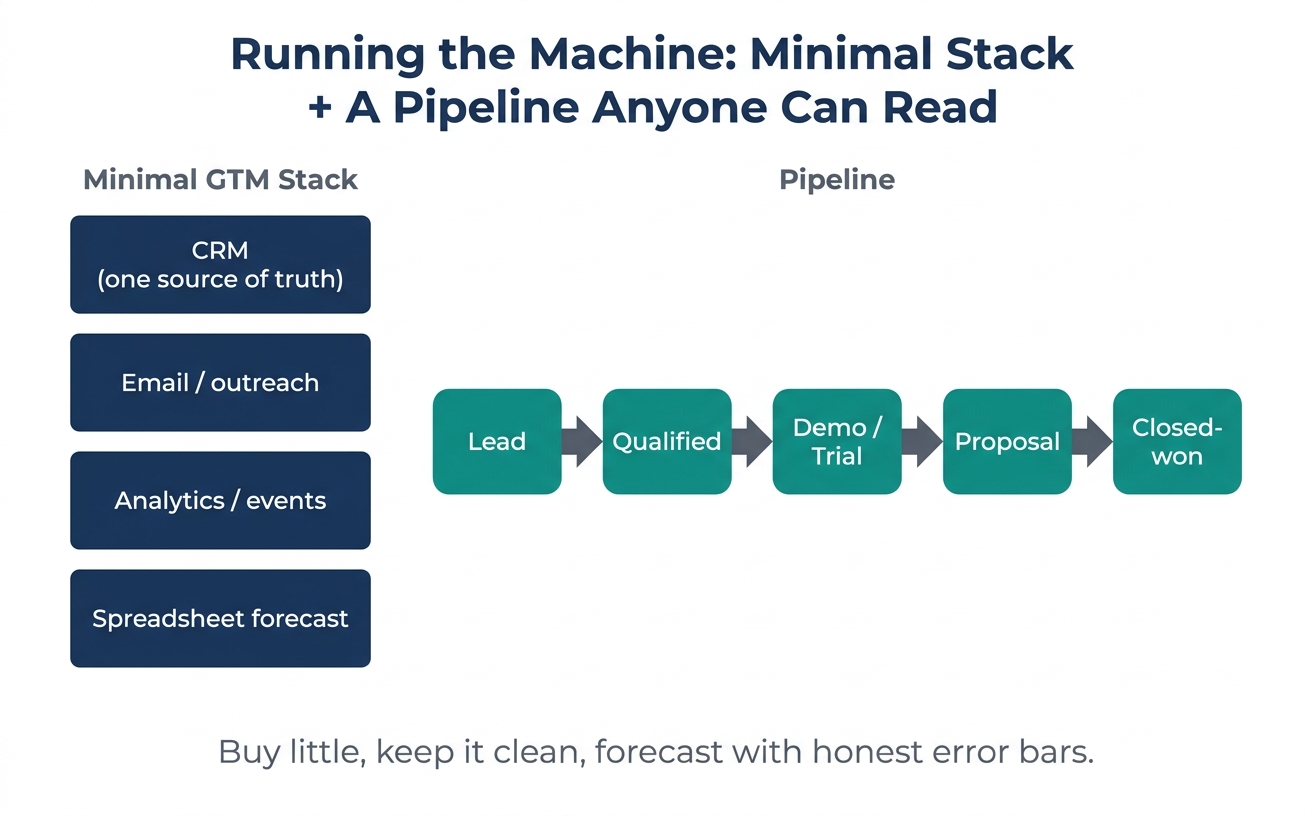
Figure 20.1: A minimal stack and a pipeline anyone can read. Buy little, keep the data clean, and forecast with honest error bars.
For a founder plus one to three sellers, an eight-stage pipeline is enough to be predictive without becoming paperwork:
- Prospecting, identified but no response yet.
- Connect, a real two-way interaction has happened.
- Discovery, a call is completed and the pain is captured.
- Qualified Opportunity, where the deal clears the Qualified bar defined below.
- Solution or Proposal, where pricing or a proof of concept is shared.
- Verbal Commit or Procurement.
- Closed Won.
- Closed Lost, with a required reason from a short picklist.
Write a one- or two-sentence definition of each stage and keep it visible inside the CRM and in your playbook. The definitions are what make the pipeline useful. A stage with no definition becomes a place where two people put two different kinds of deals, and the pipeline stops meaning anything.
The most important definition is Qualified, because that's where founders fool themselves. A meeting alone doesn't qualify a deal. The minimum bar is concrete: at least one discovery conversation is done, the problem is material and the customer agrees it matters, it's a use case you've seen before, there's a champion and a line of sight to an actual buyer, and there's an agreed next step. Enforcing that bar shrinks your pipeline, and what's left is a pipeline you can forecast from.
Clean Data Without a RevOps Hire
You won't have a revenue operations person for a while, so discipline has to do that job: a few enforced rules and one short weekly ritual.
Require a small number of fields at the moments they matter, rather than demanding everything up front. On opportunity creation, require value, close date, persona, and use case. When a deal moves to Qualified, require the fields that prove the bar above: pain, buying role (champion and line of sight to the buyer), timeline, agreed next step, and the competitor you're up against. On Closed Lost, require the reason code. Add a little validation so the system catches the obvious nonsense: no close dates in the past, deal size greater than zero, industry and employee-range present. None of this is heavy; it stops the most common ways data rots.
Then run the ritual. Once a week, block thirty minutes and walk the pipeline: update stages, close dates, and amounts to reflect reality; kill anything that has sat in one stage for more than sixty days; merge the duplicates that have crept in; and check that the six core fields are filled. Automate what you can underneath this, so dedupe and enrichment and the logging of emails and meetings happen without your attention. If you want a single number to watch, track a CRM data-health score, the percentage of open opportunities with their required fields complete. When that number drifts down, your forecast is getting less reliable.
Founder-Type Note: If you're the kind of founder who finds this work painful, don't pretend you'll grow into loving it. Automate aggressively, keep the required-field list as short as it can be while still being predictive, and put the weekly ritual on the calendar as a recurring block you don't negotiate with. The goal is to make hygiene small enough and regular enough that your distaste for it never compounds into a quarter of cleanup.
Forecasting That Is Honest about Its Own Error Bars
Early-stage forecasting won't be precise. You won't hit the number to the dollar, and anyone who claims they do at your stage is either lucky or lying. Forecast anyway, because the discipline shows you where your machine leaks, and do it in a way that admits its own uncertainty.
Start with a weighted pipeline, which is probability by stage multiplied by value. Discovery deals might carry 10-20%, Qualified 25-40%, Proposal 50-60%, and Verbal or Procurement 75-90%. Five proposal-stage deals worth $20K each at 60% give you $60K of weighted pipeline. Treat this as a sanity check, never as the final word, because one whale skews the whole calculation and a weighted number can't tell you that.
Overlay three judgment categories on top of the stages, because human judgment matters as much as math. A deal is Commit when both you and the rep believe it closes this period and there are clear next steps to get there; if it slips twice, it drops out of Commit, because repeated slips are a warning sign. A deal is Best Case when it's realistic but something major is still missing, like budget approval. Everything else open is Pipeline, not in this period's forecast. Then your reporting is clean: Forecast is the sum of Commit, Best Case is Commit plus Best Case, and Total is everything open.
It helps to hold two directions at once. Bottom-up forecasting is the sum of your opportunities times their probability plus any known expansions, and you operate on this weekly. Top-down is the planning view, where a goal like growing three times sets the target and you back into the pipeline, meetings, and outbound touches required to support it. As of September 2026, investors favor the bottom-up, efficiency-minded version, and so should you for running the business day to day.
Be clear with yourself about why the early forecast is unreliable, so the misses don't rattle you. You have few data points, so a single slipped deal can move a month by 30-50%. Your ICP and pricing are still evolving, so win rates and cycle times are unstable. Founders and reps suffer from happy ears, hearing commitment where there was politeness. And the CRM data is incomplete more often than you'd like. Expect plus or minus 30-50% error early, and spend your attention on the inputs you can improve: win rate, stage progression, and cycle time. As those improve, forecast accuracy improves with them.
The Few Metrics That Earn a Dashboard
You don't need a wall of charts. A handful of numbers, each with a rough target, tells you whether the machine is healthy.
Pipeline coverage is your period pipeline divided by your period target. For new logos, 3-5x is healthy, with higher-win-rate motions closer to 3x and outbound or lower-win motions wanting 4-6x; early on, aim for around 4x until your win rate stabilizes. Alongside it, watch new opportunity creation, where roughly two to four qualified opportunities per rep per month is a reasonable floor.
On conversion, track win rate from qualified opportunity, where 20-25% is workable, 25-35% is strong, and many early teams sit at 15-25% while the ICP evolves. Watch cycle time by segment, because it tells you when deals are stalling in a stage: SMB deals tend to run 20-45 days, mid-market 45-90, and enterprise 90-180 or more. You want cycle time stable or shortening, not quietly stretching.
On unit economics, keep three simple measures. CAC is sales and marketing spend divided by new customers. CAC payback in months is CAC divided by gross margin times monthly ARPU, and below 12-18 months is strong, though many teams sit at 18-24 or more. For a bootstrapped SMB motion, hold Chapter 8's target of 4-6 months (recover CAC within 6 months); the 12-18 month band describes sales-led mid-market teams. Net revenue retention is start MRR plus expansion minus churn and contraction, over start MRR, and healthy bands run 100-110% for SMB, 110-120% or better for mid-market, and 120% or more for enterprise. Once you have a base of customers, layer in gross revenue retention, logo churn, and expansion bookings, but not before they'd mean anything.
| Measure | Healthy band | Reality for early teams |
|---|---|---|
| Pipeline coverage (new logo) | 3-5x, 4-6x for outbound | Often run thin at 1-2x |
| Win rate from qualified | 25-35% strong | 15-25% while ICP evolves |
| CAC payback | Under 12-18 months | Frequently 18-24+ |
| Net revenue retention | 110%+ mid-market | SMB struggles to hold 100% |
Attribution the Lazy but Honest Way
You will want to know where good opportunities come from, and you can answer it well without an attribution platform. Use two cheap views and accept that neither is perfect.
The first is self-reported. Put a required "where did you first hear about us?" field on your demo form. It's unscientific, but it's the only thing that reliably catches dark social and word of mouth, the conversations in private channels and DMs that no tracking pixel will ever see.
The second is system first-touch: let the CRM log the first page or campaign that brought someone in, using a deliberately simple taxonomy like "2025-06 Webinar, AI Ops" or "Google Ads, Brand." Roll opportunity source up into two buckets, Inbound and Outbound, and compare win rate, cycle time, and CAC across those sources. That comparison answers the question that matters, which is where to put your next dollar and hour. Skip multi-touch attribution models early. They demand more clean data than you have and answer a question you're not yet big enough to need answered.
Where AI Helps the Machine
AI pays off for a tiny ops function as long as you point it at execution, not at the foundation. As of September 2026, a few uses earn their keep. AI is good at data hygiene and enrichment: the dedupe, lead-to-account matching, and field normalization you'd otherwise do by hand. It is good at call summaries and note-taking, pulling next steps, objections, and competitor mentions out of a conversation, which operators consistently report as the most tangible day-to-day value.
It can do simple forecasting and risk scoring, flagging at-risk deals from activity, stage age, and the language in emails; the unglamorous version of this is a rule like "no meeting in 21 days and a close date this month equals at risk," and it works. It can prioritize signal and intent, surfacing accounts that look like your best customers. And it can assist with content and outbound drafts and with turning notes into CRM fields and tasks.
What to ignore is the hype that sits on top. Be wary of black-box propensity scores you can't interrogate, of "autonomous selling" that removes the human (the best results still come from narrow, supervised use), and of standalone AI tools that don't integrate with your CRM, which inevitably become dashboards nobody opens.
When to Hire Your First Ops Person
You'll know it's time before you can quite justify it. The signals cluster: three to five or more GTM people each maintaining their own private spreadsheet; leadership unable to consistently answer basic questions like win rate by segment or which channels are efficient; a second or third major tool going in with integrations that feel fragile; forecast calls that argue about whose data is right instead of about strategy; and you or a sales leader spending more than 20-30% of your time on cleanup and reporting.
The first ops hire usually lands around $1M-$3M ARR with three to six reps, or earlier if you're a founder who hates this work. A useful intermediate step is fractional RevOps, six to twelve months before a full-time hire, to stand up the data dictionary, the stage definitions, the core dashboards, and basic governance, so that when you do hire, the person inherits a foundation instead of a cleanup project.
Six Ways Small Teams Get Operations Wrong
- Over-engineering too early. A complex process and a big stack at $1M-$5M ARR bury a still-soft product-market fit under tooling.
- Messy definitions producing messy data. When everyone means something different by MQL, opportunity, or a given stage, each person reads the pipeline differently and nobody's version matches.
- Avoiding the boring hygiene. No required fields, no scrubs, no dedupe, and then AI and dashboards layered on top of junk data, confidently reporting nonsense.
- Buying tools instead of fixing the motion. A low response rate is rarely solved by a better sequencer. Fix the inputs first, the message and the data, before you optimize the pipeline that carries them.
- Channel extremes. Either addiction to a single channel, or fifteen channels running at once with no measurement, so you can't tell which of them is working.
- No owner for the data. When nobody owns the CRM, everyone assumes someone else is updating it, and that turns into months of cleanup later.
How the Pattern Plays Out
Take a composite: a roughly fifteen-person SaaS company at about $1.5M ARR ran HubSpot plus Apollo with native reporting and a six-stage pipeline. What they changed was discipline, not tooling. They required the Qualified bar (pain, a champion with line of sight to the buyer, timeline, and an agreed next step) to be filled in before a deal could enter Qualified, ran a weekly 45-minute review, kept required-field completeness above 95% with a monthly audit, and added AI meeting summaries into HubSpot plus one simple rule: no new meeting in fourteen days flags the deal as at risk.
After tightening qualification and pruning the fake pipeline that the old loose bar had let in, win rate moved from 18% to 28%, and once they enforced Commit discipline, forecast accuracy went from plus or minus 45% to plus or minus 20%. The change was ordinary: they stopped counting deals that weren't real.
A larger composite team, around forty people at $5M-$7M ARR running a product-led motion with sales assist, shows what the next stage looks like. They ran HubSpot plus product analytics like Pendo or Heap plus a small warehouse feeding a BI layer, and their first RevOps hire built a unified data dictionary and replaced dozens of conflicting dashboards with five to seven core metrics. They used AI to score accounts on usage, firmographics, and web signals so sales spent its time on the top tier. The result was pipeline coverage falling from a noisy 6-8x to a clean 3-4x while the company kept growing, along with higher rep productivity and stronger retention. The lesson both companies point at holds at every size from a solo founder upward: a simple stack plus strong definitions plus disciplined hygiene plus targeted AI beats complex tooling. A one-person version is a free CRM, written stage definitions, and thirty minutes on Friday.
Stand It Up This Week
You don't need to absorb all of this before you act on any of it. Three moves this week put the machine on a foundation. Stand up a CRM, even the free tier of HubSpot or Pipedrive if you have no revenue data yet, so there's one source of truth instead of a spreadsheet. Write your stage definitions in plain language, especially the Qualified bar, and make sure anyone selling has read them. And put the weekly thirty-minute hygiene ritual on the calendar as a standing block. That's the whole starting kit.
The motion you choose (Chapter 16) and the people you hire to run it (Chapter 21) are what scale you. Operations is what lets you see what's happening as you scale, so the first month three deals go quiet at once doesn't take you by surprise. Build the boring version well, and a team of a handful can run a go-to-market machine without losing track of it.
Sources
[1] https://madrona.com/revops-framework-2026 [2] https://leandata.com/blog/ai-revops-realities-2026 [3] https://skaled.com/insights/revops-trends-2026 [4] https://revopscoop.com (data foundation 2026) [5] https://oliv.ai/blog/build-revenue-operations-function [6] https://syncgtm.com/blog/best-revops-ai-tools-2026 [7] https://elefanterevops.com/blog/revenue-operations-strategies