
Chapter 15: Community and Social Proof: Building Trust That Sells for You
When people are uncertain, they look to others for guidance [1]. In Northwestern University's Spiegel Research Center analysis of online retail reviews, a product with five reviews was 270% more likely to be purchased than one with none [2]. For founders and small teams without brand recognition or a sales force, community presence and social proof are essential.
Case Study (First Customer from a Comment): A founder needed his first paying customer: no audience, no proof. In a founder subreddit, someone asked how to handle cold email. He wrote a detailed reply with what had worked, then mentioned building something to help, without a link or a pitch. The person DMed him, they talked, and that person became customer number one.
The Trust Deficit Problem
When you're unknown, every claim you make is suspect. "I can help you with X" sounds like every other pitch in a prospect's inbox, and they have no evidence you can deliver and no context for who you are.
Enterprise companies solve this with brand recognition; funded startups, with investor logos. You can demonstrate expertise before asking for anything, let others vouch for you, and show up consistently where your customers spend time.
Borrow Before You Build
When founders hear "community-led growth," many decide to start a community. Don't, at least not yet.
Building a community from scratch takes 6-12 months to generate meaningful activity, and a Discord server with three users looks abandoned. Without a community team, you need efficiency. Borrow existing communities first: show up where your customers already gather and let those communities do the aggregation work you can't afford to do yourself.
Where your customers gather:
For B2B founders:
- Reddit: r/startups, r/SaaS, r/entrepreneur, r/smallbusiness, plus niche subreddits. 116 million daily active uniques in Q3 2025, up 19% year over year [3], but its users are openly hostile to marketers, which forces value-first participation.
- Indie Hackers: Bootstrapped founders sharing revenue and lessons, strong signal-to-noise, great for founders targeting other founders.
- Hacker News: Technical audience; "Show HN" launches drive traffic and comments build reputation over time.
- Product Hunt: Best for launches; ongoing engagement builds relationships.
- LinkedIn groups / Slack communities: Less active than Reddit but higher-quality, relationship-focused B2B audiences.
For creator founders:
- Reddit: Topic subreddits (r/marketing, r/productivity, r/entrepreneur), same value-first approach.
- Facebook groups: Niche groups with higher engagement than public pages.
- Twitter/X communities: Building in public and joining relevant conversations, high ROI for creators.
- Discord / Substack comments: Real-time, relationship-building engagement with engaged readers.
Find where real conversations happen, not where marketers broadcast at each other. Start with 2-3 communities at most; it's better to be active in a few places than spread thin.
When You're Ready to Build Your Own
Once you have 50+ active users asking for a dedicated space, consider building your own. Options under $200/month: Slack or Discord (free), Circle ($49/month), Skool ($99/month). Many successful founders never build their own; they stay active in existing communities and focus energy on product. Guesting on podcasts, collaborating with complementary founders, and writing guest posts give you audience access without the overhead.
The Helper Approach
Show up in communities to help, not to sell, drawing on the positioning from Chapter 2 and the messaging from Chapter 13 (you know who you're helping and what problems matter). Reddit is the best example because its users are openly hostile to marketers, and that constraint forces the right behavior: users downvote promotional content heavily but upvote and remember someone who helps them.
The tactic: Find "problem awareness" threads, posts where someone is struggling with something you understand (see Reddit Strategy below for search queries). Reply with substance (the framework, the steps, the thinking), not "check out my tool." If you have something relevant, mention it naturally at the end, but value comes first.
What not to do: "I built a tool that solves exactly this! Check it out at [link]."
What works: "I dealt with this for months. Here's what finally worked: Step 1 [advice], Step 2 [more], Step 3 [more]. I ended up building a small calculator to automate Step 2, happy to share if it'd help."
The second version provides value whether or not they ever look at your tool, so when they do check your profile, they're already inclined to trust you. This works because of trust transfer: when a community accepts you (your comments get upvoted, your answers thanked), its credibility carries over to you. Paid promotion breaks the mechanism, which is why it backfires in authentic communities.
The time commitment and ROI:
| Metric | Typical Range | Notes |
|---|---|---|
| Time Investment | 30 min/session, 3-5 days/week | Counts toward your 5-7 weekly hours; consistency beats length |
| Lead Generation | Varies widely | From 2-3 active communities; track your own |
| CAC (Community) | $0 (time only) | Compare to about $341 for paid B2B SaaS acquisition (Chapter 8) |
| Attribution | Ask new customers | Direct attribution is difficult |
| Compound ROI | Months to years | Comments/posts continue generating value long-term |
To track community ROI, add a "First Awareness Source" field to your CRM (Chapter 20 covers attribution). Phrase the question as "where did you first see my name?" to catch community and word-of-mouth touches. Tag community-sourced leads and compare CAC to paid channels quarterly.
Two case studies show the payoff. GummySearch: Founder Fed built a Reddit research tool, then shared it in r/Entrepreneur, r/SaaS, and niche subreddits (value first, tool as resource) while building in public on Twitter, reaching about $100K in revenue with almost no acquisition spend [4]. (GummySearch later wound down in 2025 after failing to agree on a commercial license for Reddit's data API [5], the platform risk Chapter 12 describes.)
Creator Science: Jay Clouse built a creator-education business through consistent work around The Lab, an application-only membership initially capped at 200 members with annual plans only; in 2024 Creator Science brought in $830,000, about half of it from the membership [6]. It shows where borrowed-community work can lead: once you've earned an audience, a small owned community at premium pricing can carry a large share of revenue.
Platform-Specific Strategies
Reddit Strategy
Build karma slowly: 1-2 comments/day for the first weeks without promoting; aim for 2,000-10,000+ karma (Experienced tier) for credibility. Cap at ~10 comments/day to avoid spam filters, and always disclose: "Full disclosure: I'm the founder of X."
Select subreddits carefully: 2-3 maximum initially, where your ICP participates. Check the rules (many have weekly "Share Your Project" threads), and favor active communities with recent posts over large but dead ones.
Find problem-awareness threads with Google queries:
site:reddit.com/r/[niche] "how do I"site:reddit.com/r/[niche] "struggling with"site:reddit.com/r/[niche] "recommendation for"site:reddit.com/r/[niche] "alternative to [competitor]"
Indie Hackers Strategy
Share revenue milestones and specific metrics (MRR, growth), post "How I built X" stories, and comment on other founders' posts with useful help. Search "How do I..." and "What's working for..." threads: they signal someone ready for solutions. Budget about 15-30 minutes daily; daily commenting beats frequent posting.
Hacker News Strategy
Show HN launches can drive significant traffic, but most don't reach the front page. The real opportunity is comment-based reputation building over 6-12 months: engage where you have expertise and reference your experience naturally. Build karma before any launch. Budget about 15-20 minutes daily; HN rewards depth, so one excellent comment beats ten mediocre ones.
Product Hunt Strategy
Launch day: submit early (midnight PT), line up a hunter with good PH reputation, rally supporters to upvote and comment, and reply to every comment personally. Ongoing: give honest feedback on other launches, build relationships with active members, and use "Featured on Product Hunt" as a credibility signal in outreach.
Building in Public
"Building in public" is a trend, but the idea behind it is older: people trust an honest account more than a polished one. Sharing the messy reality of building (the failures, the pivots, the lessons) creates a connection marketing copy can't.
What to share:
- The wins, humbly: "Hit 10 customers this month. Here's what I learned getting there."
- The losses, with lessons: "Lost my biggest customer this week. Here's where I went wrong."
- The process: "Here's exactly how I structure my discovery calls, and the question I always forget."
Where to share: LinkedIn and Twitter/X both reward consistent, honest content from individuals: short posts about real experiences, specific enough to be useful.
Case Study: Base44: Solo-Owned to an $80M Acquisition in 6 Months [7] Maor Shlomo built Base44, an AI app-building product, largely in public, chronicling launches, feedback, and limitations on LinkedIn and X. Six months after it started as a stand-alone company, Wix bought it for $80 million in cash in June 2025; by then it had reportedly grown to 250,000 users and was making nearly $200,000 a month in profit [7].
GTM OS launched in February 2026, alongside my first book, AI-Powered Customer Acquisition Playbook, before the full marketing engine was in place, and I'm building that engine in public; the changelog at SoloFrameHub.com/updates shows what ships as it ships. The book itself is part of the authority strategy: content marketing at book scale, building the "topical authority" Chapter 14's AEO framework describes.
The Proof Ladder
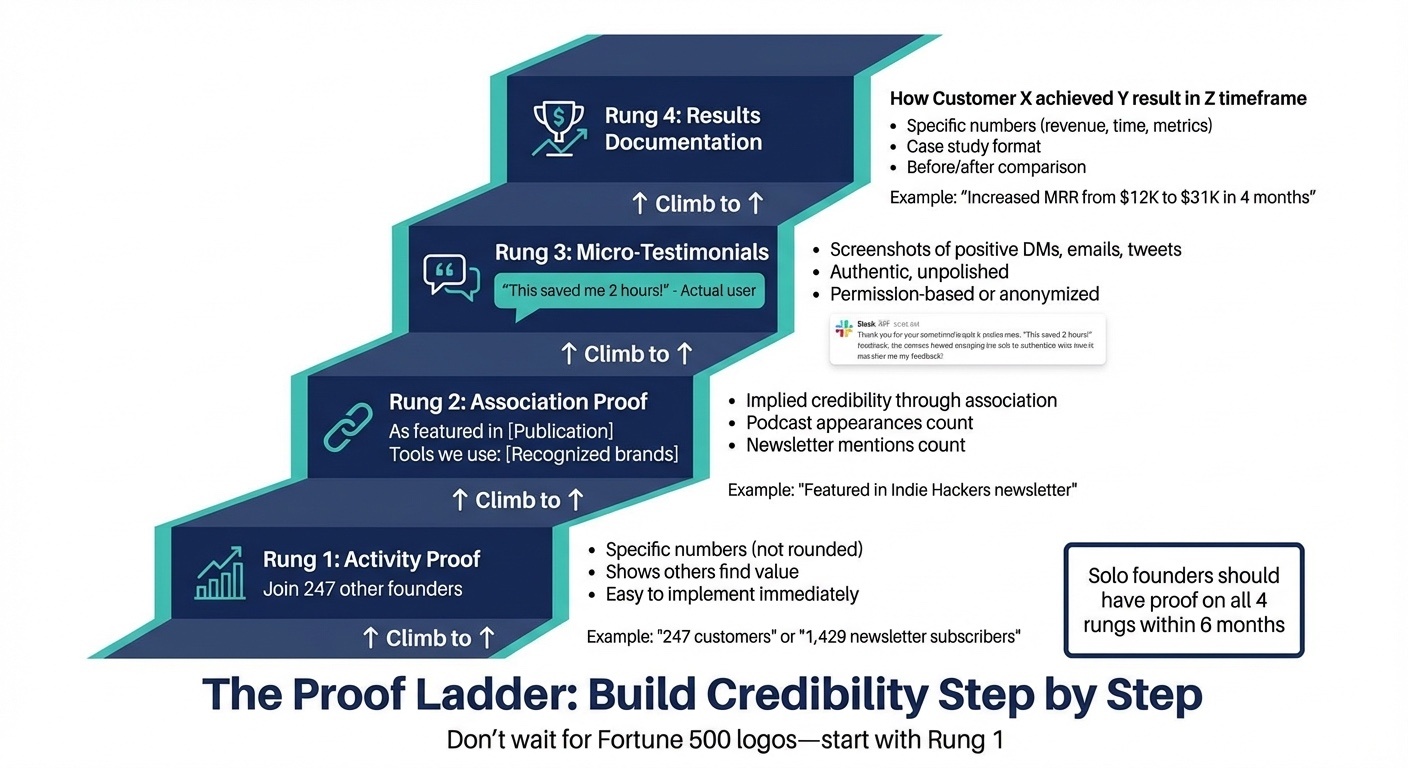
Figure 15.1: The Proof Ladder. A progression from basic activity proof to powerful results documentation. Start at Rung 1 (Activity proof: "Join 512 other founders") and climb through Rung 2 (Association proof: "As featured in..."), Rung 3 (Micro-testimonials: screenshot positive feedback), to Rung 4 (Results documentation: specific case studies with numbers). You don't need Fortune 500 logos; you need systematic credibility building.
You don't have Fortune 500 logos or thousands of customers to cite yet. But you can build credibility systematically with the proof ladder, a progression from basic activity proof to results documentation, building on Chapter 6's retention work: every customer you keep becomes potential social proof.
Rung 1: Activity proof. "Join 512 other founders" sounds modest, but it's real. You're showing that others find this valuable enough to engage. Specific numbers beat vague claims: "247 customers" is more credible than "hundreds" because it sounds counted, not estimated.
Rung 2: Association proof. "As featured in [publication]" or "Tools we use: [recognizable names]" creates implied credibility. You don't need TechCrunch. A niche newsletter mention, a guest post, a podcast with a few hundred listeners all count. The tech you use sends a signal too: "Built on [trusted infrastructure]."
Rung 3: Micro-testimonials. Don't wait for a formal video. Screenshot positive DMs, emails, or tweets. "This saved me 2 hours!" in a chat bubble feels more authentic than a polished production. Ask permission when possible; even anonymized feedback ("Solo SaaS founder, 12 customers") carries weight when it matches your buyer.
Rung 4: Results documentation. Case studies don't need to be elaborate. "How [Customer] achieved [Result] using [Your Product]" in 500 words with specific numbers beats a 3,000-word marketing piece. Use specific numbers: "increased monthly revenue from $12,000 to $31,000 in four months" is far more believable than "increased revenue."
Review Site Strategy
For B2B products, review sites like G2 and Capterra are increasingly pay-to-play for top placement. Don't try to outspend competitors. Use them as "trust repositories": a presence with real reviews gives you something to link to when prospects research you. For creators, the equivalent is Gumroad reviews, Teachable ratings, or tools like Testimonial.to.
Testimonials That Convert
Not all testimonials are equal. Specificity beats vagueness ("We reduced time-to-close from 45 days to 22 days" vs. "Great product!"). Results beat features, and transformation beats satisfaction ("I went from dreading sales calls to looking forward to them"). Include role and company when possible: "Senior Developer at Stripe" carries more weight than "John S." Reviews pay off, too: Spiegel's retail data found the biggest jump in purchase likelihood comes from the first handful of reviews [2].
Video testimonials add a face and a voice, which text can't. Even so, a natural, slightly awkward 30-second phone recording is more trustworthy than a polished production.
Anti-testimonials work too. Testimonials that acknowledge limitations ("The learning curve is real. But once you get it, you won't go back.") feel more honest than perfect 5.0 ratings; in Spiegel's data, purchase likelihood peaked for average ratings between 4.0 and 4.7 and fell as ratings approached 5.0 [2]. They also pre-qualify: people who read the warning and still proceed are more likely to succeed.
Collecting testimonials: Ask after "value moments" (when a customer achieves a result, finishes onboarding, or renews), not at purchase. Make it easy: "Just 2-3 sentences about what changed for you." When feedback arrives organically, ask "Mind if I use this as a testimonial?" Most say yes, and organic testimonials often convert better than solicited ones.
What backfires: fake reviews (destroy credibility permanently), inflated numbers ("Join 10,000+ users" when you have 200), irrelevant testimonials (Fortune 500 logos for a founder-focused product), and overproduced content that feels manufactured.
The Lean Trust Stack
A complete community and social-proof stack runs under $200/month: community participation (Reddit, Indie Hackers, Twitter/X, LinkedIn) is free; social-proof collection is $0-49/month (Testimonial.to and Senja.io free tiers, plus screenshots); monitoring is free (F5Bot for Reddit keyword alerts, Google Alerts for mentions, a weekly manual search); and an owned community platform, when you're ready, is $0-99/month (Slack or Discord free to start, Circle or Skool once self-sustaining).
The Compounding Effect
Community and social-proof investments compound in ways paid acquisition doesn't. Every helpful comment builds reputation, every testimonial strengthens your landing page, every connection is a potential referral, and that work keeps paying off when you're not actively on it.
For founders and small teams who can't outspend incumbents, trust is the advantage they can build.
A note on paid community tactics: sponsoring communities, buying featured placements, and running ads in Slack groups usually backfire. Community members are quick to spot and distrust paid promotion. The exception is supporting communities you believe in (becoming a patron of a newsletter you read), which is participation rather than buying access.
You've now covered the major acquisition channels, from direct outreach to community building to AI visibility. Part V steps back from individual channels to the strategy that ties them together.
Chapter Summary: TL;DR
The core insight: Community-led growth and social proof build trust before the sale. Borrow existing communities before building your own; help first and don't sell directly.
Key takeaways:
- In Spiegel Research Center's data, a product with five reviews was 270% more likely to be bought than one with none, and ratings of 4.0 to 4.7 outsold perfect scores
- Reddit has 116M daily active users; participate authentically in 2-3 relevant subreddits, value-first
- Video testimonials add a face and a voice; a natural 30-second phone recording beats a polished production
- Building in public: sharing the messy reality of building creates a connection polished marketing can't
- Community contributions compound: comments today generate value for years
Next chapter: Chapter 16 opens Part V with what go-to-market is and how to choose your motion.
The Exercise: Your Community Plan
Build your specific community engagement plan:
- Identify three communities where your customers spend time, using your ICP from Chapter 2: subreddits, Slack groups, LinkedIn communities, Facebook groups, or forums.
- Lurk for one week in each. Note the common questions, active members, and unwritten rules about promotion.
- Schedule 30 minutes, three days a week, for real participation. It counts toward the 5-7 weekly hours from the introduction, not on top of them: if community is your primary channel, it uses some of your Chapter 12 daily blocks; if it's secondary, take it from the 20-30% of time Chapter 13 assigns your secondary channel. Set a calendar block.
- Write your first "building in public" post. Share something real (a win, a loss, a lesson), using the Chapter 13 messaging framework.
- Collect three pieces of social proof this week: screenshot positive feedback, ask a happy customer for a testimonial (Chapter 6 relationships), document a specific result.
- Set up monitoring for your name, product, and competitors; add it to your Chapter 8 metrics dashboard.
- Identify three guesting opportunities: podcasts, newsletters, or communities where you can contribute without building your own audience first.
Chapter Checklist
Before moving to Chapter 16, complete:
- Identified 2-3 communities where your ideal customers already gather
- Created a community participation plan (which communities, what value, what cadence)
- Collected at least 3 pieces of social proof (testimonials, screenshots of feedback, or a documented result)
- Set up a system to request testimonials after customer success moments
- Decided whether building in public fits your style and market
- Mapped your proof ladder: where you are on activity, association, micro-testimonials, and results, and your next rung
Self-assessment questions:
- Am I participating in communities for value or for extraction?
- Do I have enough social proof for prospects to trust me?
- Have I asked my happiest customers for testimonials recently?
- Is my community presence building trust, or does it feel transactional?
[1] Cialdini, R. B., Influence: The Psychology of Persuasion, new and expanded edition, Harper Business, 2021.
[2] Spiegel Research Center, Northwestern University, "How Online Reviews Influence Sales," 2017. https://spiegel.medill.northwestern.edu/how-online-reviews-influence-sales/
[3] Reddit, Inc., "Reddit Reports Third Quarter 2025 Results," October 30, 2025. https://www.businesswire.com/news/home/20251030834086/en
[4] Bay, S., "Bootstrap SaaS to $100K [audience research tool for Reddit]," Indie Hackers, August 2023. https://www.indiehackers.com/post/bootstrap-saas-to-100k-audience-research-tool-for-reddit-b1a07a4897
[5] GummySearch, "The Final Chapter for GummySearch." https://gummysearch.com/final-chapter/
[6] Niche Pursuits, "How Jay Clouse Turned a 200-Member Community into 6-Figure Revenue." https://www.nichepursuits.com/jay-clouse-creator-science/
[7] Bort, J., "6-month-old, solo-owned vibe coder Base44 sells to Wix for $80M cash," TechCrunch, June 18, 2025. https://techcrunch.com/2025/06/18/6-month-old-solo-owned-vibe-coder-base44-sells-to-wix-for-80m-cash/