
Chapter 5: Presenting Your Solution (And Talking About Money)
The discovery call went well. You've qualified them, you understand their problem, and they know it. Now comes the part that trips up most founders: presenting your solution and naming your price. This is the moment your palms get sweaty, when the number you planned to say feels too high and you hear yourself offering a discount before they've even objected.
That reaction has a name, impostor syndrome, and it is common: in Kajabi's survey of 600 US entrepreneurs, 84% scored in the moderate-to-intense range on a standard impostor-phenomenon scale [1]. Many founders price low because a low price makes rejection feel less likely. Underpricing also has other drivers. In FreshBooks' 2018 survey, self-employed women in the US earned 28% less than self-employed men, and some said they had to charge less than male peers to win and keep clients [2].
Underpricing costs more than money: it signals low value, attracts price-sensitive customers, and builds a business that can't sustain itself. Research on B2B firms points the same way: in a survey of 507 account and sales managers, a sales team's collective confidence in its pricing was associated with stronger relative firm performance [3].
Founder-Type Note: Pricing models differ by business type: B2B SaaS uses subscriptions, coaches use program-based pricing or high-ticket offers, creators use product ladders (free → $50 → $500 → $2,000). The principles of value-based pricing apply to all; the structure differs.
This chapter helps you present your solution and name your price without flinching, using the same diagnosis-first approach from Chapter 4.
Why Presentations Fail
Three failure patterns recur. Feature dumping: founders, nervous about silence, fill it with features, each one something the prospect can critique. The best presentations are short. Presenting before diagnosing: without thorough discovery you're guessing, and the presentation becomes a generic pitch. Avoiding the money conversation: founders present beautifully, then mumble the price like an afterthought, which signals discomfort with their own value, and prospects notice.
The Prescription Frame
"In selling as in medicine, prescription before diagnosis is malpractice," as Tony Alessandra put it [4]. The most effective way to present is the Prescription Frame: you act as a doctor would. A doctor doesn't walk in listing medications; they examine, listen, and only then prescribe a treatment. You've done the examination (discovery); now you prescribe based on what you learned. Your question shifts from "Will you buy this?" to "Based on what you told me, here's what I recommend."
Discovery also builds the relationship. Sharp questions about how their business works and what their customers care about show that you take their situation seriously. When buyers feel you understand them before you name a price, they treat you more like an advisor than a vendor, and the price comes across as a professional recommendation.
The transition sounds like this: "I'd like to summarize to make sure I've got it right. You're losing about 10 hours a week to manual processes, you have a Q2 deadline, and you're worried about team buy-in. Did I capture that?" Inviting correction confirms understanding and reminds them why they need a solution. Only after they confirm: "Based on that, I'd recommend [specific solution]."
Case Study (composite, Prescription Frame): A marketing consultant had 12 discovery calls in 3 months but closed only 2 (17%); presentations walked through the entire methodology. After the consultant restructured around the Prescription Frame ("You're spending $8,000/month on ads but only 2% convert, so I'd recommend we fix lead qualification first"), the close rate went from 17% to 42%.
Structure of an Effective Presentation
An effective presentation has four parts:
Part 1: Recap the diagnosis. Use the transition above to summarize and invite correction. Better to learn that now than to present to the wrong problem.
Part 2: Present the solution, connected to their words. Tie every element to something they said. Instead of "our product has automated reporting," say "you mentioned spending 10 hours a week building reports manually. Here's how we automate that." Use their language, and keep it to 3-5 key points.
Part 3: Establish the outcome. Describe life after the problem is solved, in their words: "You said success would mean having your mornings back instead of firefighting reports. That's exactly what this delivers."
Part 4: Name the price and propose next steps. State the investment clearly, immediately connect it to value, and end with a clear proposal. Don't trail off.
The Pricing Conversation
Naming your price is the most exposed moment of the conversation, and how you present it signals what you believe about your value. Sound apologetic and they'll wonder what's wrong. Sound matter-of-fact (this is the investment, here's what you get), and you signal confidence [3].
Present price, then value, in the same breath. This is value anchoring: never let the price hang alone. People's judgments of value drift toward whatever number they see first, an effect psychologists call anchoring [5]. In one well-known experiment, people who first wrote down the last two digits of their social security number were then willing to pay substantially more for ordinary products when those digits happened to be high [6]. Instead of "It's $2,500," say "The investment is $2,500, and based on what you shared about losing $4,000 a month, you'd see ROI within three weeks."
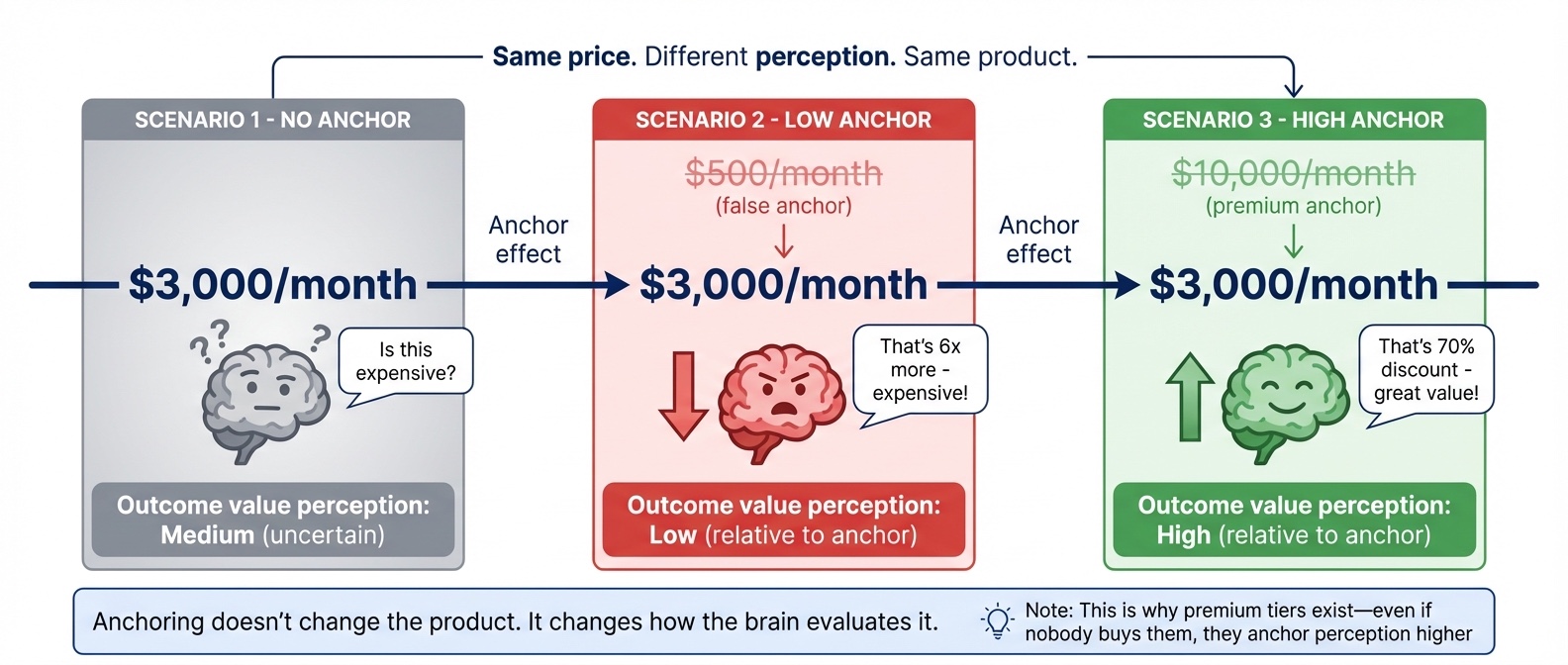
Figure 5.1: How Anchoring Affects Value Perception. The same $2,500 price feels expensive or like a bargain depending on the anchor. Establish the cost of their problem before presenting your solution.
Anchor to the cost of inaction. Use the number you established in discovery: "This problem costs you roughly $5,000 a month. The solution is $2,500, half a month's losses to fix it permanently." If they don't know their costs, help them estimate ("How many hours does your team spend on this?"), or anchor to similar customers: "Most clients in your situation lose 10-15 hours a week to this."
State the price, then pause. After you name it, stop. Don't fill the silence with caveats, discounts, or nervous justification. That signals you don't believe your own number. Let them react, then transition to next steps: timeline, onboarding, what success looks like. Showing you've thought past the sale reinforces that they're making the right decision.
Value Anchoring in Practice
Case Study (composite, value anchoring): A SaaS founder at $297/month lost deals to "more than expected." After the founder reframed the pitch from "The subscription is $297 per month" to "Your team spends 15 hours a week on this, over $3,000 a month, so at $297 you'd save ten times what you invest," the close rate doubled at the same price. A course creator priced at $497 kept hearing "Is that all?"; after anchoring against $3,000-$5,000 alternatives and raising to $997, revenue per sale doubled and the higher price drew more committed students who completed and referred.
B2B Buyers Are Betting Their Reputation
In B2B, especially with larger or regulated customers, your buyer is spending more than budget: they're putting their reputation, sometimes their job, on the line if the project goes badly, so they'll often choose the partner they trust over the cheapest option. Acknowledge it directly ("You're not just evaluating solutions. You're choosing who you'll be accountable for selecting; my goal is to make you look good") and position your support as reputation insurance: "Here's how we handle problems, because they will happen. You'll have my direct line, we review weekly, and if something breaks, I'm explaining it to your team with you."
Case Study (composite, reputation vs. ROI): A founder selling $4,000-a-year compliance software to regional firms tested two approaches across about 40 similar prospects. The ROI approach emphasized 3x return; the reputation approach led with "When this goes to your leadership team, I want you confident you picked a partner who won't disappear when things get hard." The reputation frame closed at 38% vs. 24%.
Handling Price Objections
Price objections are often about something other than price. They tend to signal unvalidated value, unaddressed risk, or confusion about what you're being compared to. When someone says "too expensive," work out what they mean. In B2B it often means "I'm not yet convinced this will work, and I'm the one who'll be blamed if it doesn't." Lower the perceived risk: show proof you've solved this before, outline how you handle issues, and make clear you'll be there when things go sideways.
"That's more than I expected." Don't immediately discount. First understand what they expected. They may have the budget but not yet see the value, have a genuine constraint, or be comparing you to something cheaper that won't solve the problem; you can't respond until you know which.
Top performers handle this by asking: Gong's analysis of recorded sales calls found top reps respond to objections with a question 54.3% of the time, against 31% for average reps [7]. So rather than "I can do $1,800 instead of $2,500" (you just lost $700 learning nothing), ask "What were you expecting?" then "What made you think that range?" Often they're comparing to a DIY tool or junior freelancer, a different solution entirely, and now you can address the real gap.
"I need to check with [spouse/partner/boss]." Often legitimate. Treat it as part of the process. "Absolutely. What do you think their main concern will be? I want to make sure you have what you need to explain the value." Equip them to sell internally, and offer to join a call with the other decision-maker.
"Can I get a discount?" Many founders cave here; don't. Tie any discount to something in return ("15% off for a three-month pilot with a clear scope and a testimonial at the end"), or reduce scope rather than price. Never discount for nothing: an automatic discount destroys margin and teaches the buyer that your first price wasn't real. Consider a discount only for a pilot with clear scope and testimonial, or a multi-year/referral commitment.
"We're looking at other options." Competition is normal. "What are you comparing us to? I'd like to help you make the right decision, even if that's not us." That tells you how they're framing the choice.
"I need to think about it." Usually masks unresolved budget, missing information, or authority issues. High S and High C buyers sometimes do need time; even then, don't just say "Take your time!" and leave it open. Instead: "Of course. When people say that, it's usually one of four things: questions about fit, timing, the investment, or someone else who needs to weigh in. Which is closest?" Then book a specific follow-up. That lets them name the real objection without feeling pressured.
The Close: Asking for the Decision
Many founders do everything right until the end, then never ask for the decision. A direct ask respects the buyer's time, so make it plain: "Based on our conversation, I think this is the right solution for you. Ready to get started?" If they're not ready: "What would need to happen for you to move forward?" Then propose specific next steps: "I'll send the agreement this afternoon; once you sign, we'll schedule onboarding next week. Wednesday or Thursday?"
Use the assumptive close with caution: when they're asking implementation questions ("how quickly can we start?") and objections are addressed, assuming the sale feels natural. When you hear "yes," confirm next steps and end the call. It's easy to talk yourself out of a deal by continuing to pitch after the prospect has already decided.
When to Walk Away
Not every sale is worth making. If you're desperate for revenue, take the deal and manage the consequences; survival comes first. Once you have runway, be selective. Walk away when they haggle aggressively after you've explained value (predicts friction), when their expectations don't match what you deliver, when they're dismissive of your process, or when your gut says no. It sounds like: "I don't think we're the right fit. Let me recommend [alternative] who might be better suited."
Adapting to Buyer Style
The DISC framework matters in presentations too. Match your approach to their style.
- High D (Dominant): Keep it short, get to the bottom line. "Investment: $X. ROI: [calculation]. Ready to move forward?"
- High I (Influence): Let them talk. Share testimonials, emphasize the experience: "You're going to love working with us. Let's get started."
- High S (Steadiness): Don't push. Emphasize support and guarantees: "Take the time you need. I'll send materials, and we can reconnect next week."
- High C (Conscientiousness): Bring data, be precise, answer detailed questions. Close with logic: "Based on the specs we discussed, this addresses your requirements." High C buyers trust your pricing when you show a spreadsheet proving 3:1 ROI.
A presentation that works for a High D will frustrate a High C, so adjust to the person in front of you.
After the Presentation
If they said yes: confirm within the hour ("As discussed, [summary]. Next step: [action]. Agreement attached"). The longer you wait, the more time for doubt. If they said no: thank them, ask what drove the decision, offer to stay in touch; "no" sometimes becomes "yes" months later. If they need to think about it: set a specific follow-up. Many sales take several follow-ups before a decision.
The Psychology of Pricing Confidence
Most pricing problems are psychological. The fix is to price on value delivered, then communicate it confidently. If your $2,000 product saves them $10,000 in year one, that's a 5x return, which makes it a bargain. A simple ROI calculator helps buyers quantify the impact before they buy. Practice saying it: "The investment is $2,000, and based on what my clients experience, you'll see five times that in year one." If you haven't delivered results yet, start with prices that feel slightly uncomfortable and raise them as you gather evidence. If you don't believe your price is fair, either your price is wrong or your understanding of your value is.
Pricing Structure Decisions
Should you offer one price or multiple tiers? When buyers see three options, many gravitate to the middle one, a pattern consumer researchers call the compromise effect [8]. But start with one tier until you understand your market: early on you lack the data to design meaningful tiers, and premature tiering adds complexity without insight. Once you have 10-20 customers, natural segments emerge. Make each tier obviously different, and use the high tier as an anchor: a premium option makes the middle tier feel more reasonable [8]. Start simple; add complexity when customers tell you they need it.
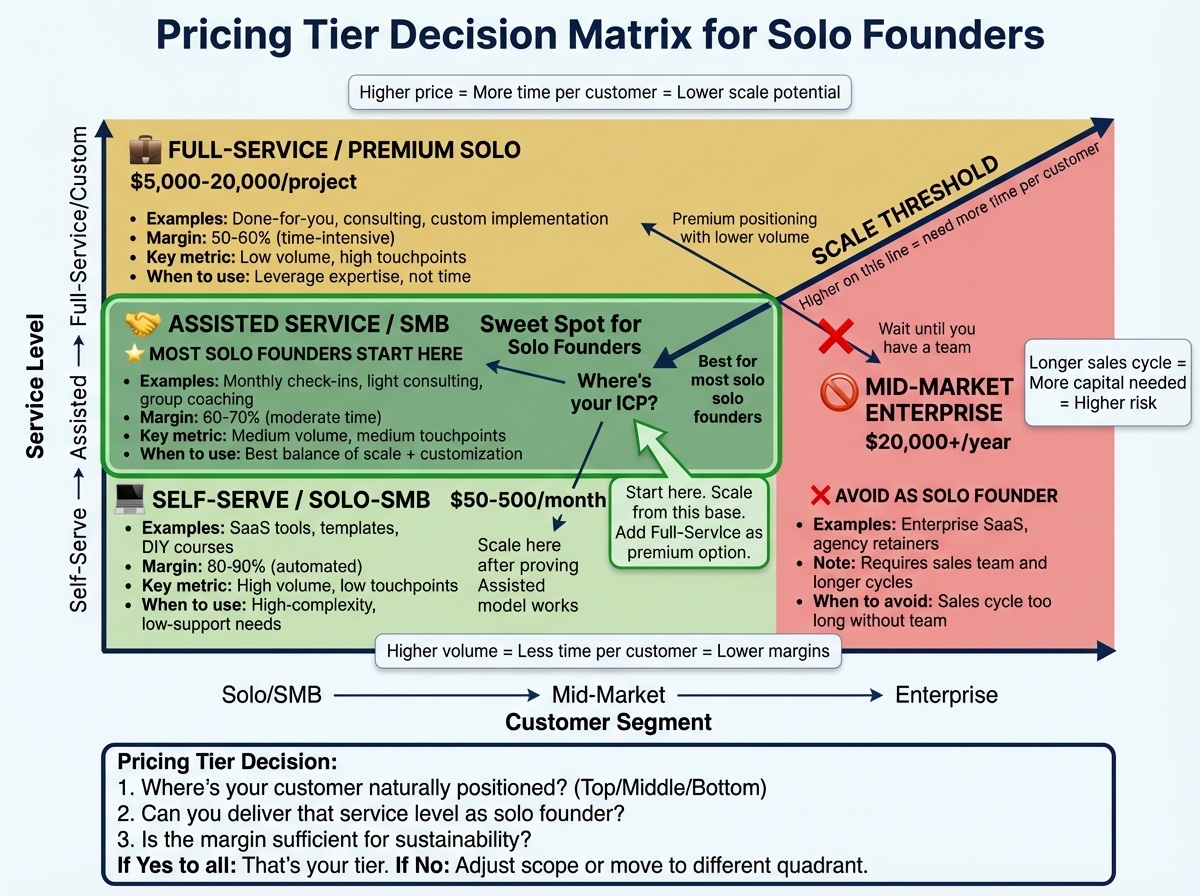
Figure 5.2: The Pricing Tier Decision Matrix. For founders and small teams, the "sweet spot" is typically Assisted Service for SMB customers ($500-$5,000, monthly or per engagement).
Chapter Summary: TL;DR
The core insight: Present your solution as a prescription, not a pitch. The questions you ask in discovery build more trust than the pitch itself. In B2B, buyers are betting their reputation on you, so trust matters as much as ROI.
Key takeaways:
- Prescription Frame: you've done the examination (discovery), now prescribe the solution
- Discovery builds relationships: sharp questions shift you from vendor to consultative peer
- B2B buyers put their reputation on the line; they want a partner who'll be there when things go wrong
- Value anchoring: never let price hang alone. State it, then immediately connect to value
- Objections often mask risk: "too expensive" frequently means "I'm not convinced this works and I'll be blamed"
- DISC: High D wants the bottom line, High I wants stories, High S wants reassurance, High C wants data
- Ask before you discount: top reps answer objections with a question far more often than average reps [7]
If pricing conversations drain you or you're avoiding them: See Chapter 12 (sustainability and recovery).
Next chapter: Chapter 6 covers retention, referrals, and growing revenue from existing customers.
The Exercise: Prepare Your Presentation
Before your next qualified prospect:
- Write your transition statement: the exact words to summarize their situation and propose your solution.
- Map 3-5 solution elements to specific problems they described.
- Calculate their ROI and practice saying it naturally.
- Practice your price statement: price, then value connection, until it sounds natural.
- Prepare responses to the three objections you hear most often (from this chapter's five), delivered without sounding defensive.
- Script your close: direct and specific.
Aim to internalize the structure rather than memorize a script, so you can adapt in the moment.
Chapter Checklist
Before moving to Chapter 6, complete:
- Written your transition statement (from discovery to presentation)
- Mapped 3-5 solution features to specific problems from discovery
- Calculated ROI for typical customer scenarios
- Practiced your price statement with value connection
- Prepared responses to the 3 objections you hear most often (from this chapter's five)
- Scripted your close question
Self-assessment questions:
- Am I presenting as a prescription (based on diagnosis) or a pitch (generic)?
- Can I state my price confidently with immediate value connection?
- Have I adapted my presentation approach to their DISC type?
[1] Kajabi, "Impostor Phenomenon Study: Most Entrepreneurs Affected," November 2020. https://kajabi.com/blog/impostor-phenomenon-study. 600 US entrepreneurs and small business owners scored on the Clance Impostor Phenomenon Scale; 84% scored at moderate, frequent, or intense levels. Kajabi found men and women affected at similar rates.
[2] FreshBooks, "New Research from FreshBooks Discovers a 28% Wage Gap Among Self-Employed Women and Men," Women in the Independent Workforce report, May 2018. https://www.freshbooks.com/press/data-research/women-in-the-workforce-2018
[3] Liozu, S. M., "Pricing superheroes: How a confident sales team can influence firm performance," Industrial Marketing Management 47, 2015, pp. 26-38. https://doi.org/10.1016/j.indmarman.2015.02.003. Survey of 507 B2B account and sales management professionals.
[4] Alessandra, T., Wexler, P., and Barrera, R., Non-Manipulative Selling, Simon & Schuster, 1992 edition.
[5] Tversky, A., and Kahneman, D., "Judgment under Uncertainty: Heuristics and Biases," Science 185(4157), 1974, pp. 1124-1131. https://doi.org/10.1126/science.185.4157.1124
[6] Ariely, D., Loewenstein, G., and Prelec, D., "'Coherent Arbitrariness': Stable Demand Curves Without Stable Preferences," Quarterly Journal of Economics 118(1), 2003, pp. 73-106. https://doi.org/10.1162/00335530360535153
[7] Gong, "30 Mind-Blowing Sales Stats That Will Change The Way You Sell." https://www.gong.io/blog/sales-stats
[8] Simonson, I., "Choice Based on Reasons: The Case of Attraction and Compromise Effects," Journal of Consumer Research 16(2), 1989, pp. 158-174. https://doi.org/10.1086/209205