
Chapter 4: The Discovery Call That Actually Works
Neil Rackham's research at Huthwaite International, which observed more than 35,000 sales calls over 12 years, found that in larger, more complex sales the most successful sellers asked more and better questions about the buyer's problems instead of pitching early [1]. In complex sales, good questions matter more than a polished pitch, especially with buyers who need to understand their problem before evaluating solutions.
Yet many founders run discovery as a checklist: questions asked without listening, and a rush to pitch before they understand the problem. Call data points the same way: in Focus Digital's 2025 benchmarks, sales calls under five minutes succeeded 3.2% of the time, against 22.1% for calls of 30 to 60 minutes [2]. Some of that gap is selection (calls run long when the prospect is engaged), but the takeaway holds: duration matters less than whether the call leaves room for diagnosis.
A discovery call is for finding out whether you can help this specific person with their specific problem. If you can, the sale becomes a logical next step. If you can't, you've saved everyone's time. As sales author Tony Alessandra put it: "In selling as in medicine, prescription before diagnosis is malpractice" [3].
Founder-Type Note: B2B founders deal with multiple stakeholders and approval processes; coaches and creators sell to individual decision-makers where emotional readiness matters more. The qualification framework in this chapter (MVQ, introduced below) applies to both; the decision-mapping differs.
Why Traditional Qualification Fails
Enterprise teams use frameworks like BANT (Budget, Authority, Need, Timeline) and MEDDIC (Metrics, Economic Buyer, Decision Criteria, Decision Process, Identify Pain, Champion). These work for large organizations selling six-figure deals to buying committees.
BANT is usually credited to IBM's mainframe sales teams of the 1950s and 1960s, and it still shapes much enterprise qualification, but its rigid "do you have budget" questioning feels like an interrogation at lower price points. At $500-$5,000, budget is often created on the spot if the value is clear. MEDDIC, created at PTC in 1996 for complex enterprise software deals, requires identifying champions and mapping decision processes [4]; for a deal under $5,000, that is overkill.
Qualification still matters at small deal sizes; it just has to be lighter. When you're a founder without a sales team to work volume, every hour spent on a deal that was never going to close is an hour taken from one that would.
The framework that works for founder-led sales is simpler but still rigorous: figure out quickly whether this person has a problem you can solve, whether they're motivated to solve it now, and whether they can decide to buy.
The MVQ Framework: Minimum Viable Qualification
For founders and small teams selling to individuals (whether B2B or creator context), this book uses a simplified framework called MVQ (Minimum Viable Qualification; see Appendix: Glossary). It compresses the core of MEDDIC and the pain-first discipline of consultative selling into three questions that fit the $49-$5,000 offers this book targets: Pain, Impact, and Decision.
For creators and coaches: discovery with individual buyers centers on emotional readiness. Do they have the pain, are they ready for change now (not "someday"), and can they decide without extended deliberation? There is usually a single decision-maker. For B2B SaaS founders and consultants: even at lower price points, you deal with other stakeholders. Who else influences the decision, what's the internal approval process, and what competing initiatives might deprioritize this? Buying committees show up even at $2,000-$5,000.
Pain: Do they have a specific problem you can solve? You're looking for a concrete pain point that causes real friction, rather than vague dissatisfaction. The more specific, the better. "Marketing isn't working" is vague. "We're spending $5K/month on ads and getting zero qualified leads" is specific.
Impact: What's the cost of not solving this? Pain alone isn't enough. People live with pain all the time. What makes them act is understanding what it's costing them in money, time, stress, opportunity, or risk. If the impact is small, they won't prioritize solving it.
Decision: Can they decide to buy? What matters is whether they can commit resources to solving this, whatever their title. For B2B that means budget authority; for individuals it might mean a spouse or partner. You're learning who else needs to be in the conversation; a partner's involvement doesn't disqualify anyone.
When all three are present (acute pain, significant impact, decision authority), you have a real opportunity. When one is missing, develop it or move on. The data backs this up: in an analysis of more than 2.5 million recorded sales conversations, 40% to 60% of deals ended in "no decision," with the buyer unable to commit, rather than in a loss to a competitor [5]. MVQ forces those questions early, before you invest weeks in a deal that was never going to close.
Case Study (composite, creator/coach): A leadership coach spent 45 minutes on a call with anyone who booked; most never converted. She implemented MVQ with explicit checks: probing for the specific trigger behind vague answers ("I want to be a better leader"), asking about the cost of inaction (e.g., being passed over for promotion again, or losing two direct reports this year), and confirming whether a spouse or the employer would be involved in paying. Her MVQ check took 12 minutes, and her close rate went from 18% to 41% over 6 months.
The 30-Minute Discovery Structure
Longer discovery calls go with better outcomes: 22.1% success for 30-60 minute calls versus 3.2% for calls under five minutes, in the benchmark above [2]. The problem is time: 30 prospects a week at 30 minutes each is 15 hours, more than double the 5-7 hours a week this book assumes you have for acquisition, before follow-up, prep, or actual work.
The realistic approach: use short qualification calls (10-15 min) to filter aggressively upfront, reserve 25-30 minute deep discovery for A-tier prospects only, and accept that you'll say no to most inbound. (For small teams, this is the natural first split to delegate: a rep can run the qualification calls and hand A-tier prospects to whoever owns the close.)
The structure below works for deep discovery with qualified prospects. Most should take 20-30 minutes; if yours run longer, check who is doing the talking. A long call driven by the prospect's answers is fine; a long call driven by your explanations is not.
Expect your first 10-20 calls to feel awkward. That's the learning phase; by call 30 the structure becomes automatic. Treat the first 20 as deliberate practice: follow the framework instead of chasing closes, and the close rate will follow once the mechanics feel natural.
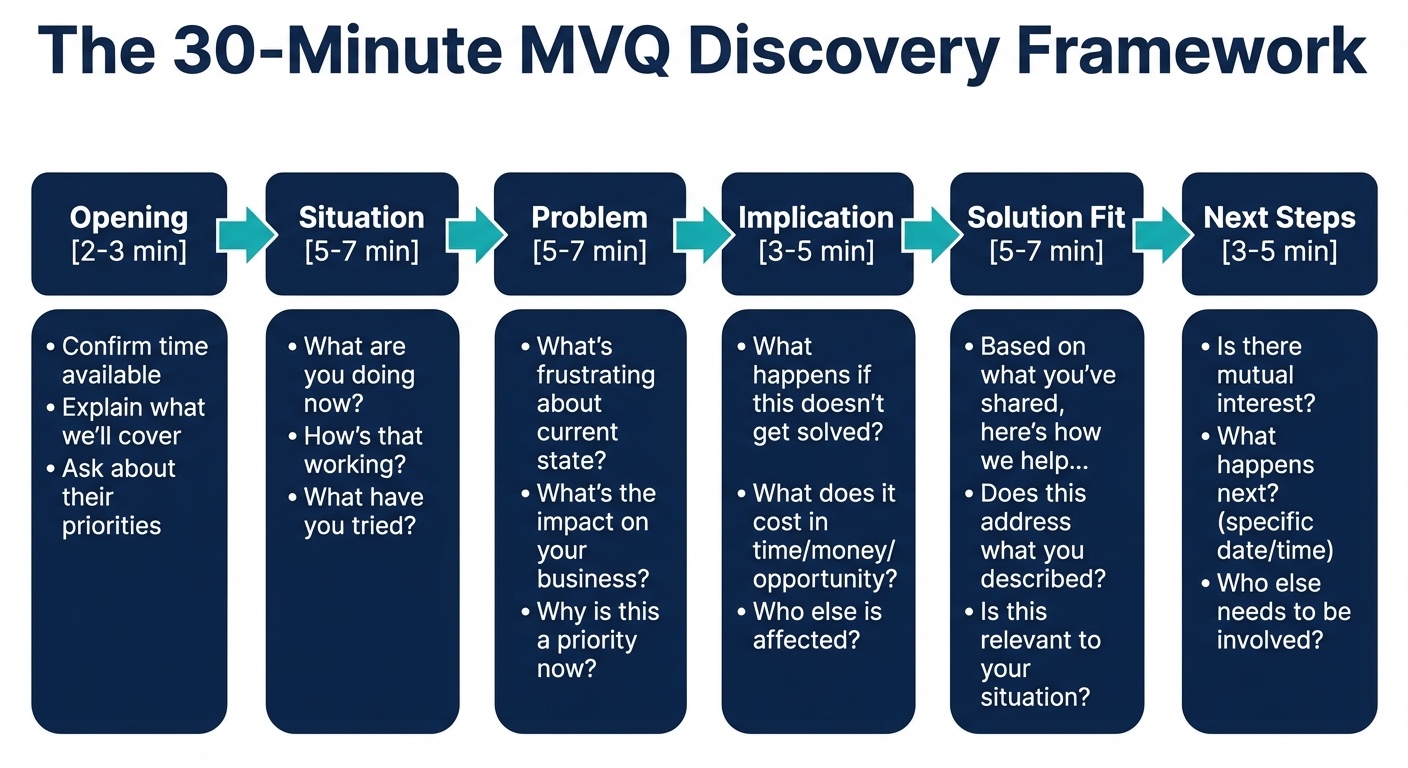
Figure 4.1: The 30-Minute MVQ Discovery Framework. A structured flow from Set the Frame (minutes 1-3) through Diagnose the Pain, Quantify the Impact, Understand the Decision, and Transition or Close, each with specific questions designed to qualify efficiently while making prospects feel heard rather than interrogated.
Minutes 1-3: Set the Frame
Establish what the call is and isn't:
"Thanks for taking the time. I want to use our 30 minutes to understand your situation and see if I can help. I'll ask some questions; if it looks like a fit, I'll walk you through how we might work together. If not, I'll point you toward something better suited. Sound fair?"
This sets expectations for length, positions you as a problem-solver (not a pusher), signals you'll be asking questions, and gets explicit buy-in.
Minutes 3-15: Diagnose the Pain
This is where most of your time goes. You're after three things: what's the problem, how bad is it, and what have they tried.
"What prompted you to book this call today?" Gets at the trigger: something moved them from passive awareness to active exploration, which tells you about urgency.
"Tell me more about the challenge you're facing with [relevant area]." Open-ended; lets them describe the problem in their own words. Listen for the language they use. You'll reflect it back later.
Common Mistake: Happy Ears
Hearing interest as buying intent. "That's interesting" and "Tell me more" aren't commitments. Probe for real urgency and timeline. Ask "What would need to happen for you to move forward?" If they can't answer with a clear timeline and decision criteria, they're not a real opportunity yet: develop it with a follow-up or move on.
"How long has this been going on?" Problems that have persisted for years without being solved usually don't get solved now, unless something changed. New, acute problems get attention.
"What have you tried so far?" Tells you which approaches they've rejected, what alternatives they're comparing you to, and how sophisticated their understanding is. Follow up with "What happened?" to understand why those didn't work, which points you toward what would.
Minutes 15-20: Quantify the Impact
"If you don't solve this in the next 6-12 months, what happens?" The cost-of-inaction question. "Nothing much" means no urgent opportunity; real consequences (lost revenue, missed opportunities, continued stress) mean you do.
"If we could fix this, what would that mean for you/your business?" The future-state question: knowing what success looks like helps you position your solution and test whether your offer delivers it.
For intangible outcomes (confidence, clarity, peace of mind), use the scale method: "On a scale of 1-10, where are you now? Where would you need to be to feel this was solved?"
Minutes 20-25: Understand the Decision
"Is solving this a priority right now, or more of a someday thing?" If it's not a priority, they won't act however good your offer is.
"Have you set aside resources to solve this?" Gets at budget without asking directly. You learn whether they have money, time, and bandwidth.
"Besides yourself, is anyone else involved in this decision?" Not just B2B committees. Spouses often need to align on courses or coaching; small businesses may have a partner.
"If you thought this was the right solution, what would your process look like for moving forward?" Surfaces hidden obstacles: some "think about it" as policy, some check with an accountant. Knowing the process lets you work through it together.
Minutes 25-30: Transition or Close
You're now in one of three positions:
Strong fit: acute pain, significant impact, they can decide. Present your solution briefly, connect it to what they told you, propose next steps.
Unclear fit: some elements present but you need more. Propose a follow-up with additional stakeholders, or homework before you continue.
Weak fit: vague pain, low impact, or they can't decide. Be honest: "Based on what you've shared, I'm not sure we're the right fit right now. Here's why..." Then recommend an alternative if you have one. This builds trust, and they sometimes return when circumstances change.
The "Magic Wand" Question
One question works especially well in discovery:
"If we were talking 6 months from now and you were thrilled with how this turned out, what exactly would have changed?"
It gets them to articulate their ideal future state in concrete terms, reveals what they care about most (sometimes different from what they first said), and gives you language for your proposal: "You said you wanted X. Here's how we deliver that."
Reading Buyer Behavior with DISC
Different people want different things from a discovery call. The DISC behavioral framework (Dominant, Influence, Steadiness, Conscientiousness; see Appendix: Glossary) helps you adapt based on how someone naturally communicates.
Vendors of DISC-based sales tools publish impressive conversion claims for this kind of matching, but independent evidence is thin. The practical case is simpler: people buy more easily from someone who speaks their language, and DISC gives you a quick vocabulary for noticing how someone likes to communicate.
Caveat: many academic psychologists regard DISC as lacking scientific validity, and it should never be used for hiring or for predicting job performance. Use it as a rough guide to how someone likes to communicate, never as a diagnostic tool.
Founder-Type Note: On your first 10-20 calls, focus on MVQ and listening. After 30+ calls, patterns (speed vs. details vs. reassurance) become visible. That's when DISC becomes useful.
The 60-Second Identification Method
Within the first few minutes you can usually make a reasonable guess at someone's primary style using a two-axis framework. Treat the guess as a hypothesis and update it as the call goes on.
Axis 1: Pace. Fast: quick responses, interrupts, gets to the point. Slow: pauses to think, asks clarifying questions, methodical.
Axis 2: Focus. Task: processes, data, outcomes, efficiency. People: relationships, team dynamics, feelings, impact on others.
The four combinations:
- Fast + Task = High D (Dominant)
- Fast + People = High I (Influence)
- Slow + People = High S (Steadiness)
- Slow + Task = High C (Conscientiousness)
60-Second Identification: Cues Table
| DISC Type | Verbal Cues | Behavioral Cues |
|---|---|---|
| High D | "Bottom line," "Cut to the chase," "What's the ROI?" | Direct eye contact, checking phone/watch, minimal small talk |
| High I | "Tell me more," "Who else uses this?" "That's exciting!" | Animated gestures, enthusiastic tone, personal stories |
| High S | "Let me think about that," "How does this affect the team?" | Calm demeanor, thoughtful pauses, collaborative language |
| High C | "Can you send me the specs?" "What's the methodology?" | Takes notes, asks detailed questions, methodical |
Adapting to Each DISC Type
High D: be brief, lead with ROI, skip small talk. Discovery: "I'll be direct: what's the biggest challenge, and what's it costing you?" Close: "This is the fastest path to [result]. Ready to move forward?"
High I: match their energy, share testimonials, skip technical detail. Discovery: "I've worked with [similar person] who had this challenge. Does that resonate?" Close: "You're going to love this. Let's get you started."
High S: slow down, emphasize support and guarantees, use "we" language, don't push for same-call decisions. Discovery: "Let's take this at a pace that works for you. What would make you most comfortable?" Close: "Take your time. We have a [guarantee], so there's no risk."
High C: be precise, have data ready, send docs, no hype. Discovery: "Walk me through how you're handling this now. What metrics are you tracking?" Close: "Based on the specs we discussed, this solves your [specific problem]. Does that align with your analysis?"
Case Study (composite, DISC adaptation): A founder (High I) selling compliance software pitched the IT security lead at a 12-person clinic (High C) with success stories; the lead said "I need specifications, not testimonials." Once he slowed down and walked through security protocols methodically, he closed a $4,800 annual contract in two weeks. Separately, a SaaS founder using the same thorough feature explanation for everyone closed 19% across 50 calls; adapting by type (results-and-ROI in 10 minutes for High D, guarantees and no rush for High S) took her to 32% (68% improvement). That is one founder's experience, not proof, but in both cases the product and price stayed the same; what changed was how each founder communicated.
Technical founders often lean task-focused themselves. Personality research on engineers points the same way: in Capretz's survey of 100 software engineers, 81% came out as "thinking" types on the Myers-Briggs scale, favoring objective analysis over personal considerations [6]. Many also default to a slow, thorough pace, which puts them close to High C. The instinct is to show all the data; that works well for another C-type, but to a High D who wants the bottom line it feels like wasting their time. Present information the way the buyer wants to receive it.
DISC applies to email and LinkedIn too. Short ROI-focused messages signal D; exclamation points signal I; "we" language signals S; methodology requests signal C. Match your reply style accordingly.
The Questions That Disqualify
Discovery means looking for reasons not to work with someone as well as reasons to. Be as willing to disqualify a prospect as to qualify them. Many prospects in a typical pipeline will never buy, and every hour spent on one of them is an hour not spent on someone who would.
Disqualifying questions:
"Why now?" Often the most important question in your whole process. Prospects with a clear trigger ("my boss gave me until Q2," "I'm burning out and something has to change") typically close; "just exploring options" rarely does.
"What would make this project a failure?" Surfaces hidden concerns and misaligned expectations. If their definition of success is something you can't deliver, better to know now.
"What would need to be true for you to move forward in the next 30 days?" Reveals obstacles: some real (budget approval), some stalling.
"If budget wasn't a factor, would you do this?" If "still not sure," the objection isn't budget.
Pay attention to vague answers; buyers with real problems usually give specific ones.
Handling Common Objections
Objections on discovery calls usually mean you need more information. How you respond should vary by DISC type.
"What's the price?" Early, before you understand their problem, redirect: "I want to give you accurate pricing, which depends on your situation. Can I ask a few more questions first?" After discovery, answer directly; avoiding price erodes trust. (High D buyers ask first; give them a range in one sentence, then ask your remaining questions.)
"I need to think about it." Usually means you haven't created enough clarity or urgency: "That's fair. What specifically do you want to think about? I might be able to clarify right now." High S and High C buyers often do need processing time. Schedule a specific follow-up instead of pressing.
"I need to talk to my [spouse/partner/boss]." Legitimate. Equip them: "What do you think their main concern will be, and how can I help you address it?" For High I, offer a group call to build collective enthusiasm.
"We're looking at other options." Ask "What are you comparing us to?" to understand how they think about the problem. For High C, offer a comparison document with specs.
"I don't have budget right now." Probe: "Is this a timing issue or not a priority?" If the budget isn't there, stay in touch. For High D, reframe as ROI: "It's $X, but it saves you $Y in Q1."
The No-Pitch Discovery Call
A counterintuitive approach that works well for founder-led sales: don't pitch at all on the first call. Use it entirely for diagnosis, then summarize: "So you're dealing with X, which is causing Y, and you've tried Z without success. Is that right?" Then: "Based on what you've shared, I have some ideas. Would you like me to put together a recommendation to review?"
This positions you as a consultant. The recommendation you send afterward is your pitch, and it arrives after you've shown you understand their situation, tailored to what they told you.
Case Study (composite, B2B consultant): A consultant who pitched on call one closed 18% of deals at a $3,000 average. Switching to diagnosis-only on call one and tailored recommendations on call two took him to 42% at a $4,500 average over 45 calls.
Case Study (composite, creator/coach): A business coach presenting her program structure on the discovery call closed 27% at $1,500 average enrollment. Asking deep questions and sending a personalized recommendation afterward took her to 53% at $2,400 over 30 calls.
When to skip the two-call approach: it works best for longer cycles or prospects still exploring. If your inbound is already well-qualified and ready to decide (referrals who say "what's the price?"), present on call one. Don't artificially slow down buyers who are ready to move.
After the Call: What Happens Next
The discovery call isn't complete until you've documented what you learned and set clear next steps.
Within 1 hour: send a brief recap email. "Thanks for the conversation. Here's what I heard: [2-3 bullets on their situation and goals]. Next step: [what you agreed to]. Let me know if I missed anything." This confirms alignment, creates a paper trail, and lets them correct misunderstandings.
For your own records: capture pain (in their words), impact (quantified if possible), timeline and deadlines, decision process and stakeholders, next step and date, and your fit assessment (Strong/Medium/Weak). You don't need a CRM; a spreadsheet works if you fill it in after every call. (As your team grows, this shared record is what lets a second person pick up a deal without dropping context.)
Example: a founder lost a $5,000 deal because the proposal ignored the Q2 deadline the prospect had mentioned; the prospect concluded he wasn't paying attention and chose a competitor who referenced it. The fix was a template with those fields (pain, impact, timeline, decision process, next step, fit) filled out right after each call.
If the next step is a proposal: reference specific things they said and connect each element of your offer to a problem they articulated. "Based on our conversation about [their specific challenge], here's what I recommend..." lands far better than "Thank you for considering our services."
Timing: if you promised to send something, send it within 24 hours. Every day of delay reduces momentum. Speed matters even earlier in the process: in a Harvard Business Review study of 1.25 million web leads, firms that tried to contact a new lead within an hour were nearly seven times as likely to qualify it as firms that waited even an hour longer [7].
When Discovery Goes Wrong
Common ways discovery calls go wrong, and what to do about them:
| Problem | Diagnosis | Fix |
|---|---|---|
| They take over | Low trust, testing you | Gently redirect: "Can I ask a specific question to make sure I understand?" |
| Won't open up | Defensive, uncertain | Slow down, share a relevant story, model vulnerability |
| Not a fit, won't accept it | Ego, sunk cost | Be honest, recommend alternatives, protect your reputation |
| Silent after call | Lost momentum, low urgency | Follow up once with value, once more, then let go |
| Asks price too early | Testing, or ready to buy | Redirect if early ("depends on your situation"); answer directly if late |
| "I need to think about it" | Unclear value or unaddressed concern | Ask: "What specifically?" then clarify or schedule follow-up |
Case Study (composite, the early pitch mistake): A SaaS founder got an inbound from the operations lead at a 50-person agency: "drowning in spreadsheets." He demoed for 15 minutes; she said "Let me think about it" and never returned. He'd never asked which spreadsheets, why they were drowning, or what solving it would mean. A competitor's rep asked questions for 30 minutes, learned the real issue was resource-allocation visibility (not task management), positioned around that, and won the $4,800 annual deal.
The Numbers Behind Good Discovery
A few rules of thumb for B2B software, consulting, and coaching:
The 70/30 rule: during diagnosis, the prospect should do most of the talking, around 70%. If you're talking more than 30% during diagnosis, you're probably pitching. The rule is for the diagnosis, not the whole call: across entire recorded calls, including the recommendation, benchmarks put even top reps at 54-58% talk time [2].
Question-to-statement ratio: aim for at least 3:1 during diagnosis. Each time you catch yourself making a statement, ask whether you could have asked a question instead.
The pause principle: after asking, wait. Count to three silently. Prospects often fill the silence with things they wouldn't otherwise have volunteered.
Follow-up depth: keep asking until you reach the specific problem. "We're looking to improve our marketing" tells you nothing; "What specifically isn't working?" gets closer; "What happened when you tried to fix that?" gets the real problem.
Allego's analysis of recorded sales calls found that top performers' discovery calls ran 76% longer than other reps', and that on those calls top performers both asked and received far more questions [8]. They stay in discovery mode instead of jumping to pitch mode.
AI-Augmented Discovery
AI helps with discovery in three ways:
Pre-call research that took hours now takes minutes. Feed the prospect's LinkedIn, company site, and recent news into an AI assistant: "What challenges does this person likely face? What's their company's competitive position? What questions should I prioritize?" Use the output as background, so you walk in knowing their industry, likely pain points, and terminology.
Transcripts show patterns you'd miss during the call. Recording calls (with permission) and transcribing them surfaces talk-time ratios, question frequency, and topics that drove engagement. Example: a founder analyzed 50 calls and found he spent too long on technical questions and too little on impact. The analysis also showed that every stalled deal had a weak impact discussion, which he hadn't noticed on the calls themselves.
Post-call synthesis captures what you'd forget. Paste your notes into an AI right after: "What are the key pain points? What was the implied urgency? What should I have asked but didn't?"
AI won't listen, read emotional cues, or build rapport for you. The call is still between two people; AI saves time on the research before it and the analysis after it.
Chapter Summary: TL;DR
The core insight: discovery is diagnosis, not pitch. MVQ (Pain, Impact, Decision) qualifies prospects efficiently; DISC adaptation helps you match your communication style to how each buyer likes to talk.
Key takeaways:
- In call benchmarks, calls under 5 minutes succeed 3.2% of the time vs. 22.1% for 30-60 minutes; leave room for diagnosis
- MVQ: Pain (specific problem), Impact (cost of not solving), Decision (can they decide?)
- 60-second DISC: Fast/Slow pace + Task/People focus = 4 types
- 70/30 rule (during diagnosis): prospect talks 70%, you talk 30%
- Top performers' discovery calls run 76% longer, with far more questions asked on both sides
If you're dreading or avoiding discovery calls: see Chapter 12 (sustainability and recovery).
Next chapter: Chapter 5 covers presenting your solution with the Prescription Frame and handling pricing.
The Exercise: Prepare Your Discovery Framework
Before moving on, prepare for your next discovery call:
- Write your opening frame: the first 60 seconds that set expectations. Practice it aloud until it sounds natural.
- List 5-7 core discovery questions covering pain, impact, and decision; write them word-for-word, then internalize them.
- Identify your disqualifiers: what answers tell you this isn't a fit, and what you'll say when you hear them.
- Prepare a DISC cheat sheet for later: four styles, how to recognize each, your closing phrase for each. Keep it in reserve until MVQ feels automatic.
- Draft your recap email template with placeholders for pain point, impact, and next step.
- Schedule practice: a dry run with a colleague; record and listen back.
These get you started; competence comes from running calls and getting feedback on them.
Chapter Checklist
Before moving to Chapter 5, complete:
- Written your opening frame (first 60 seconds of a discovery call)
- Listed 5-7 core discovery questions covering Pain, Impact, Decision
- Created a DISC cheat sheet to use once MVQ feels automatic (4 types, recognition cues, closing phrases)
- Drafted a recap email template with placeholders
- Practiced the discovery framework (dry run if possible)
Self-assessment questions:
- After 30+ calls: can I make a reasonable DISC guess within the first few minutes?
- Do I have specific questions for Pain, Impact, and Decision?
- Am I talking more than 30% of the time during the diagnosis part of my calls?
- Do I know what answers would disqualify a prospect?
[1] Rackham, N., SPIN Selling, McGraw-Hill, 1988. Based on Huthwaite International's observation of more than 35,000 sales calls over 12 years. https://www.huthwaiteinternational.com/sales-training/spin-selling
[2] Focus Digital, "Average Sales Call Time: 2025 Benchmarks." https://focus-digital.co/average-sales-call-time/. Success rate by call duration: under 5 minutes 3.2%, 30-60 minutes 22.1%; top-performing reps at 54-58% talk time. Compiled from recorded sales calls; the relationship is correlational.
[3] Alessandra, T., Wexler, P., and Barrera, R., Non-Manipulative Selling, Simon & Schuster, 1992 edition. The line "In selling as in medicine, prescription before diagnosis is malpractice" is widely quoted from this book.
[4] MEDDICC, "MEDDPICC Sales Methodology and Process." https://meddicc.com/meddpicc-sales-methodology-and-process. MEDDIC was created inside PTC in 1996 by Dick Dunkel, with Jack Napoli.
[5] Dixon, M., and McKenna, T., The JOLT Effect: How High Performers Overcome Customer Indecision, Portfolio, 2022. Analysis of more than 2.5 million recorded sales conversations; 40% to 60% of deals were lost to "no decision."
[6] Capretz, L. F., "Personality types in software engineering," International Journal of Human-Computer Studies 58(2), 2003, pp. 207-214. https://doi.org/10.1016/S1071-5819(02)00137-4. Survey of 100 software engineers: thinking 81%, feeling 19%.
[7] Oldroyd, J. B., McElheran, K., and Elkington, D., "The Short Life of Online Sales Leads," Harvard Business Review, March 2011. https://hbr.org/2011/03/the-short-life-of-online-sales-leads
[8] Allego, "Top-Performing Sales Reps Discuss Product Features 50% Less Than Lower Performers, According to New Allego Data," news release. https://www.allego.com/news/sales-call-research-report-release/