
Chapter 17: Pricing, Packaging, and Monetization
A buyer asks "So what does this cost?" and you haven't decided. You name a number you half-invented that morning, listen to how it lands, and adjust on the fly. Maybe they say yes too fast, and you wonder whether you went too low. Maybe they go quiet, and you start discounting before they've even pushed back. Either way you walk away with a signed deal and no idea whether you left money on the table or scared off three other buyers with the same number.
Founders tend to avoid pricing longer than any other part of go-to-market, partly because it feels exposing. A price is a public claim about what you're worth, and naming it invites the question of whether you're right. So many small teams guess a single number once and rarely revisit it. Pricing works better as a system: the model you charge on, how you package it into tiers, how you discount, and how accounts grow over time all have to reinforce each other and fit the motion you chose in the previous chapter [2][7]. If they pull in different directions, even a good product loses revenue.
You don't need a pricing team or a six-week study to set a defensible price. You need a model that matches how your product creates value, a clean set of tiers, a price you can say out loud without flinching, and a plan to raise it. This chapter walks through each of those, with extra attention to the part that's new as of September 2026: pricing a product whose costs move every time someone uses it.
Pricing as a System
Pricing has four moving parts, and a decision in one constrains the others.
- The model is what you charge on: a flat fee, seats, usage, outcomes, or some blend.
- The packaging is how you group features and limits into tiers a buyer can choose between.
- The discounting is the discipline around when you bend the price and what you get in return.
- The expansion is how an account's spend grows after the first purchase.
Weak pricing usually comes from two of these parts fighting each other. Flat pricing with no expansion axis means your biggest customers pay roughly what your smallest ones do. Generous per-deal discounting with no trade-off trains buyers to haggle and makes renewals painful. The aim of this chapter is a setup where the four parts agree with each other and with your motion. Low-ACV, self-serve products need pricing a buyer can act on without a call. Higher-ACV, sales-led products can carry a model that takes a conversation to explain.
Choosing a Model: Follow How Value Scales
To pick a model, ask what grows when a customer gets more value from you, and charge on that.
Flat subscription is one fixed recurring price for everything. It fits simple SMB products with low variance in how hard people use them, and it's the easiest thing to sell and to forecast. The catch shows up later: a heavy user costs you the same as a light one, so your most demanding customers become your least profitable, and you have no clean way to capture upside from a large account [2][7].
Per-seat or per-user pricing fits when value tracks the number of people using the product, which is common for collaboration, CRM, and helpdesk tools. It supports a land-and-expand pattern well, since adding the eighth and ninth user is a small, natural decision. Watch for two problems: seat pricing can feel arbitrary for AI products that deliver value to the business rather than per person, and it rewards seat-hoarding and shared logins, where a team buys three seats and rotates ten people through them [2][7].
Usage-based or metered pricing charges on a unit that scales with benefit: API calls, messages processed, documents, gigabytes, minutes. It fits developer, infrastructure, and AI products especially well, where customers range from tiny to enormous and a unit of usage maps cleanly to a unit of value. The advantages are a low barrier to start and expansion that happens automatically as usage climbs. The costs: revenue gets harder to forecast, and buyers carry a low-grade fear of "bill shock," the surprise invoice after a heavy month. Usage pricing works best when you pair it with clear usage visibility and guardrails so no one is surprised [2][7].
Value or outcome-based pricing ties the price to a result: a share of savings, a fee per qualified lead, per resolved ticket, per hire. It works when you can measure the outcome credibly and your buyers are used to justifying spend with a business case. It's also the hardest to run: it needs trust, shared data, and a clean way to attribute the outcome to you, and the deals tend to take longer. For an early-stage team without strong proof yet, it's usually a later move [5].
Hybrid pricing combines a stable base with a variable component: a platform fee plus usage, seats plus overage, a minimum commitment plus consumption above it. It fits when you want a predictable baseline but your marginal costs matter, which describes most AI products. Common shapes include "$500/mo base plus a per-thousand-events charge" or "$40 per user per month plus a per-document AI fee" [2][7].
The credit or token model has also become common for AI products: customers prepay for a bundle of compute, and you meter it down as they generate documents, images, or minutes. It fits when your costs are inference that scales with use and you want to cap your downside. The challenge is that credits are abstract. "500 credits" means nothing to a buyer until you translate it into something concrete like "about 500 documents a month," so packaging matters even more here.
Founder-Type Note: The model is the one pricing decision that's expensive to reverse, because it reshapes contracts, billing, and expectations all at once. The other three parts (packaging, discounting, expansion) are far easier to adjust later. Spend most of your early pricing thought on matching the model to how value scales, and tune the rest in flight.
Packaging: Three Tiers and an Enterprise Door
After you've picked a model, packaging is how you make it legible. Once you've passed Chapter 5's single-price stage (roughly 10-20 customers), the pattern that has held up across most of B2B SaaS is good-better-best: three self-serve tiers plus a fourth Enterprise or custom option you quote by hand [2][7]. Three is usually the right number because it gives buyers a clear frame. The top tier anchors the price and makes the middle look reasonable, the middle tier becomes the one most people pick, and the entry tier gives smaller buyers a way in without crowding the page. More than three public tiers tends to confuse buyers [7].
A typical shape is a Starter tier with the core job and lower limits, a Growth tier with advanced features, higher limits, and integrations, and a Pro tier for power users with advanced controls and automation, plus the Enterprise door carrying security, premium support, and volume terms.
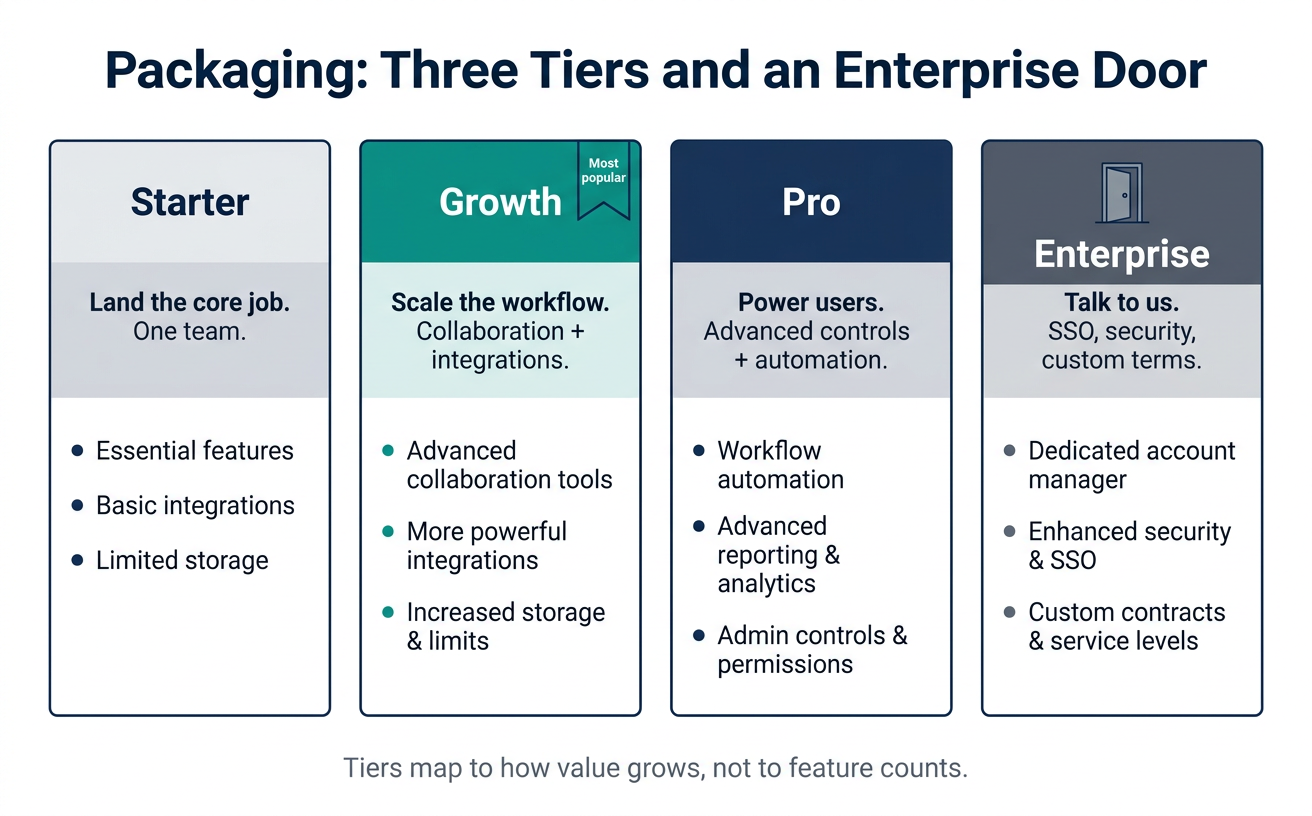
Figure 17.1: Good-better-best plus an Enterprise door. Tiers map to how value grows for the customer, not to a count of features.
Within that structure, you make one recurring choice: what to gate behind a limit and what to gate behind a feature flag. A useful default is to limit-gate the core job and feature-gate the advanced features. Gate the thing people do most (projects, contacts, messages, AI tasks) with a numeric limit, because that creates a natural, friction-free upgrade as a customer succeeds and outgrows the cap. Gate advanced or organizational needs (SSO, role-based access, compliance controls, advanced automation) behind the higher tiers, because those are the things larger buyers will pay a step-up to get [2][7]. The mistake to avoid is feature-gating the core value itself, which makes the entry tier feel broken rather than starter-sized.
Free, Trial, Freemium, or Reverse Trial
How a buyer first gets in is part of packaging, and the right answer follows your motion and your time-to-value.
- Demo-only, no free path fits enterprise and complex products with high ACV and heavy onboarding, where letting someone loose unsupervised wouldn't show value anyway.
- A free trial (commonly 7 to 30 days, full or near-full product) fits when value is demonstrable inside about two weeks. It qualifies buyers quickly. Operators commonly quote a trial-to-paid rate of roughly 15-30% among qualified signups; measure your own.
- Freemium, a forever-free tier, fits when you have real top-of-funnel volume, a product-led motion, and low enough marginal cost that free users don't sink you. The risks are support load and weak conversion if the free tier gives away the whole value. Freemium-to-paid conversion is commonly quoted in the low single digits.
- A reverse trial gives the user the full premium product for a couple of weeks and then downgrades them to a free tier unless they pay. It often beats pure freemium on conversion, because people get used to the premium features and don't want to lose them.
Start from your motion. If you picked a product-led motion in the previous chapter, you want a self-serve entry, because the product has to do the selling: a free trial if value shows inside two weeks, a reverse trial if premium features drive the upgrade, and freemium only if you have the volume and low marginal cost it needs. If you picked sales-led at a higher ACV, demo-first or a guided trial fits, because a human is already in the loop.
Finding What Buyers Will Pay, Without a Pricing Team
You can learn most of what you need about willingness to pay from work you can do in a week or two.
Structured interviews with both won and lost buyers are the highest-yield tool. Ask what they use and pay for today, what they'd do if you vanished tomorrow, at what price your product becomes a no-brainer, and at what price it would need sign-off from someone else. You're listening for their real alternatives and prices, who owns the budget, the threshold where approvals kick in, and the non-price frictions that stall deals. A dozen of these conversations usually teaches you more than any benchmark.
The Van Westendorp Price Sensitivity Meter is a light, structured way to triangulate a range. You ask four questions: at what price is this so cheap you'd question its quality, at what price is it a bargain, at what price is it getting expensive but still worth considering, and at what price is it too expensive to consider at all. Plotting the cumulative answers gives you an acceptable band and a rough psychological optimum. It needs roughly 20 to 50 responses from real ICP buyers to mean anything, and it's worth segmenting by persona or company size, since a 5-person team and a 500-person one rarely answer alike.
Pricing-page A/B tests work once you have self-serve traffic. Change one major thing at a time (the price points, the number of tiers, or whether monthly or annual is the default), run it for four to eight weeks, and measure the whole chain, from visit to signup to active use to paid, plus the resulting ARPU and churn. Testing one dimension at a time keeps the result interpretable.
Throughout, watch the behavioral signals. If buyers say yes without needing approvals and treat the cost as no big deal, you're probably underpriced, and a buyer asking "what's the catch?" usually means the same thing. If deals consistently die at procurement on budget, or you get hard pushback against a named alternative, or your win rate falls off a cliff above a certain number, you've found the ceiling. The most common signal is easy to miss because it's an absence: if you never hear "that's too expensive," you are almost certainly charging too little [5].
Pricing in the AI Era: Protecting the Margin
This part of pricing has changed, and small teams get hurt here if they price like it's 2020. When your product calls a model, every active user has a variable cost attached, and a pricing setup that ignores that can run at negative margins without anyone noticing until the invoice from your provider arrives.
The first principle is to align the AI charge to usage or outcomes, not to a flat all-you-can-eat promise. Charge on prompts, documents, minutes, or tokens, or on the task the AI completes, so that revenue moves in the same direction as cost. Many teams land on a hybrid: a base subscription, a healthy amount of included AI usage in each tier, and overage beyond it.
The second is to pass through inference cost with a margin. Include a baseline of AI usage in each tier sized to match what a healthy user consumes, then charge overage at a markup over your raw inference cost, often in the range of 2-5x, so that the heaviest users fund their own compute rather than eroding your margin. Prepaid credit bundles can carry a volume discount without giving away the floor.
The third is to treat credits as a UX problem. Map a credit to an action a buyer can picture (one credit equals one document up to some page count), bundle credits into tiers with top-ups available, and give customers a live usage dashboard with alerts at 80% and 100% so the bill is never a surprise.
Three traps commonly wipe out the margins of AI products that look healthy on paper:
- Underestimating context size. Long documents and long conversations consume far more tokens than a quick test suggests, so the real cost per use can be several times your estimate.
- Power users under flat pricing. A small minority of users often drives a large share of consumption, and a flat plan hands them an unlimited claim on your most expensive resource.
- Model upgrades. Moving to a better model raises your unit cost, and under a fixed price you absorb all of it.
The defenses are the same for all three: prefer a hybrid model over flat, set caps and overage, offer a standard AI mode alongside a premium one, and watch gross margin by plan and segment rather than in aggregate, since a blended number can look fine while one tier loses money.
Common Mistake: Promising "unlimited" AI
"Unlimited" is easy to put on a pricing page and expensive to honor. Your most engaged customers are also your most costly, and you've contractually agreed not to charge them for it. If you want the simplicity of "unlimited" in your marketing, build a fair-use cap behind it and an overage path above it, so the promise holds for normal use without underwriting abuse.
Discounting, Terms, and Raising Prices
Discounting is where a clean pricing system most often breaks down. Set clear bands and stick to them: SMB deals rarely justify more than 10-15% off for annual prepay, while mid-market and enterprise can reach 15-30% in exchange for something real like a multi-year term, higher volume, or a reference. A discount should always buy you something back: a longer commitment, a case study, a logo you can name. The habit to avoid is the one-off rep discount that cuts list price with nothing in return, because it teaches every future buyer to haggle and makes renewals a fight.
The annual-versus-monthly choice is partly a cash-flow lever and partly a churn one. Annual plans commonly run about 10-20% below the monthly rate, toward the low end for SMB. A product-led company that defaults its page to annual can see a large share of revenue land on annual terms [7]. Annual billing improves cash flow and tends to lower churn, because the renewal decision comes up once a year instead of twelve times. A reasonable default is to show annual first with the monthly equivalent next to it, and offer month-to-month as an on-ramp for the smallest teams.
Raising prices is the lever founders most underuse, usually out of the same fear that set the price too low in the first place. A few practices make it routine.
Raise for new customers first, so you can watch how the market accepts the new number before touching anyone you already serve. For existing customers, grandfather partially: hold the old price through one more renewal, or step the increase up gradually (something like 15-25%, not a 2-3x jump), give 30 to 90 days of notice, and explain the reason plainly, whether that's added product, rising AI cost, or deeper support. An increase is also a natural moment to simplify your tiers and move legacy customers onto current packaging. The signs you've earned the right to raise are the same ones that tell you the product is working: strong win rates, little pushback on price, and healthy net revenue retention.
Expansion: Designing for Growth After the First Sale
The first contract is rarely where the money is. Most durable SaaS revenue comes from existing customers spending more over time, which is why a pricing system should have a built-in way to grow. The vectors are familiar: more seats as the product spreads to new teams and departments, more usage as events or documents or AI credits climb, upsells into higher feature tiers, and add-ons like premium support, SSO, or extra workspaces [2][7].
Design the expansion axis on purpose: the dimension along which a customer's spend grows naturally as they get more value. If you priced on usage, expansion is largely automatic. If you priced on seats, expansion follows adoption across the org. The number that tells you whether this is working is net revenue retention, the change in revenue from your existing base after expansion, contraction, and churn. Above 100% means the average account grows even before you win anyone new. For context, the median private SaaS company in SaaS Capital's 2025 survey sat at 101% (104% for bootstrapped companies) [8], so 100-110% is a reasonable place to be while you build the expansion motion, and sustained 110%+ puts you well above the median.
Six Ways Founders Get Pricing Wrong
- Copying a competitor's price. A competitor's number reflects their costs, stage, and strategy, not yours. Use it as one input, never as the blueprint [4].
- Underpricing out of founder fear. Anchoring to your own sense of what's affordable rather than the ICP's willingness to pay produces a low ACV with no room to fund sales or support, and the whole motion starves [5].
- Too many tiers and add-ons too early. Three self-serve tiers plus an Enterprise door is plenty for a team of one to ten; more makes the page harder to read and the sale harder to close [7].
- No value metric or expansion lever. Flat pricing where a large customer pays roughly what a small one does leaves your best accounts underpriced and caps your growth from the base [2].
- "Unlimited" promises, especially on AI. They look generous, and they lose money once usage grows.
- Inconsistent, per-deal custom pricing. Bespoke pricing on every deal creates revenue leakage now and renewal pain later, when no two customers are on the same terms.
How the Pattern Plays Out
The companies worth studying changed their pricing as their products and buyers grew. HubSpot is the clearest example of packaging discipline. It went from a sprawl of features to a set of segmented Hubs (Marketing, Sales, Service, and others), each with its own good-better-best tiers and a platform fee, so a customer can start small in one Hub and expand across the suite over time. Its sales and service products lean on per-seat and feature tiering, while its marketing product is priced on contacts and usage, which is a useful reminder that the right model can differ across one company's lines [7]. The lesson is to define clear packaging axes so that expansion tracks value rather than fighting it.
Slack ties price to engagement. It charges per active user, billing only for seats in use, which removes a real objection to rolling it out broadly. Its free tier is deliberately strict on message history and integrations, which nudges serious teams toward paid, and its higher tiers sell security and compliance (SSO, longer retention) to the larger buyers who need them. The takeaway is to let your pricing follow how the product is used, and to reserve the organizational features for the tiers whose buyers value them.
OpenAI's API illustrates the AI-era shape directly. It prices per token, varies the rate by model quality, and offers volume discounts, with clean per-model tables a developer can reason about. Many AI products built on top of it have adopted a hybrid of their own: a subscription, a block of included usage, and overage or credit packs above it. If your costs are usage-driven, your pricing should follow the same shape, while staying understandable enough that a buyer can predict their bill.
Set a Price You Can Defend
You'll learn more from buyers reacting to a real price than from more analysis. So pick a model that matches how your product creates value, package it into three tiers and an Enterprise door, and choose a number you can say out loud without flinching. Ship it, and plan to raise it once the signals show the product is working.
Pricing depends on decisions you've already made. Who pays, and how much room they have in their budget, comes straight from the ICP work earlier in the book. And the price you can sustain is bound to the motion you chose in the previous chapter: a low-ACV product wants pricing a buyer can act on without a call, while a higher-ACV product can carry a model a salesperson explains in a conversation. The Constraint Triangle applies here too, since every hour you spend agonizing over the third decimal of a price is an hour not spent learning from a real buyer's reaction to a number you chose and shipped.
So commit to a price this week. Write down the model, the three tiers, and the number, put it in front of a real buyer, and watch what happens. The chapters ahead cover what turns that price into reliable revenue: the channels that bring buyers to that pricing page, the onboarding that gets them to value, and the operations that show whether the economics hold.
Sources
[1] https://revenueml.com/insights/articles/top-2026-pricing-trends-reshaping-business-services [2] https://rethinklab.co/blog/b2b-saas-pricing-models-flat-fee-vs-usage-vs-per-seat [3] https://thesmallbusinessexpo.com/blog/small-business-pricing-in-2026 [4] https://quickbooks.intuit.com/r/pricing-strategy/pricing-strategies [5] https://adience.com/blog/insights/b2b-pricing-strategies [6] https://canidium.com/blog/how-to-beat-a-tough-market-in-2026-with-your-pricing-strategy [7] https://paddle.com/blog/saas-pricing-models-strategies-fltr [8] SaaS Capital, "2025 B2B SaaS Retention Benchmarks," research brief, September 2025. https://www.saas-capital.com/wp-content/uploads/2025/09/RB32WS1-2025-B2B-SaaS-Retention-Benchmarks.pdf