
Chapter 9: Handling Obstacles: Objections, Rejection, and the Psychology of Selling
The prospect said they needed to "think about it." That was three weeks ago, and you've heard nothing after two follow-ups. Another lead went cold after a promising discovery call. A third said your price was "more than expected," so you immediately offered 20% off, and they still declined. Each rejection lands harder than the last.
Rejection is inevitable in sales. Most outreach won't get responses, most responses won't convert, and most assumptions about customer needs will prove wrong. That is normal in customer acquisition and doesn't mean you're failing. Founders who succeed learn to hear "no" as information about the offer rather than a verdict on themselves, and they build systems that keep rejection manageable.
Two things make this harder than it needs to be. Price objections are usually about something other than price: unvalidated value, unaddressed risk, or concerns the prospect hasn't voiced. And negativity bias means every rejection feels disproportionately significant: across many areas of psychology, bad experiences carry more weight than good ones of the same size [1].
Founder-Type Note: Objection patterns differ by business model. B2B SaaS founders often hear "we need to evaluate other options" or "budget approval required"; coaches and creators more frequently hear "I can't afford this right now" or "I need to think about it." The underlying psychology is the same; the specific objections differ. See Chapters 4 and 5 for tactical responses; this chapter covers the mindset that makes them effective.
The Psychology of Why Selling Feels Hard
Selling feels hard for psychological reasons, and it is hardest for founders moving from "builder mode" to "seller mode."
The Identity-Role Conflict
Most founders experience selling as a conflict between their "builder" identity and the "seller" role; attempting to sell signals acting "out of character," triggering anxiety. If you don't have an established builder identity yet, it feels more like "I don't know who I am in this role," and that ambiguity is normal; these uncomfortable experiences are part of how you form one. You will feel the conflict either way; what matters is how you respond when objections amplify it.
Negativity Bias and Rejection
Negativity bias research finds that bad experiences outweigh good ones of the same size [1], so one "no" can overshadow several "yes" responses. Without a team to share the load, every "no" feels personal: rejecting your software feels like they're saying your code is bad; rejecting your coaching, that you're not worth it. The reaction is irrational, but knowing about it helps you notice when you're overweighting negative feedback.
Common Mistake: Discounting at the First Price Objection
When a prospect says "that's more than I expected," the instinct is to discount immediately. This signals your original price wasn't real, and it often still doesn't close the deal.
What to do instead: Explore what's behind it: "What were you comparing it to?" or "What would make this feel like a worthwhile investment?" Most price objections come from value the prospect hasn't seen validated yet. Address the real concern before adjusting price.
The Imposter Syndrome Tax
In Kajabi's survey of 600 US entrepreneurs, 84% scored in the moderate-to-intense range for imposter feelings (feeling unqualified despite evidence to the contrary) [2]. In sales it shows up as underpricing, over-qualifying yourself before the ask, and reading any hesitation as confirmation. It creates a vicious cycle: you underprice, low prices attract difficult customers, and those customers reinforce the sense that you're not good enough, so you underprice more. Breaking it requires external evidence, so track your wins.
When you don't have wins to track yet: Early-stage founders face a chicken-and-egg problem: imposter syndrome prevents selling, and lack of sales reinforces it. Track effort rather than outcomes: log every outreach sent, conversation had, and piece of feedback received. This log shows you're doing the work despite the fear, and that work is what eventually produces outcome-based wins.
Reframing Sales: From Extraction to Service
Chapter 1 introduced the core reframes (diagnosis, scientist, invitation). Here is how each one changes the way you handle objections.
The Old Frame (Extraction): "I am trying to get money from you." This makes every conversation adversarial. You're on opposite sides, and if they pay, they lose something.
The New Frame (Service, Chapter 1's diagnosis frame): "I am trying to see if I can solve your problem." This makes sales collaborative: you figure out together whether there's a fit. If there is, you both win; if not, you've both learned something. The frame also changes how you behave: you ask more questions and stay curious about whether you can help rather than anxious about whether they'll buy.
The Scientist Frame (For Technical Founders)
If you struggle with sales, treat every conversation as research. Your goal is to gather data: what problems does this person face, how do they solve them now, what would make a solution valuable, and what would make them not buy? This aligns with how technical people think. You're investigating, so the pressure to be "good at sales" eases. (One technical founder with pre-call anxiety reframed selling this way, as adding a skill rather than replacing identity, and his pressure dropped.) It's easier with runway, though; three months from broke, "research" is a luxury, so survival mode needs both the scientist mindset and direct asks for the business.
The Invitation Frame (For Creators)
If you're a creator selling courses, coaching, or services, the invitation frame helps. You've created something valuable, and you're inviting people to participate if it fits, without begging or trying to convince them they need it: "I've built this for people facing [specific challenge]. If that's you, you're invited; if not, no problem." This removes the pressure to "convert" people who aren't a fit, and it tends to convert better, because prospects respond to a seller who isn't pushing.
Objections: The Psychology Behind the Tactics
You've already learned the tactical responses. Chapter 4 covers them during discovery calls, Chapter 5 during presentations. This section focuses on what those chapters don't: the psychological dimension of objections and how your mindset affects your ability to handle them.
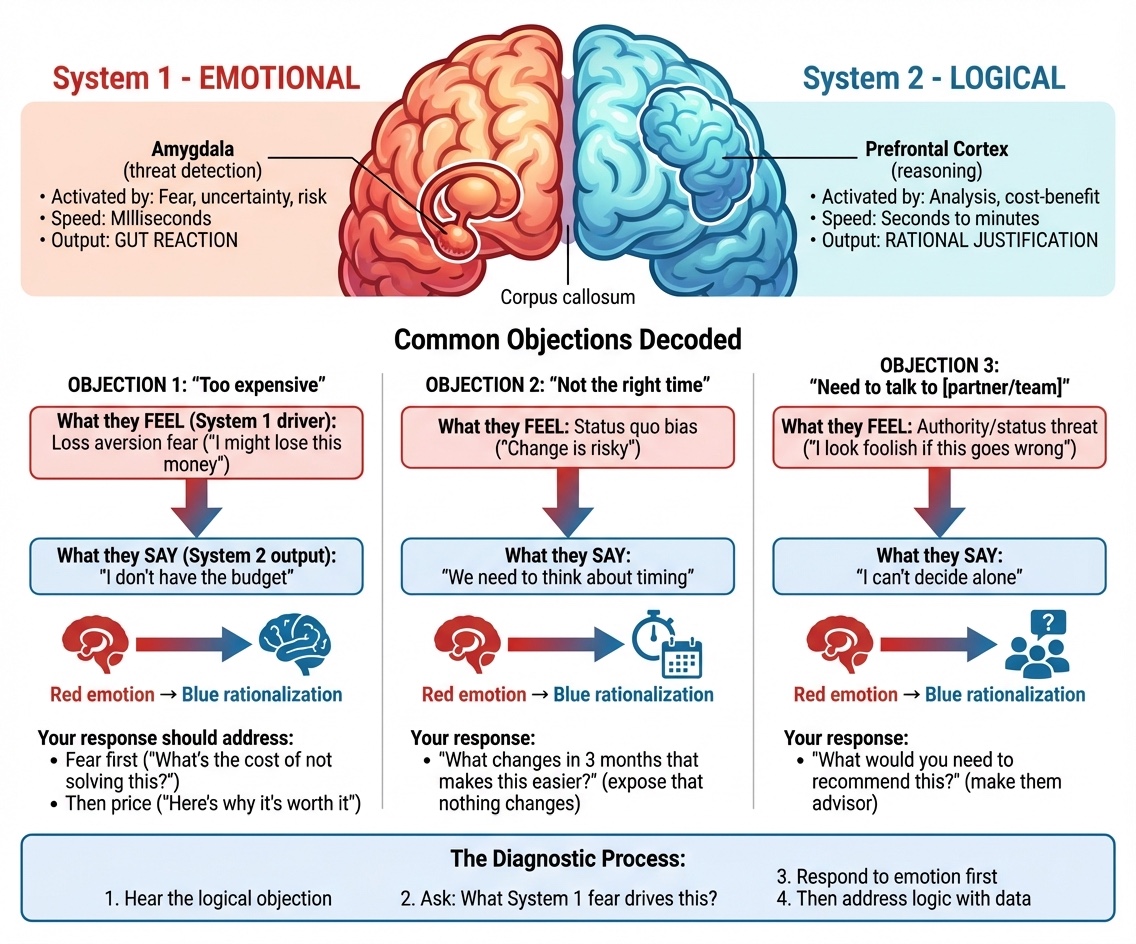
Figure 9.1: The Emotional-Logical Split. Objections operate on two levels: what the prospect says (logical) and what they feel (emotional). "It's too expensive" might mean they don't see the value yet. "I need to think about it" often signals unvoiced concerns. Effective objection handling addresses both layers: the stated concern and the underlying emotion.
Once you understand what sits underneath an objection (and with price objections, it is usually something other than price), you can treat objections as diagnostic information instead of attacks.
Why Your Mindset Matters More Than Your Script
Two founders can give the same answer to "that's too expensive," and one closes the deal while the other doesn't. The difference is in how they say it. If you're operating from fear, prospects notice: your voice tightens, your questions sound defensive, you rush to discount. Operate from the service frame (curious about the fit, confident in your value, willing to walk away) and the same words land as honest exploration. The earlier reframes shape this directly: service turns objections into diagnostic information, the scientist frame turns them into data points, and invitation removes the pressure to "overcome" anything.
The Creator-Specific Objection: "I'm Not Ready"
One objection is especially common in coaching and creator businesses and isn't covered in earlier chapters: "I'm not sure I'm ready for this." It can stem from fear of failure, capacity concerns, imposter syndrome, a genuine timing issue, or value uncertainty. It often comes from people who are ready but scared; the ones who confidently say "yes" are often less coachable than those who thoughtfully consider whether they can commit.
Validate, then distinguish timing from confidence. Explore first: "What would make you feel ready? What specifically concerns you?" If it's a legitimate timing constraint, respect it and offer to check in later. If it's confidence, reassure them (the people who think they're not ready are often the ones who benefit most), then address the specific fear: name the cost of not trying, or share a success story with a similar starting point.
Case Study (composite, waitlist for "not ready"): A course creator tracking 50 calls found that many prospects who said "I'm not ready" or "I can't afford it" bought within 3 months when she stayed in touch, so the objection was about timing and confidence more than budget. Instead of discounting to close on the call, she offered payment plans plus a waitlist with monthly free resources. Within 6 months, 40% of the waitlist converted at full price, versus 0% when she'd said "let me know when you're ready" and stopped contact.
Key insight: Know when to walk away. Someone who wants you to carry the commitment for them becomes a problem client; someone who's scared and needs reassurance is often your best customer; someone with a real timing constraint belongs on your waitlist.
Building Your Objection Confidence
Tactical responses work only once you've practiced them enough that they feel natural. Until then, objections trigger your threat response and you default to whatever feels safest, usually discounting or retreating. Smoothness comes from drilling responses until they're automatic: role-play and practice out loud until the words don't feel foreign, so that an off-guard moment produces confidence rather than panic.
The mindset shift: Every objection is either (1) a request for more information, (2) a signal of misalignment, or (3) a test of whether you believe in your value. None of them is a personal attack, and you can handle all three from the right frame.
Handling Rejection Without Breaking
Since rejection is inevitable, what matters is how you process it.
The Separation Practice
Every time you receive a rejection, practice this mental separation: "They rejected the offer. They didn't reject me." It sounds obvious, but it's easy to conflate the two. An offer is a hypothesis about value; when someone says no, they're telling you it doesn't fit their situation. A prospect who didn't book a call rejected your message or timing; one who didn't buy rejected the fit between their problem and your solution, not your worth.
The Numbers Game Mindset
At scale, rejection becomes statistical rather than personal. If 20% of qualified prospects buy, every 10 conversations yield two sales, and the 8 rejections lead to the 2 successes. But this only works with volume: get rejected 5 of 5 and it feels devastating; close 20 of 100 and rejection becomes a cost of doing business. Set your expectations from the start: most cold emails won't get responses, and expecting that makes each silence easier to take.
The Learning Extraction
Many rejections contain learning. After a lost deal, ask: was this a qualification problem (wrong prospect), a presentation problem (right prospect, wrong pitch), or a timing problem (right everything, wrong moment)? One founder who tracked lost deals noticed losses clustered when budget first came up at the proposal stage, a sign of insufficient budget qualification in discovery. Asking about budget on the first call eliminated the pattern.
The Recovery Routine
When you lose a deal you wanted, do one productive thing immediately: send another email, make another call, write content. The worst response is to retreat and ruminate; doing something right away interrupts that. The activity matters less than having a consistent response.
When rejections pile up: Some days you won't have the reserves to bounce back. Give yourself a defined recovery period, then commit to returning. A break is fine; the danger is letting it become permanent avoidance. Set a time to resume, and honor it.
The Mindset of Professional Persistence
Annoying persistence and professional persistence are different things. Annoying persistence ignores signals: the prospect said no, but you keep emailing the same message. Professional persistence adds value with each touchpoint: a relevant resource, then a case study from a similar company. When their situation changes, you're top of mind because you've been helpful.
The Follow-Up Framework
A structure for persistent follow-up that doesn't feel pushy:
Follow-up 1 (3 days): Brief and direct. "Following up on our conversation. Any questions I can answer?"
Follow-up 2 (7 days): Add value: a link to an article, case study, or resource related to their situation.
Follow-up 3 (2 weeks): Different angle. "I was thinking about what you mentioned regarding [their challenge]. Have you considered [specific approach]?"
Follow-up 4 (1 month): Direct check-in. "Wanted to see if your situation has changed or if there's anything I can help with."
Follow-up 5 (Breakup, about Day 45): Give them an out. "I'm guessing the timing isn't right, so I'll stop reaching out, but feel free to get in touch if things change."
That breakup email often gets a response. Some people were busy; others appreciate that you respected their silence. Either way, you've closed the loop professionally.
When you have few opportunities: This framework assumes a pipeline large enough that moving on makes sense. With only 3-5 active opportunities, extend the timeline so follow-ups become quarterly, but recognize the signal: if you can't afford to let prospects go, the fix is to generate more opportunities.
When You're the Problem
Sometimes you are the obstacle.
Procrastibuilding
Founders are particularly susceptible to procrastibuilding: building features instead of selling. "I'll start outreach once I add one more capability." The product is probably ready enough, and the next feature won't make sales easier. You're avoiding rejection by hiding in building mode. The fix is commitment: block sales time before you open your development environment, and make outreach the first thing you do each day.
The Content Treadmill
Creators have their own version: posting endless free content to avoid making offers. Sales problems usually come from an unclear offer and a lack of confidence more than from audience size. You can have 100 engaged followers and make sales, or 10,000 and make nothing because you never ask. The fix is the same: decide when you'll make offers and make them regardless of whether you feel ready.
The Emotional Rollercoaster
Selling as a founder or small team brings big emotional swings: one hour celebrating a closed deal, the next processing a harsh rejection, often with little team to absorb the swings.
Success has its own risk. Close a big deal and you might coast, or stop prospecting because "things are going well." The best founders maintain consistent activity regardless of recent results; pipeline work happens every day, win or loss. Low periods are equally inevitable: weeks without a response, lost deals, ghosting. Go back to basics and keep your activity volume up; sitting and worrying doesn't help. It also helps to talk to current customers who already value what you do; their feedback reminds you your work matters when the pipeline feels empty.
The Support System
Find a peer group of other founders at similar stages to share wins and losses with and to get perspective when you're spiraling. If you've made a first GTM hire or a rep co-owns the playbook, that partner is part of this system too.
Case Study: Nathan Barry's Critical Reframe. A year and a half into ConvertKit, Barry had watched revenue climb to about $2,000 a month, stall, and then slowly decline [3]. At a conference, Hiten Shah (co-founder of KISSmetrics) told him he should "shut it down or take it seriously, and like go all-in on it" [4]. Barry went all in, and by early 2022 ConvertKit was at nearly $30 million in annual run rate [3]. Shah gave him a clear choice at a point when Barry was stuck.
Building Resilience Over Time
Rejection tolerance builds with exposure. The first cold email feels terrifying; the 500th is routine. The fastest way to build resilience is to do more of the thing that scares you: 10 outreach messages every day for 30 days, or more sales calls instead of waiting until you feel ready. And keep the long game in view: the email you send today might not convert for six months, which makes progress hard to see in real time. Founders who succeed keep their activity steady even when short-term results are uncertain.
Chapter Summary: TL;DR
The core insight: Most price objections are about unvalidated value, unaddressed risk, or hidden concerns rather than price. Treat each rejection as information about the offer and the fit, and build habits that keep rejection from stopping you.
Key takeaways:
- Most deals need several touches; most founders give up after one or two
- Bad experiences outweigh good ones of the same size, so one "no" can overshadow several "yes" responses
- Reframe sales from extraction to service, science, or invitation to handle objections from a confident mindset
- Common objections mask patterns: unvalidated value, timing, trust gaps, hidden stakeholders (see Chapters 4-5 for tactical responses)
- Procrastibuilding (building features instead of selling) is the avoidance pattern founders are most prone to; for creators it's the content treadmill
- Build resilience through deliberate exposure and tracking wins: tolerance increases with volume
Next chapter: Chapter 10 provides specific playbooks for different founder and small-team contexts, from zero to first customers and from traction to scale.
The Exercise: Build Your Objection-Handling Toolkit
Part 1: Create Your Living Objection Document
The frameworks in Chapters 4 and 5 are starting points; your conversations will surface objections specific to your market, offer, and customer type.
- Start with the objections from Chapters 4 and 5 (price, "need to think about it," stakeholder involvement, competitor comparison).
- After every conversation, add new objections, in the prospect's exact wording, not your paraphrase.
- Label each as B2B, Creator/Coach, or Universal.
- Draft response frameworks for the ones you hear repeatedly: principles and questions, not scripts.
- Review and refine monthly. Which objections recur? Which responses work?
After six months of real conversations, this list will be more useful than generic sales training.
Part 2: Prepare for Obstacles
- Identify your avoidance pattern. Procrastibuilding? Content treadmill? Easy activities instead of hard ones? Be honest.
- Create a rejection recovery routine you can execute without thinking, and write it down.
- Set a specific commitment for uncomfortable activity: decide how many outreach messages and sales conversations you'll have this week, and hold yourself to it.
- Start a wins log for every small victory, beginning this week.
Chapter Checklist
Before moving to Chapter 10, complete:
- Created your living objection document (starting with objections from Chapters 4-5)
- Identified your primary avoidance pattern (procrastibuilding, content treadmill, etc.)
- Designed your rejection recovery routine
- Set a specific weekly commitment for uncomfortable activity (outreach, calls)
- Started a wins log for small victories
- Identified which reframe (service, scientist, invitation) resonates most with you
Self-assessment questions:
- Can I hear "no" as information rather than a threat to my identity?
- Do I have a system for processing rejection without spiraling?
- Am I doing productive work or productive-feeling avoidance?
- Have I committed to a specific number of uncomfortable activities this week?
[1] Baumeister, R. F., Bratslavsky, E., Finkenauer, C., and Vohs, K. D., "Bad Is Stronger Than Good," Review of General Psychology 5(4), 2001, pp. 323-370. https://doi.org/10.1037/1089-2680.5.4.323
[2] Kajabi, "Impostor Phenomenon Study: Most Entrepreneurs Affected," November 2020. https://kajabi.com/blog/impostor-phenomenon-study
[3] Creator Science Podcast #96, "Nathan Barry: from $150K/yr in ebooks to $30M in ARR with ConvertKit," March 29, 2022. https://podcast.creatorscience.com/nathan-barry/
[4] Baremetrics Founder Chats, "Building ConvertKit with Nathan Barry." https://baremetrics.com/founder-chats/nathan-barry