
Chapter 2: Finding the Right People to Talk To
A large share of every founder's sales effort goes toward people who were never going to buy. Research on B2B deals bears this out: in an analysis of more than 2.5 million recorded sales conversations, anywhere from 40% to 60% of deals ended up stalled in "no decision" rather than lost to a competitor [1]. Some of those buyers were never going to change anything, and qualification is how you find that out sooner.
The pattern is predictable. Founders accept anyone who shows interest: startups with no budget, enterprises with eighteen-month procurement cycles, clients who want extensive work for minimal investment. Most of those calls go nowhere, and the wrong-fit deals that do close become nightmares of scope creep and payment chasing. The usual cause is undefined targeting. For time-constrained founders and small teams, qualification is one of the best uses of an hour.
The Expensive Mistake of Selling to Everyone
When you're desperate for revenue, any customer looks good, but every hour spent on the wrong prospect is an hour not spent on the right one.
Enterprise teams have the pipeline volume to walk away from any unqualified prospect. A founder or small team with 20-30 active prospects can't drop half of them. Your ICP does the hard filtering before outreach; inside the pipeline, think in tiers: A-tier (perfect fit, prioritize heavily), B-tier (good fit, pursue if time allows), C-tier (marginal, keep warm). You focus energy without abandoning opportunities you might need.
Record possible deals in a CRM pipeline (a deal stage plus an A/B/C tag) or a simple Notion, Airtable, or Google Sheet with a tier column, then filter so you see A-tier first. With a first sales hire, the tier system doubles as shared language for who owns which accounts. Prioritization only works if it's visible in the system you actually update.
What an Ideal Customer Profile Is
Enterprise frameworks like BANT and MEDDIC were built for large teams chasing six-figure deals with multiple stakeholders. If you're selling $49-$5,000 offers, the full enterprise playbook is overkill. You need a lighter, adapted version: this chapter defines who to target, and Chapter 4's MVQ framework handles qualification inside the conversation.
An Ideal Customer Profile (ICP; see Appendix: Glossary) is more than a demographic checkbox like "marketing managers, 28-45, in tech companies," which tells you almost nothing. A real ICP answers one question: Who can I help the most, who will pay what I need to charge, and who will be a joy to work with? Those three elements (help, pay, enjoy) form three overlapping circles. A customer who fits two but not three will cost you, and the cost depends on which one you compromised (see Figure 2.1).
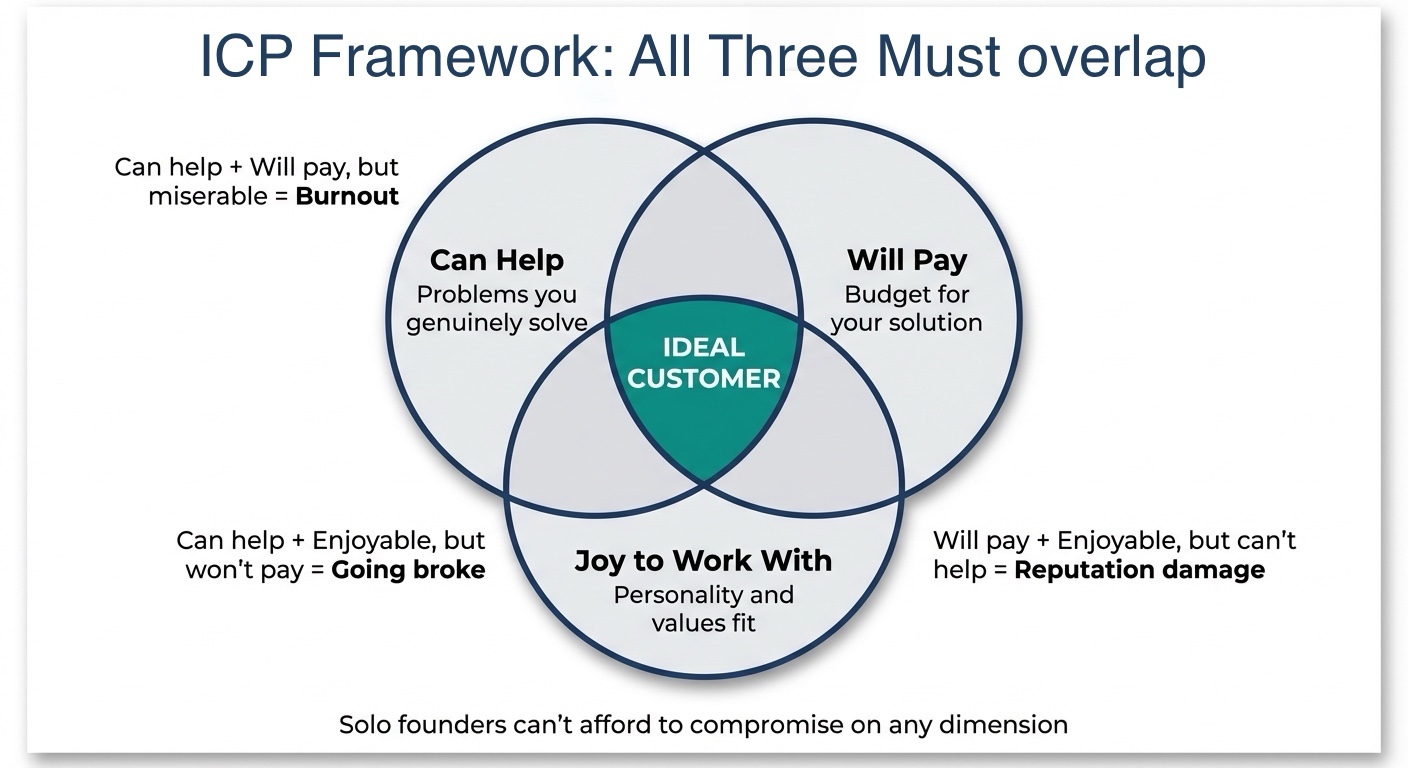
Figure 2.1: The ICP Framework. Your ideal customer sits at the intersection of three circles: people you can help, people who will pay what you need to charge, and people who are a joy to work with. Compromise on any dimension and you'll pay for it in burnout, broken finances, or damaged reputation.
Common Mistake: Defining Your ICP Too Broadly
If you try to serve everyone, your message fits no one. Your ICP should be specific enough to filter 90% of potential customers OUT. Founders target broadly because they fear limiting their market. Narrow to a specific person with specific problems, win that niche, then expand.
Case Study (composite): Building for 50 People, Not 50,000
"Content creators" is a market of millions, and impossible to message clearly. A founder building a content-repurposing tool instead built exclusively for the hosts of one niche live-audio community, a few dozen people with a single pain point and a single solution. That community became the product's most loyal customers. Word spread fast, premium pricing held, CAC stayed low.
The B2B ICP Framework
Founder-Type Note: This section is for B2B SaaS founders and consultants selling to businesses. Coaches and creators selling to individuals: see "The Creator ICP Framework" below (same principles, different characteristics).
If you're selling to businesses (even one-person operations), evaluate company and person separately.
Company characteristics: industry or vertical, size (employees and/or revenue), stage (startup, growth, mature), geography, technology stack (if selling technical products), budget cycle timing. A 10-person startup might buy on a founder's whim after 15 minutes; a 500-person mid-market company has procurement, budget committees, and security reviews.
Person characteristics: job title and function, decision-making authority, role-specific pain points, how they measure success, and (most important) what gets them promoted or fired. Knowing what gets someone promoted tells you what they'll pay attention to: a VP of Sales measured on pipeline growth cares about lead generation; one measured on close rates cares about sales enablement.
Founders who start with vague targeting like "IT managers at enterprises" wonder why outreach falls flat. Specificity comes from analyzing your best customers (or, before you have any, your best research conversations): the ones who implemented quickly, renewed, and referred others.
Case Study: Security Consulting Team (Mid-Market Financial Institutions)
A security team was doing free or discounted work for anyone who showed interest: exhausting, low margin, no clear ICP. We defined a focused ICP (mid-sized financial institutions needing independent security assessments for boards, regulators, and insurers), mapped personas (CISOs, Heads of IT) and triggers (audit findings, board pressure, regulatory changes), and repositioned the firm around fixed-scope, paid assessments (typically $7,500-$20,000 each, above this book's usual price range) with messaging that spoke directly to the ICP. Reply rates jumped from 3-5% to 12-18%, and follow-on work (reassessments, remediation roadmaps, board reporting) created predictable recurring revenue.
The Creator ICP Framework
Founder-Type Note: This section is for coaches, consultants selling to individuals, and creators selling digital products. B2B SaaS founders: the framework above is more relevant.
If you're selling courses, coaching, or digital products, the help, pay, and enjoy logic is the same; you're selling to individuals, so "company characteristics" become "life situation characteristics."
- Situation characteristics: career stage, income or business revenue, current challenge or goal, failed solutions already tried, trigger event that created urgency.
- Person characteristics: self-awareness about the problem, willingness to invest, ability to implement what you teach, coachability, expectations that match what you deliver.
Not everyone can be your customer, and accepting that early saves you time.
Case Study: Psychiatric Practice (Adjacent ICP for Leverage)
(Advanced example. Your first ICP draft can be much simpler.)
A psychiatric practice that had grown to four practitioners wanted to expand beyond one-to-one appointments. Instead of a conventional campaign, I recommended practitioner-led digital wellness education targeting an adjacent ICP: people seeking mental health education and self-management skills, not necessarily ready for clinical care. The resulting academy expands the top of the funnel, creates cash-pay revenue independent of insurance, and feeds clinical services. Learners who connect with the material move toward appointments.
Takeaway: When an ICP is profitable but growth is capped by delivery capacity, look for adjacent ICPs that create leverage without adding headcount.
The Pain-First Approach
Research on 35,000+ sales calls (Huthwaite International, 12-year study) found that consultative selling focused on pain identification outperforms pitch-based approaches [2]: in complex sales, the quality of your questions beats the quality of your pitch.
Build your ICP backward from the pain you solve, since pain is what makes people buy:
1. Define the pain precisely. "They struggle with marketing" is too vague. Better: "They're getting 500+ visitors per month but under 1% convert to sales calls, and cheaper fixes didn't work."
2. Identify who feels it most intensely. Who wakes up at 3 a.m. worrying about this? The more acute the pain, the easier the sale. People put off fixing mild discomfort indefinitely.
3. Determine who can pay. Pain without budget is a dead end. A consultant struggling to hit $3K/month isn't your customer for a $5,000 program; a freelancer earning $1,500/month isn't your customer for a $300/month tool.
4. Add the "joy" filter. You'll spend hours with these people. Do you want to?
A clear ICP sharpens your messaging and speeds up qualification.
Validation: Testing Your ICP
An ICP that exists only in your head is untested, so test it against real prospects.
If you have customers: Look at which customers are working out: not only who pays the most, but who gets the best results, who renews or refers, and whom you enjoy serving. Then look for patterns.
If you don't have customers yet (most readers): Your ICP is a hypothesis. Your first 5-10 customers will be imperfect fits who teach you what works. Interview people who match it: research conversations, not sales calls. By customer 10, the picture will be much clearer. Revise it monthly until you have about 10 customers.
Questions that reveal ICP fit:
- "What's the biggest challenge you're facing with [problem area] right now?"
- "Have you tried to solve this before? What happened?"
- "If you could wave a magic wand and fix this, what would be different six months from now?"
- "Is this a priority right now, or more of a someday thing?"
- "Have you set aside resources to solve this?"
Listen for intensity. A minor inconvenience means they're not your customer; pain described like it's ruining their life deserves attention.
The Disqualification Mindset
Sandler's sales training builds its qualification process around disqualifying early. In its own words, the secret to pre-qualifying is "embracing the importance of disqualifying people and opportunities that simply have no business being in your pipeline in the first place" [3]. So flip the default: look for reasons to disqualify. It's respectful of everyone's time: the faster you identify a misfit, the faster you both move on.
Common disqualification signals:
"No budget right now, but..." There will never be budget. Budget is created for priorities; if they haven't created it for this, this isn't a priority.
"I need to check with my partner/boss/board." They may not be the decision-maker. Ask who else is involved and how they decide, or you may be talking to the wrong person.
"We're looking at several options." Not necessarily a disqualifier, but probe: if they're comparing you to radically different solutions, they probably don't understand what you offer.
"This sounds great, let me think about it." This usually means "No, but I'm too polite to say it." Real buyers ask about implementation, timing, and next steps.
"Can you send me more information?" Often "I want to end this without confrontation." Real buyers ask specific questions.
None of these alone means someone is wasting your time, but they're yellow flags that warrant deeper qualification before you invest more energy.
Documenting Your ICP
Your ICP needs to exist outside your head; writing it down forces clarity and makes it teachable the moment you bring on a teammate or sales hire. Use this format:
For B2B:
Company: [Industry], [Size range], [Stage], [Geography]
Person: [Title/Role], [Reporting structure]
Pain: [Specific problem, in their words]
Trigger: [What event creates urgency]
Budget: [Range and source]
Timeline: [Typical decision cycle]
Disqualifiers: [Automatic no-go criteria]
For Creator businesses (swap Company for Situation, replace Timeline with Mindset):
Person: [Life/career stage], [Income/revenue level], [Key demographic if relevant]
Situation: [Current state], [Goal state], [Failed attempts]
Pain: [Specific problem, in their words]
Trigger: [What event creates urgency]
Budget: [How they think about this purchase]
Mindset: [Attitudes that predict success]
Disqualifiers: [Automatic no-go criteria]
Fill every field with specifics in your customer's words. The security consulting case study above shows the level of specificity to aim for.
Personas and Customer Journey: Who You're Talking To, and Where They Are
Your ICP answers which kinds of people are worth your limited time. Two tools sharpen how and when you talk to them: personas and the customer journey.
Persona: one human inside your ICP. Where the ICP describes a type, a persona describes one person, such as "the technical founder who hates selling" or "the head of ops under board pressure." One to three personas make messaging feel written for a specific person. For each, capture role or life stage, goals, fears and objections, definition of success, and the phrases they use: language to mirror in your content and outreach.
Customer journey: the path from stranger to advocate. The stages run awareness → consideration → decision → retention → advocacy. For B2B this maps cold email or LinkedIn to signed contract and expansion; for creators, first content to enrollment, completion, and renewal.
Where to Find Your Ideal Customers
With your ICP and personas defined, the next question is where these specific people already spend time.
For B2B:
LinkedIn search is the starting point for most founders; free search works, and Sales Navigator is the upgrade once you prospect regularly. At roughly $90-$120 a month for the Core plan ($119.99 billed monthly or $1,079.88 a year, as of September 2026), it's the most cost-effective way to find specific job titles at specific company types [4]. The power is in the filters (industry, company size, title keywords, geography) plus two especially useful ones:
- Job changes in the last 90 days: people new in a role are often re-evaluating the tools and vendors they inherited, which makes it a natural time to reach them. Saved searches alert you automatically.
- Posted on LinkedIn in the last 30 days: filters out inactive accounts that won't see your outreach.
Boolean operators make searches precise: (Coach OR Consultant) AND (Fitness OR Wellness) AND "Owner". Beyond LinkedIn, consider where your ICPs gather: conferences (even virtual), trade publications, Slack communities, subreddits, podcasts.
LinkedIn as a data source: Using Sales Navigator to find prospects, then enriching their emails for cold campaigns, gives the highest-quality leads. This is separate from sending LinkedIn messages or connection requests. Purchased lists are generally low-quality; conference attendee lists often work well. AI lead-research and enrichment tools (Clay, Apollo, Origami) can automate the find-and-enrich step once your ICP is defined, though their output is only as good as the ICP fit and list quality you feed them.
For Creators:
Your ideal customers are consuming content somewhere: YouTube (comments on videos about your topic), podcasts your ICP listens to, newsletters already reaching your audience, communities (Slack, Discord, Circle, Facebook groups), and social platforms (LinkedIn for B2B-adjacent, Instagram/TikTok for consumer).
Justin Welsh built a seven-figure business by becoming highly visible where his ideal customers already spend time: LinkedIn [5]. "Building in public" works the same way: people drawn to what you share are more likely to be good fits than people you cold-approach.
Two underused channels apply the same logic. The first is newsletter partnerships: find creators who reach your audience but don't compete, then offer cross-promotions. A mention in the right newsletter can beat months of cold outreach because readers already trust the source. The second is podcast guesting: rather than starting your own show (a long-term play), guest on ten existing ones. Each appearance is a warm endorsement plus content you can repurpose.
The Ongoing Refinement
Your ICP will change as each deal you win, lose, or walk away from shows you who you're serving. Revise it monthly until you have about 10 customers, then review it quarterly:
- Who were my best customers in the last 90 days? What made them great?
- Who were my worst fits? What should have warned me earlier?
- What patterns am I seeing in objections or deal failures?
- Have my disqualification criteria changed based on experience?
Expect to revise your ICP several times in your first couple of years. Each revision makes sales more efficient; as it matures, win rates rise because you're only pursuing people who fit.
The Courage to Say No
The hardest part of ICP discipline is emotional. When someone wants to give you money and doesn't fit, saying no takes courage, especially when every dollar feels critical. But saying yes to the wrong customer costs you: time that could go to right customers, energy drained by friction, reputation damage from poor outcomes, and the opportunity cost of the right customer you couldn't serve because you were busy with the wrong one.
Chapter Summary: TL;DR
The core insight: A large share of every founder's sales effort goes toward people who were never going to buy. Your ICP (Ideal Customer Profile) is the intersection of three circles: people you can help, people who will pay, and people who are a joy to work with. Compromising on any one costs you. Add 1-3 personas so messaging feels written for a specific human, and map the customer journey (awareness → consideration → decision → retention → advocacy) so you know what to say at each stage.
Key takeaways:
- 40-60% of B2B deals stall in "no decision"; qualify early and tier your pipeline so A-tier prospects get your time
- B2B ICP: company AND person characteristics; Creator ICP: situation AND person characteristics
- Personas are evidence-based portraits of individuals inside your ICP (goals, fears, objections, phrases)
- Your ICP should filter 90% of prospects OUT; test it with real outreach, not theory
Next: Chapter 3 covers how to reach them.
The Exercise: Build Your First ICP Draft
Draft your ICP using the templates above or your own format. The structure matters less than the thinking.
- Who are your best (or best hypothetical) customers? Specific people, not abstractions. Give them names if it helps.
- What pain do they have that you solve? In their words, as they'd describe it to a friend.
- What trigger event creates urgency? Why buy now versus six months from now?
- What can they pay? A specific range.
- What are your automatic disqualifiers? At least three things that make you walk away no matter how interested the prospect seems.
Optional (personas and journey):
- Who is one specific persona inside your ICP? A name or type ("the technical founder who hates selling"), plus their goals, fears, objections, and a phrase they'd use.
- Where do they enter your world, and what happens next? Map what you'd say or offer at each stage: awareness, consideration, decision, retention, and advocacy.
This draft will be wrong, and that's fine: the point is to have something concrete to test. Every customer conversation becomes a data point that improves it.
Chapter Checklist
Complete before continuing:
- Written your ICP hypothesis using the format provided
- Identified your three circles: who you can help, who will pay, who you'll enjoy working with
- Listed at least 3 automatic disqualifiers
- Sketched 1-3 personas (goals, fears, objections, phrases they use)
- Mapped the customer journey for at least one persona (awareness → consideration → decision → retention → advocacy)
- Identified where your ideal customers gather
Self-assessment questions:
- Could I use my ICP to filter 100 prospects down to the 10 most likely to buy (90% OUT)?
- Have I covered both company AND person (B2B) or situation AND person (creator) characteristics?
- Do I know which persona I'm talking to, and which journey stage each touchpoint serves?
Outreach, discovery, qualification, and closing all get easier when you're talking to the right people from the start.
[1] Dixon, M., and McKenna, T., The JOLT Effect: How High Performers Overcome Customer Indecision, Portfolio, 2022. Based on an analysis of more than 2.5 million recorded sales conversations; the share of deals lost to "no decision" ranged from 40% to 60% depending on the organization.
[2] Rackham, N., SPIN Selling, McGraw-Hill, 1988. Based on Huthwaite International analysis of 35,000+ sales calls across 12 years. Key finding: in complex sales, the quality of questions beats the quality of pitch.
[3] Sandler Training, "The Importance of Pre-Qualification," sandler.com. https://sandler.com/blog/the-importance-of-pre-qualification/
[4] LinkedIn, "Compare Plans and Pricing: LinkedIn Sales Navigator," accessed September 2026. https://business.linkedin.com/sales-solutions/compare-plans. Core: US$119.99/month or US$1,079.88/year per license.
[5] Growth In Reverse, "How Justin Welsh Built a $1.7M Solo Business in Just 3.5 Years." https://growthinreverse.com/justin-welsh/. Welsh built his business primarily on LinkedIn.